

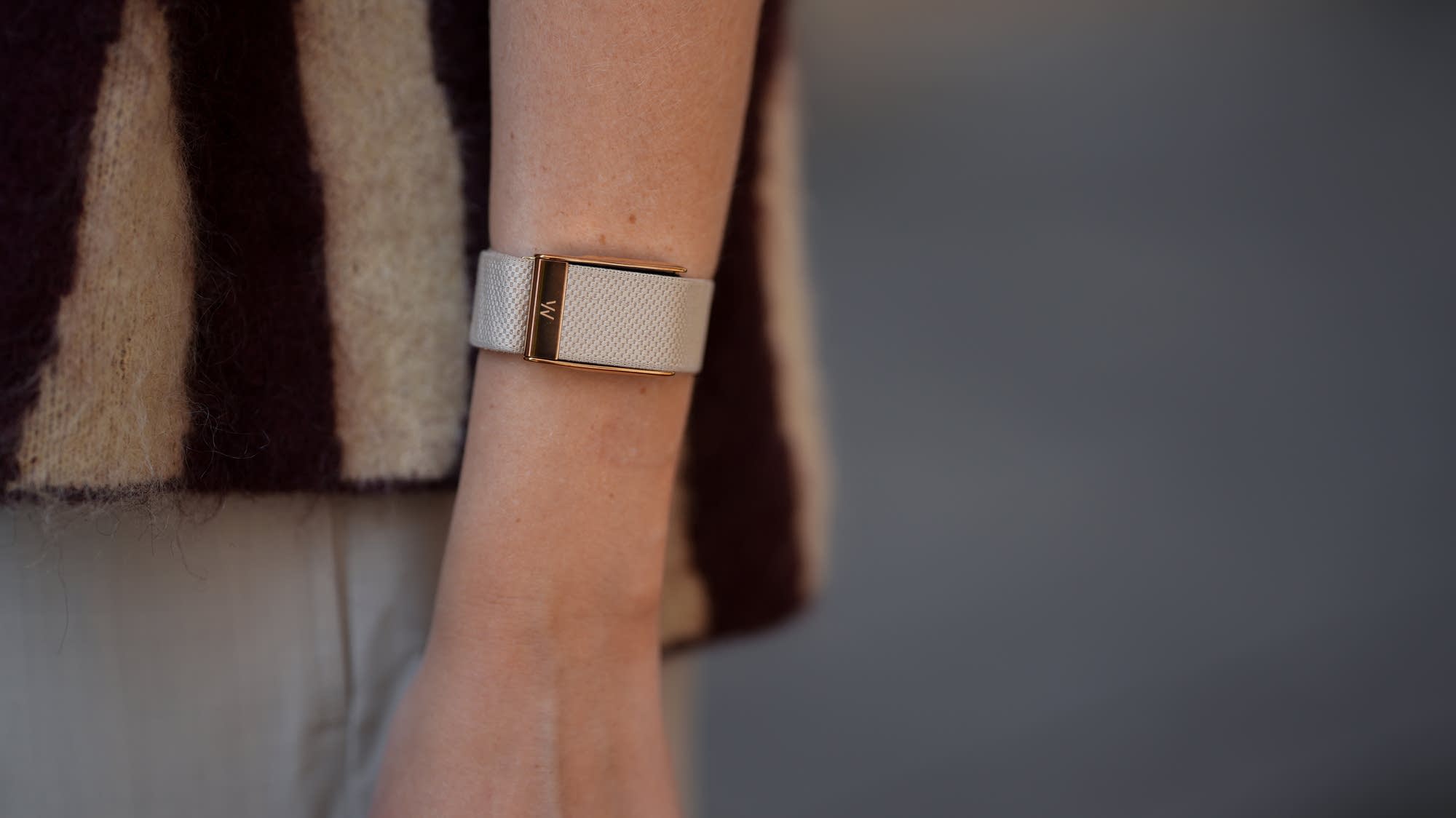
“It doesn’t make you serially check your phone, because you don’t have text and Instagram also there,” one user said of his screenless health monitor.
David Glantz, a recent Cornell graduate and software engineer at Bloomberg, is not categorically anti-screen. He spends his days immersed in code, dashboards, and the glow of a dozen open terminal windows. But when it came to smartwatches, Glantz was a proud holdout. He saw smartwatches as an extension of his phone, a device that just relocated that same compulsive checking from his pocket to his wrist.
“I’m fine looking at a screen all the time,” Glantz explained. “It’s really when I look at my phone. I really don’t like being on my phone, and getting an Apple Watch or something with a screen… seem[s] like having a phone always on you.”
And then came the WHOOP. A screenless and silent fitness tracker that didn’t pose the same threat of distraction as your typical smartwatch.
When his credit card company offered a deal on a year’s WHOOP subscription, Glantz jumped at the chance.
Now, he’s an avid WHOOP user, praising the tech’s ability to track his sleep and other health metrics while providing a disruption-free interface.
And Glantz is hardly alone in his enthusiasm; WHOOP, which launched its first workout band in 2016, had 2.5 million active members and was valued at $10.1 billion as of this past March. Oura, its closest rival in the space, is even bigger: the company has sold more than 5.5 million rings since 2015, was valued at $11 billion in an October funding round, and filed for an IPO this past May. Other competitors have entered the screenless market as well — Garmin recently announced its new screen-free smart band the CIRQA, and Google just launched its own version, the Fitbit Air.
Avi Greengart had some thoughts on the screenless wearables trend. Greengart is the president and lead analyst at Techsponential, a consumer technology market research and advisory firm, and has been covering wearable tech for “longer than [he’d] like to admit.”
Greengart acknowledged that screen fatigue may be driving some of the surge in screenless tech but he says the trend can be largely attributed to another factor: sleep tracking.
Consumers by and large flock to screenless wearables and other similar products for their advanced sleep-tracking technology, Greengart says, as sleep has become an increasingly important focus of the broader wellness movement. There’s a simpler logic at play too: a device that lights up or buzzes isn’t ideal to have on your wrist while you’re trying to fall asleep. Glantz said as much when explaining why he picked WHOOP over a smartwatch — he wanted something that “doesn’t have a screen, doesn’t light up, doesn’t vibrate or anything like that.”
“The awareness that sleep is something that is incredibly important to your long-term health, but also something that can be measured… is extremely relevant,” Greengart said. “That research wasn’t there 20 years ago, and the technology wasn’t there earlier than about 10 years ago. You combine [them], and you’ve got a nice trend.”
And sleep analysis sensors are only getting more accurate—and more discreet.
“The cost of sensors has dropped to the point where you can build one of these things in a very, very thin package. They tend to have some sort of fabric covering instead of rubber or metal,” Greengart explained. “These wearables… sort of blend into the background… [they’re] more comfortable to sleep in.”
Battery life was also an oft-cited consideration for screenless tech adopters.
Ariella Scheer, recent Williams College graduate and Oura Ring enthusiast, ditched her Apple Watch for an Oura Ring after one-too-many premature battery fails.
“[The Oura ring] lasts maybe four or five days, but it lets you know 24 hours before it’s going to die, which I like — it gives me enough time to recharge it,” Scheer said. “Whereas the Apple Watch would just be like, ‘it’s at 10%,’ and then you’re stuck.”
But it wasn’t just the longer battery life that convinced Scheer to make the switch. She, too, felt too tethered to her phone: “I thought [the Apple Watch] made me addicted to my phone… it would buzz every time I got a text.”
Glantz described a nearly identical relationship with his own phone. “There’s something else about the phone where it’s a distraction, and you kind of use it as a time filler,” he said. “If I have 10 minutes, I can’t really sit still, and I just use my phone instead of sitting there with my thoughts. That’s one of the reasons I don’t want my watch to also have a screen.”
Of course, screenless doesn’t mean screen-free. In order to actually check the various health metrics the tech provides users, they must open the device’s associated app. However, Glantz and Scheer both maintained this screen usage was fairly insignificant compared to the mindless scrolling smart watches encouraged.
Glantz said he checks in once a day, prompted by a notification rather than habit: “They give notifications, so I give it a look — a once-over every day — because it’ll give you a summary at the beginning of the day, like your sleep score, and it links to the dashboard.”
Scheer also feels the screenless wearables are a less addictive option. “I check my Oura Ring app from time to time, but I’m not … obsessive about it,” she said. “It doesn’t make you serially check your phone, because you don’t have text and Instagram also there.”
Screenless tech does have its limits, though. It doesn’t work for avid runners who want live pace and GPS, or for Type 1 diabetics who need to check blood sugar on the fly. Chicago’s Annie Chin, for instance, has stuck with her Apple Watch over an Oura Ring because it displays her blood sugar readings straight from her Dexcom app.
“I’ve been interested in the Oura Ring for a while now, especially its newer model, which is slimmer and more compact… But the main appeal of the Apple Watch is that I can see my blood sugar readings through my Dexcom app right there. The Oura Ring can’t do that.”
That shift toward smarter, quieter tech is personal for Greengart as much as it is professional. As an Orthodox Jew, he takes a full day off from his devices each week for Shabbat — screenless wearable included. “I just let it know I’m not going to be tracked,” he said, “and it wished me a good Sabbath and adjusted its metrics accordingly. I’ve never seen anything like that before.” It’s a small moment, but it gets at what’s actually driving people toward the WHOOPs and Oura Rings of the world: not a rejection of technology, but a demand that it finally learn when to stay quiet.
Glantz, for his part, isn’t thinking much about where any of this is headed. He just knows his WHOOP does its job without asking anything of him — no buzzing, no notification, no reason to reach for his phone. “I really don’t like being on my phone,” he said, back at the start of all this. For a growing number of consumers, that might be the whole point: the best technology, it turns out, is the kind you forget you’re wearing.
- <img src="https://aitoday7.com/wp-content/uploads/2026/08/60caab-20260827-nvidia-s-sign-at-its-headquarters-600.jpg” alt=”Nvidia’s estimate would put its fiscal 2028 revenue in the $690 billion to $700 billion range.”>
Nvidia expects revenue to grow by 70% over the next year
Companies

How the McDonald’s mobile app compiled 515-page dossier on one reporter
Technology

The AI slop-ification of Etsy
Retail
