

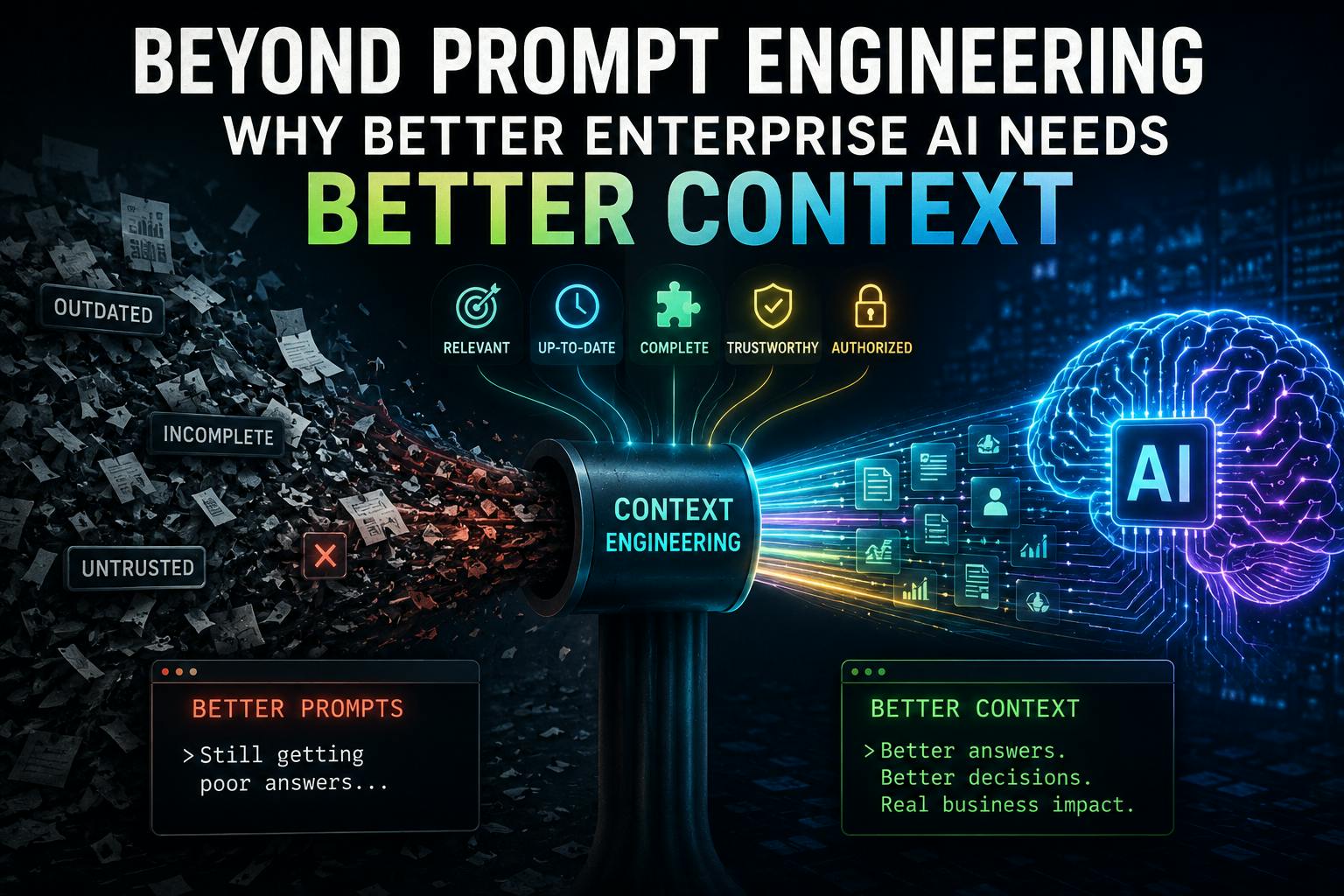
From Better Prompts to Better Context
An AI system is only as effective as the quality of information it receives. Better answers do not always come from better questions; they come from better context.
AI systems are powerful, but their responses depend heavily on the information available to them. Prompt engineering can improve how we ask a model to respond, but it cannot provide missing enterprise business and application context or fix outdated, incomplete, or unreliable information. In enterprise environments, this is where context engineering becomes important. The goal is to give AI systems the right information, at the right time, with the right controls.
Key Takeaways
This article explores why enterprise AI is moving beyond prompt-only techniques, what context engineering means in practice, and what makes context reliable enough for enterprise use.
- Context engineering goes beyond instruction design by managing what information isretrieved, filtered, and provided to the AI model.
- Context must be relevant, fresh, complete, trustworthy, and authorized.
- Enterprise AI increasingly depends on context pipelines rather than isolated prompts.
- Cloud platforms provide scalable context retrieval, orchestration, security, and governance capabilities.
- The next generation of enterprise AI systems will depend on well-managed context, strong access controls, and governance.
What Is Prompt Engineering?
Prompt engineering is the process of giving clear instructions to a Large Language Model (LLM), so it understands what you are asking and how you want the response to be structured. This could mean adding more detail to a question, providing examples, setting certain rules, or specifying the format of the answer.
For many early Generative AI use cases, improving the prompt often led to noticeably better responses. But in enterprise applications, a good prompt can only go so far. If the AI system does not have access to the right, current, and trusted information, even a carefully written prompt can still produce an incomplete or inaccurate answer.
What Is Context Engineering?
Context engineering is the process of gathering, organizing, filtering, enriching, securing, and presenting the information an AI system needs to generate a response. Prompt engineering focuses mainly on the instructions given to a model, while context engineering focuses on the broader information environment around those instructions. The aim is to provide relevant, current, complete, trustworthy, and authorized information so the model can respond more accurately and safely in a business application.
Prompt Engineering vs. Context Engineering in Enterprise AI.
A simple way to think about enterprise AI quality is:
AI Output Quality = Model Capability × Context Quality × Governance
Why Prompt Engineering Alone Is Not Enough
LLMs are good at generating, summarizing, and reasoning over text, but many enterprise AI challenges are increasingly tied to the quality of information available to the model. A carefully written prompt may improve the interaction, yet it cannot compensate for missing, outdated, inaccurate, or unauthorized data. That gap is one reason organizations are paying more attention to context engineering rather than relying on prompt engineering alone.
Enterprise AI trends: market growth, data quality, and RAG.
Some of the most common limitations of prompt-only approaches are:
- Lack of enterprise knowledge: AI systems do not inherently understand an organization’s business processes, internal data, applications, or real-time operational context needed to make accurate decisions.
- Stale or conflicting information: AI responses may not be trustworthy when models rely on outdated documents or conflicting internal data.
- Poor data quality and governance: AI systems have the potential to access false or unauthorized data without appropriate validation, ownership, and access control.
- Limited context capacity: Enterprise information needs to be intelligently retrieved, ranked, summarized, and compressed because AI models operate within limited context windows.
- Security and privacy risks: Poorly controlled access to enterprise information may expose sensitive business data and increase risks such as context poisoning or data leakage.
The significance of context quality can be seen in recent AI research, as well as industry adoption trends. Retrieval-Augmented Generation (RAG) has gained popularity because it enables AI systems to retrieve external knowledge before generating a response, which can improve factual grounding and reduce the risk of hallucinations2.
The Five Dimensions of High-Quality Context
The quality of an enterprise AI response is directly dependent on the quality of the context behind it. In practice, useful context should be relevant to the task, current, sufficiently complete, trustworthy, and authorized. These five dimensions, Relevance, Freshness, Completeness, Trustworthiness and Authorization, provide a simple framework in relation to context quality.
Five dimensions of high-quality AI context: relevance, freshness, completeness, trustworthiness, and authorization.
Context is relevant when it directly supports the task the AI system is trying to complete. Providing too much irrelevant information can reduce response quality and increase processing costs. For example, a customer-support assistant should retrieve only the customer history, product details, and service information relevant to resolving the issue at hand.
AI systems need current information to produce dependable results. Stale context can quickly lead to incorrect answers, especially in dynamic business environments. Cloud-based applications can help maintain freshness by keeping databases, operational logs, and customer information synchronized.
Complete context does not mean providing as much information as possible. It means providing enough information to support the task without overwhelming the model with unnecessary details.
AI systems depend heavily on the quality and reliability of their informationation, reliability checks, and provenance, providing traceability so users can understand where the retrieved information came from and whether it can be trusted
Security must be an integral part of context engineering from the beginning. AI systems should access and retrieve only the information permitted by organizational policy, with identity, access control, and permission-aware retrieval protecting sensitive enterprise data.
Conclusion
Together, these five dimensions help turn raw enterprise data into context that AI systems can use with greater accuracy, security, and confidence. Better prompts are still valuable, but they can only deliver reliable results when they are paired with context that is relevant, fresh, complete, trustworthy, and authorized.
Treating context as an enterprise asset is therefore not only a data management exercise. It is a foundation for building AI systems that can operate responsibly at scale. The next challenge is operationalizing this framework: collecting context from the rightach task, and enforcing governance throughout the process
Part 2 will explore how enterprises can build these context pipelines using retrieval, orchestration, security controls, and cloud-native services.
1 – https://www.fool.com/investing/2024/10/26/the-artificial-intelligence-ai-market-size-could/
2 – https://arxiv.org/abs/2507.18910?utm
