

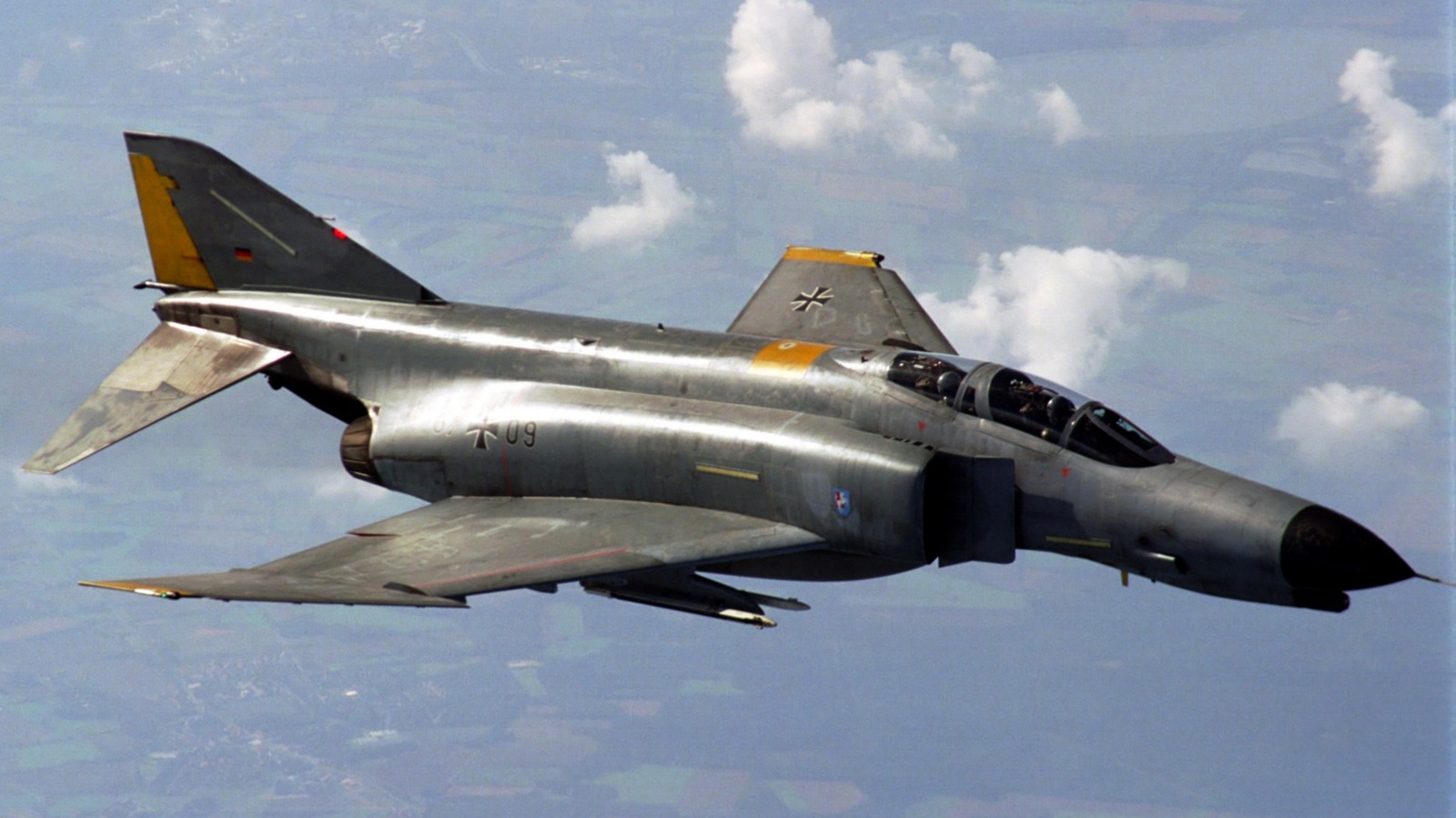
Most stories involving a military aircraft like the legendary fighter jet, the F-4 Phantom II involve its weapons, radar, flight characteristics, or its use in combat. Fortunately, every once in a while, that’s not the case, and in 1986, an F-4 Phantom II wasn’t used for war; it was used to save a life. It’s an unusual scenario for an aircraft that proved its worth throughout the Vietnam War, but in Fargo, North Dakota, a four-month-old child tragically died, and his parents decided to donate his organs to other patients.
Across the country in California, a five-month-old now struggled to survive his lethal cardiac condition called endocardial fibroelastosis. Nothing could save the child outside of a heart transplant, and while tragedy struck in Fargo, it offered a rare opportunity to save a child in California. The only problem was the distance, as the donor heart needed to make it across some 1,800 miles in only four hours, or the heart couldn’t be transplanted into the patient.
After a Learjet’s engine failed to start and with no other options, the doctors turned to the North Dakota Air National Guard. One of the U.S. Air Force’s best fighter jets, an F-4 Phantom II, was dispatched from Fargo with the heart onboard. The F-4 took off and flew at full speed, driving its twin J79 turbojet engines to the limit. 1st Lt. Robert Becklund successfully made it from Fargo to Stanford, California, in the time required, and the baby successfully received his new heart.
An F-4 Phantom II prepared for war saved a child’s life
Dispatching a fighter jet like an F-4 Phantom
Dispatching a fighter jet like an F-4 Phantom II that’s capable of reaching speeds of Mach 2.23 (1,473 mph) isn’t something a hospital can normally do. In this instance, after the donor heart was removed and placed in the cooler for transport, it was 11:45 p.m. in Fargo, and there was an awaiting Learjet. The problem was that it was also December 24, 1986, and if you know anything about North Dakota, you know it gets cold that time of year.
One of the two engines on the Learjet failed because of the cold, eliminating it as an option. A doctor on the transport team called then-Governor George Sinner for help. At the time, an F-4 Phantom II was fueled, armed, and ready to take off on ramp alert. If an emergency required a jet in the air, that’s what it was there for, but it didn’t get that type of call on Christmas Eve. The Governor called and spoke with Maj. Gen. Alex Macdonald, who took the call, hung up the phone and told one of the two duty pilots, 1st Lt. Becklund, that he had to get in the air.
He delivered the donor heart, and the child, Andrew De La Pena, survived the transplant. He grew up, and his story resurfaced in 2018 when he married Leoni Fohr. At the time, the local news, Valley News Live interviewed the couple, and De La Pena said, “I would have no other connection to Fargo, North Dakota, except for this, but every time I’ve come here, I’ve had a great time.”
