

The AI product designer and human-computer interaction (HCI) researcher combines research in diffusion-based interface generation, agent behavior design and controlled model testing to advance human-centered AI design.
Ask an AI tool to change a headline, and the next version may also rearrange the layout. Ask for a simpler image, and the model may introduce an extra object. These are interaction problems with a technical cause: a person’s request has to become instructions that a generative system can interpret, while preserving the parts of the work the person wants to keep.
Yanice Yang works on that translation. Her generative AI design practice connects the information supplied to models, the behavior of AI agents and the controls through which people review and revise an output. She designs how user intent travels through the system, then tests what happens when the model receives it.
An AI product design lead with graduate training in human–computer interaction at the University of Michigan and a fine-arts background at Pratt Institute, Yang brings research, visual judgment and prototyping into the same process. Her work includes coauthored IEEE conference research on diffusion-based interface generation and computer vision, alongside collaborative AI design projects recognized by MUSE and Vega.
The practical aim is to reduce cognitive load: the effort users spend interpreting, directing and correcting AI output. They should be able to communicate a direction without mastering prompt syntax, understand what the AI has inferred and correct a result without rebuilding the entire request. Yang addresses those burdens through decisions about context, constraints, feedback and evaluation.
Turning visual intent into model instructions
A person may know which photographs express the right mood yet struggle to describe that mood in words. Giving the model every available reference can create another problem: the material may contain conflicting directions. Yang’s visual-guidance work examines both the user’s starting point and the information the model receives.
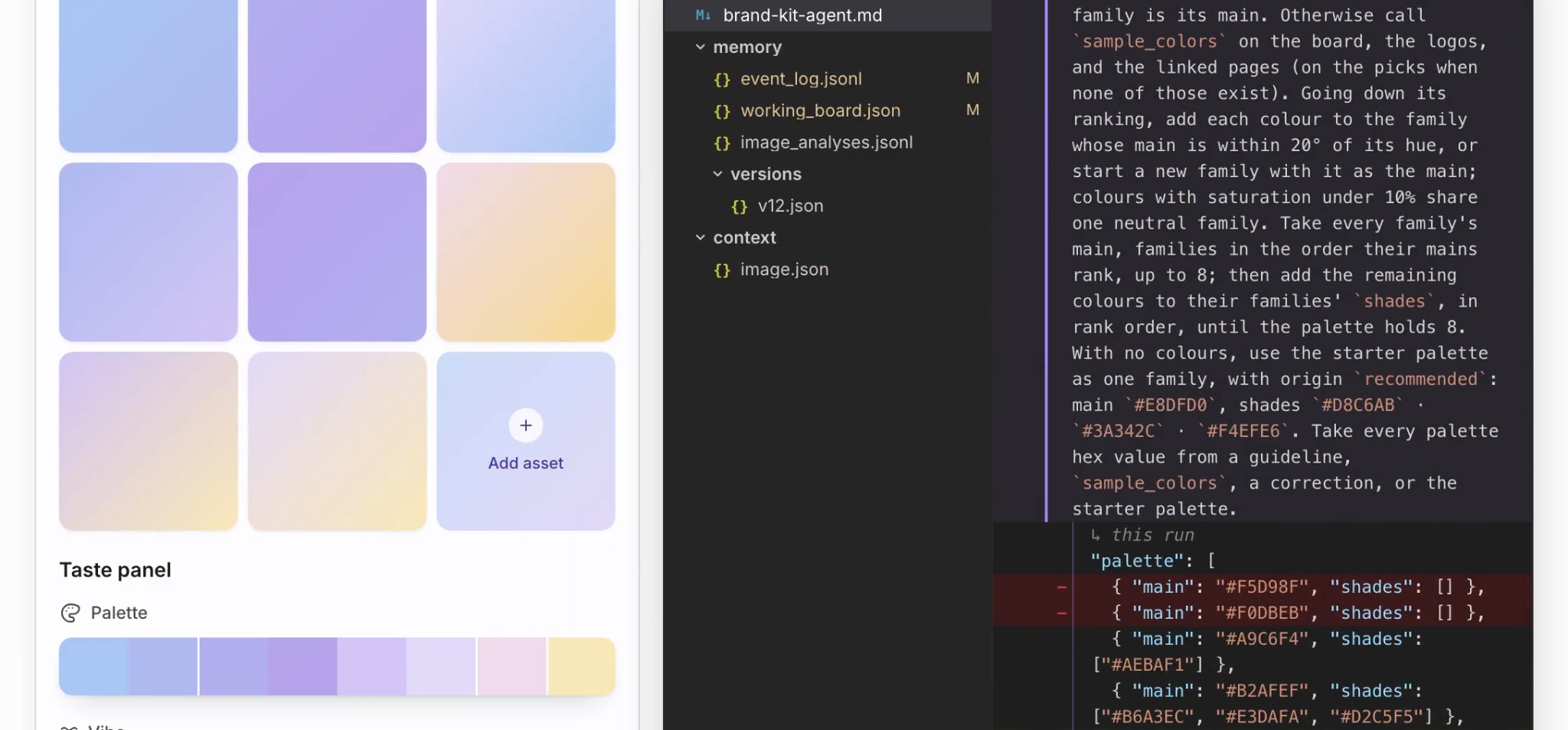
She designed a focused board of up to nine references, paired with a review panel showing palette, visual cues and voice examples. The board gives people concrete choices: retain an image, remove it or replace it with one that better represents their intention. The panel makes the proposed interpretation available for review.
Behind that interaction, Yang specifies how the reviewed material becomes structured visual planning and palette guidance for generation. Short tags summarize the direction for the user; the generation system receives the more detailed plan. The distinction matters because a recognizable label and a useful model instruction perform different jobs.
Her code-based demonstration links a reference edit to changes in the associated palette, planning and versioned context. It gives collaborators a way to inspect the relationship between the interface and the instructions behind it. The prototype makes a proposed behavior concrete enough to examine before relying on it.
This is how Yang connects reduced user effort with a technical design decision. People can express a preference through examples, while the system receives a more explicit account of what those examples should guide.
Researching how feedback shapes generation
The same concern appears in her coauthored research, published as Liuqingqing Yang, the name Yanice Yang uses in her academic work. Automated UI Interface Generationnvestigates a framework that combines text descriptions and sketches with design constraints and interactive feedback
In the framework, user requirements help condition the generated interface, while rules involving layout, color and spacing guide its organization. Feedback allows users to refine the result. Together, those elements address a practical problem for generative systems: producing something a person can direct and correct.
Yang’s research has drawn independent attention from academic and industry teams beyond the original author groups. In Not Another EHR, researchers from Microsoft Research, the University of Washington and Stanford place her diffusion-based UI study within a discussion of generative healthcare interfaces. Their proposed application would let physicians request patient information in natural language and receive a view organized around their clinical needs. The next challenge is judging what AI produces. CANVAS, a benchmark from KAIST, Korea University and Yonsei University, includes the same paper in its discussion of evaluation methods. It tests whether models can recreate screens and make targeted edits, such as resizing or inserting components, through tools in Figma.
Beyond design software, the focus shifts to understanding people’s actions. Gestura, involving China Telecom’s TeleAI and Goertek, discusses Yang’s coauthored CNN study as background to gesture recognition. Its prototype AI-glasses experiments test gestures expressing intentions such as adjusting air-conditioning temperature, turning pages and taking photos. Her CNN work also appears in YOLOv8n-RF research on camera-based smart-TV control, while a MethodsX assistive-communication prototype study references her DeepSORT paper in exploring how a small gesture vocabulary can become text or actions. These independent discussions connect her research to the problem she addresses in product design: turning human intent into system behavior people can understand and control.
Yang has also conducted deep research on visual tracking and completed peer reviews for Engineering Applications of Artificial Intelligence. Her judging and review experience spans academia and industry, including student design reviews at the University of Michigan and jury service for Orpetron Web Design Awards and Top Design King. Moreover, She also served as a judge in several AI hackathons including AI Solution Makers Hackathon, assessing projects involving AI agents, automation and system reliability.
Giving AI agents boundaries for memory and revision
When an AI workflow carries information across several tasks, a correction has consequences beyond the current screen. A different color for one image may be a temporary choice. A revised visual direction may be intended for future work. An agent needs a defined way to handle that difference.
Yang’s agent specifications distinguish a local asset edit from a proposed update to lasting guidance. They define which information takes priority, how owner corrections are retained and when a person must decide whether a suggested change should persist. In the designed workflow, generation tools read the context; updating that context follows a separate path.
Accepted updates become profile versions, withn be traced. Reviewers can propose changes, while the owner decides whether to incorporate them. Earlier outputs keep their original context instead of silently acquiring the meaning of a later preference
Her specifications also address incomplete or conflicting information. Missing material, low-confidence values and requests that do not map cleanly to an existing field need visible handling. These are points where the workflow may need clarification or a human decision.
For scoped image edits, her specifications pair the requested change with instructions about what should remain. A coordinate-based selection can identify an area in the prompt, but cannot by itself guarantee which pixels change. Yang includes review and version recovery in the workflow so the person can examine the actual result.
For the user, the intended benefit is continuity without constant supervision. An accepted preference can travel into later creation, while a one-time adjustment remains limited to its task. Yang designs the rules that make those two outcomes distinguishable.
Measuring whether a model follows the brief
A tone selector is useful only if its choices produce meaningfully different language. Yang investigated that relationship in a controlled evaluation of 720 generated captions, covering five tones, four business categories and four tasks across three prompt conditions.
The test used GPT-4o mini to generate the captions and GPT-4o to assign tones in shuffled five-way comparisons. Abstract adjective instructions reached 45 percent tone separability. A structured phrase bundle reached 88 percent, and an iteration of that bundle reached 89 percent. The measure concerns how distinguishable the tones were within those controlled, AI-judged comparisons.
The bundles supplied preferred phrases, phrases to avoid, example lines and a sentence-style hint. The result informed a design direction in which users could review and adjust language choices and examples. The familiar tone setting would have more explicit guidance behind it, reducing reliance on a single ambiguous adjective.
A separate image-generation test showed why evaluation also requires looking for unintended behavior. In a controlled gpt-image-1 comparison, a pixel-based background measure scored a variant at 1.00, while a GPT-4o vision evaluator preferred it in only nine of 24 paired comparisons. Inspection found that an instruction intended to simplify an image could add a prop.
Yang recommended changing the prompt control. The discrepancy exposed a design problem the favorable metric had missed: a user choosing simplification could be left with another object to remove. Testing the instruction behind the control gave her a basis for revising the interaction.
For Yang, evaluation feeds back into the interface. A tone control can expose example language that users can inspect; an image control can be revised when its instruction creates extra work. The test has a purpose in the design process: it helps determine what the product can reasonably ask people to rely on.
Keeping generative video open to human direction
In video creation, the question becomes where automation should hand a decision back to the creator. A model can find relevant footage and assemble a sequence, yet the creator still needs to judge whether the material tells the intended story.
Yang’s footage-to-video work spans product definition, workflow architecture, interaction design and prototyping, in collaboration with product, R&D, design and machine-learning teams. Her case study describes research drawing on more than 500 active-user survey responses and over ten user reviews. Users welcomed AI assistance but wanted a draft they could refine.
She organized the experience around footage search, clip selection, storyboard generation and voiceover editing. These stages give the creator specific ways to intervene: review theesting with more than ten users examined design choices at those decision points
The design addresses the burden of repeated regeneration by making the draft editable at meaningful stages. A creator can work on the part that needs attention while keeping the larger intention in view. Yang’s role is to determine where model assistance is useful and what control a person needs when the result is uncertain.
Her collaborative AI design record includes a generative video-editing concept awarded Platinum at the 2024 MUSE Design Awards in Conceptual Design–Technology. Sonic AI, an at-home concert experience concept credited to Yang and two collaborators, received Gold at the 2025 Vega Digital Awards in UX–Product. These recognitions sit alongside the research, specifications and tests that document her practice.
Across the work, Yang’s product design leadership connects human intent with the behavior of a generative AI system. The interface lets a person express or revise a choice; the agent rules determine how that choice travels; testing examines whether the model follows it. Each part affects how much effort remains with the user.
Highlights
HCI and Generative Interface Research: Yang’s coauthored IEEE research is cited in studies of generative healthcare interfaces, AI design evaluation and wearable gesture interaction, including work involving Microsoft Research, KAIST and China Telecom’s TeleAI. Her studies examine how systems interpret input, apply constraints and respond to feedback—the same questions she addresses in AI product design.
AI Product and Agent Design: Yang leads product definition, workflow architecture, interaction design and prototyping. She specifies how visual references become model guidance, how agents distinguish local edits from lasting preferences, and where users review or approve a change.
Model Testing and User Control: Yang uses controlled caption and image tests to examine whether models follow the intended direction and to revise instructions behind interface controls. Her video workflows give creators specific points to review footage, select clips, change a storyboard and edit narration.
