

Key Takeaways
-
Radiant’s microreactor has secured DOE safety analysis approval, advancing toward full-power testing at Idaho National Laboratory.
-
The planned campaign targets 60 effective full-power days, including at least 150 continuous hours of operation without operator intervention.
-
Radiant aims to begin commercial deliveries in 2028, with planned deployments at US military installations.
A US nuclear microreactor has cleared a key safety hurdle ahead of a planned test campaign targeting 60 effective full-power days of operation and at least 150 continuous hours without operator intervention.
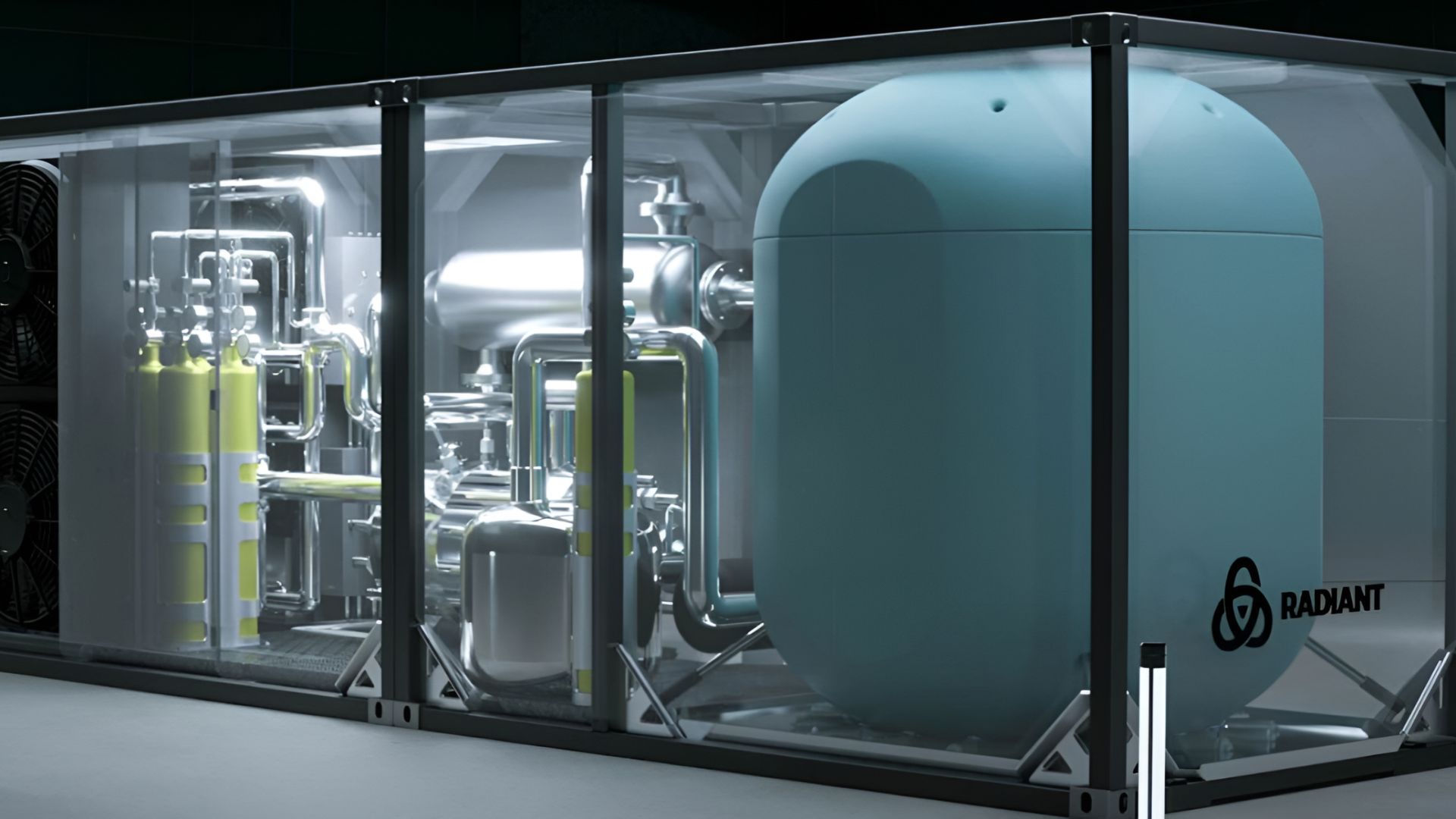
California-based nuclear technology developer Radiant announced that the US Department of Energy (DOE) has approved the Documented Safety Analysis (DSA) for its Kaleidos microreactor.
The approval brings the reactor closer to full-power testing at Idaho National Laboratory (INL), where Radiant plans to evaluate its performance under operating conditions.
Unlike preliminary tests that establish whether a reactor can sustain a controlled nuclear chain reaction, the upcoming campaign will examine how Kaleidos performs during extended operation.
Radiant says the demonstration will be the industry’s only full-power, extended-duration test of a nuclear microreactor to date.
However, the reactor must first pass DOE’s Readiness Review before nuclear operations can begin.
Testing beyond criticality
The planned testing campaign will take place at the National Reactor Innovation Center’s Demonstration of Microreactor Experiments (DOME) facility at INL.
The five-phase program will begin with initial criticality, the point at which a reactor achieves a self-sustaining nuclear chain reaction.
Testing will then progress through increasingly higher power levels, allowing engineers to evaluate the reactor core, instrumentation, and integrated systems under operating conditions.
More from Energy
See All
EnergyGiant heat pump turns paper mill waste heat into 248°F steam with less fossil fuel
Energy15 MW microreactor deployment in US advances as Hyundai partners with NANO Nuclear
EnergyNew catalyst matches platinum in hydrogen production using 75% less metal
EnergyFire at US nuclear site triggers ‘radiological release’ alert, FAA restricts flights
EnergyNew battery manufacturing method cuts processing time 60%, could save $100 million
The campaign targets 60 effective full-power days (EFPD) over several months. This represents the equivalent of 60 days of operation at full power, rather than necessarily 60 consecutive days.
Another major objective is to demonstrate at least 150 hours of uninterrupted operation at full power without operator intervention.
The test would help establish whether the reactor can maintain sustained operation without requiring constant human adjustments.
Radiant’s chief nuclear officer, Rita Baranwal, said the approval covers a broader demonstration than initial criticality alone.
“This approval for full power demonstration is a first within the microreactor industry. It moves us forward to test our complete reactor system under sustained operating conditions.”
The latest approval follows DOE’s acceptance of Radiant’s preliminary safety analysis in February 2026.
Kaleidos is a transportable nuclear microreactor designed to provide electricity for military installations, industrial facilities, and locations requiring reliable power.
The reactor has a planned electrical output of 1 megawatt and is designed to be transported by land, sea, or air.
Radiant built the unit at its El Segundo, California, facility and shipped it to IdahoNational Laboratory in August 2026.
The company plans to test a reactor design and custom fuel similar to those intended for commercial customers.
This approach is intended to generate operating data directly relevant to future deployments, rather than relying solely on smaller experimental systems.
Radiant plans to manufacture Kaleidos units at its R-50 facility in Oak Ridge, Tennessee.
The company is targeting its first commercial deliveries to Buckley Space Force Base in Colorado and Fort Benning in Georgia in 2028.
Earlier in October, the US Navy also selected Radiant to deploy Kaleidos at Naval Weapons Station Crane in Indiana.
These projects reflect growing military interest in compact nuclear reactors that could provide power independently of conventional electricity grids.
Before testing begins, DOE’s Readiness Review must determine whether the reactor, supporting systems, and operating personnel are prepared for nuclear operations.
If the review is successful, Radiant can proceed with fueling Kaleidos and beginning its planned test campaign.
The reactor has not yet demonstrated the full-power endurance or unattended operation targeted in the program.
With over a decade-long career in journalism, Neetika Walter has worked with The Economic Times, ANI, and Hindustan Times, covering politics, business, technology, and the clean energy sector. Passionate about contemporary culture, books, poetry, and storytelling, she brings depth and insight to her writing. When she isn’t chasing stories, she’s likely lost in a book or enjoying the company of her dogs.
- 115 MW microreactor deployment in US advances as Hyundai partners with NANO Nuclear
- 2New catalyst matches platinum in hydrogen production using 75% less metal
- 3Solar planes at 60,000 feet could fly for months with 500 Wh/kg batteries: US study
- 4Massive 442-foot tunneling machine building world’s longest undersea railway tunnel
- 524,000-ton nuclear-powered submarine fires 5,160-mile-range missile while submerged
