

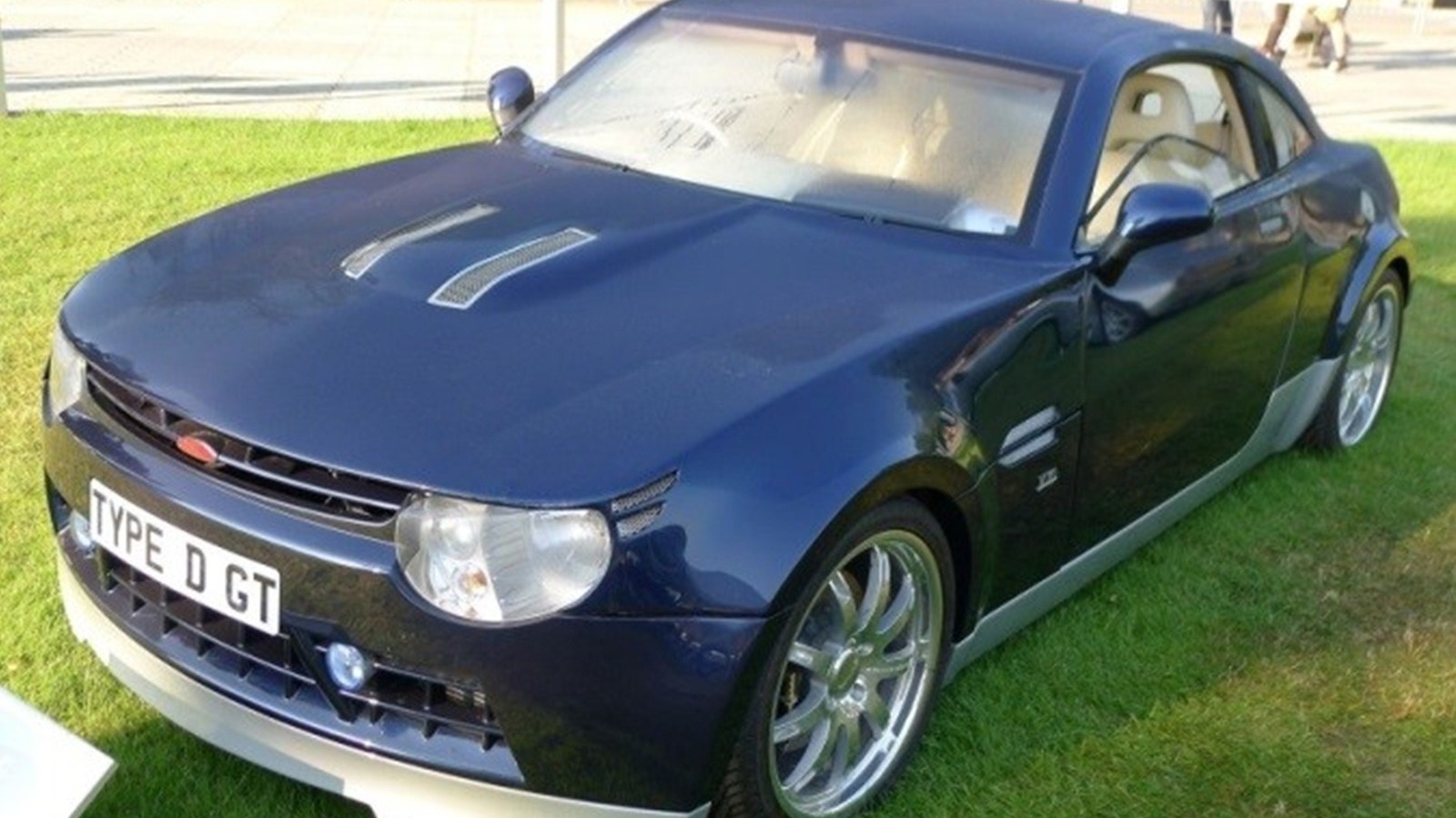
It’s easy to forget how far automotive and powertrain technology has advanced — something as unexciting as the 2026 Hyundai Ioniq 5 AWD will manage 320 horsepower without using any gasoline. So it’s quite remarkable that in 2005, Connaught set about designing a supercharged 2.0-liter V10 to go in its Type-D Syracuse GT. That’s 10 cylinders with about as much total displacement as a normal four-cylinder car engine. Why limit the greatness of human engineering to only four cylinders when you can fit 10? Connaught pushed to get close to 300 hp at the crank, or around 150 hp per liter, which compares very favorably with many other powerful V10 engines.
Low weight, four seats, rear-wheel drive, a five-speed manual transmission, plus an interesting engine; this is what former Jaguar engineers Tim Bishop and Tony Martindale wanted to achieve with the Type-D Syracuse GT. A 0-60 mph time of less than five seconds and a top speed of about 170 mph were Connaught’s estimates, all of which would be impressive for that period. However, as PistonHeads discovered on its visit to view one in December 2005, the example there was unable to move under its own power, although the V10 engine had reportedly been run separately. Hardly ideal conditions in which to judge the abilities of a purported 170 mph car.
How Connaught squeezed ten cylinders into two liters
You’d expect most 10-cylinder engines to be sizable beasts. Not so Connaught’s, with a very narrow angle of 22.5 degrees between its two banks of cylinders, so only one cylinder head was required, and it took up much less room overall. Each cylinder displaced only around 200cc. Villiers Engineering, which continued work on the engine after Connaught, says it had an all-aluminum block, cylinder head and intake manifolds. Villiers later replaced the original crankshaft shell bearings with needle rollers to minimize frictional losses. Add a supercharger to this equation, and it can be seen how Connaught expected about 300 hp from this powertrain.
Another benefit was that the engine could be mounted well back toward the center of the car, just behind the front axle, giving favorable weight distribution, all with the benefits of rear-wheel drive. For comparison, the contemporary BMW M5 produced 500 horsepower from a naturally aspirated 5.0-liter V10, while the original Dodge Viper used an 8.0-liter V10 to produce 400 horsepower. So Connaught was aiming to extract around 50% more power per liter than BMW’s V10 and three times as much as the original Viper’s, though this was helped considerably by the supercharger. On the other hand, both these other manufacturers offered at least one model available to the buying publicConnaught hoped to sell about 100 examples at about £62,000 each, or just under $150,000 in today’s money.
The hybrid ambitions were even more interesting
Robin Corps from Crowthorne, England – CC BY 2.0 / Wikimedia Commons
Clearly not content with designing and building such an unusually small-displacement 10-cylinder engine, in 2004, Connaught also proposed a version of the Type-D as a hybrid. Here, the slightly larger 2.1-liter naturally aspirated V10 would be supplemented by a 48-volt electric motor, with capacitors to accept and store energy recovered during braking. This would assist acceleration, particularly from low road speeds, relieving the engine of some effort, for example in creeping traffic conditions. Overall, Connaught anticipated 162 bhp and 42 mpg using imperial gallons, or about 35 U.S. MPG. Reasonable economy from a car with a V10 engine, and this was long before the introduction of cars such as the Porsche 918 Spyder.
Neither the supercharged GT nor the proposed hybrid reached series production, with Connaught Motor Company citing a lack of funds. No one has been able to independently verify the claimed acceleration and fuel consumption figures in a production car. Four prototypes were completed, with two believed to survive as of September 2025, according to Car & Classic. One of these retains the V10 while the other, green with silver accents, was a running suspension-test prototype first registered in July 2006. It has a standard 2.0-liter four-cylinder Ford engine, conveniently of similar weight.
