

Abstract
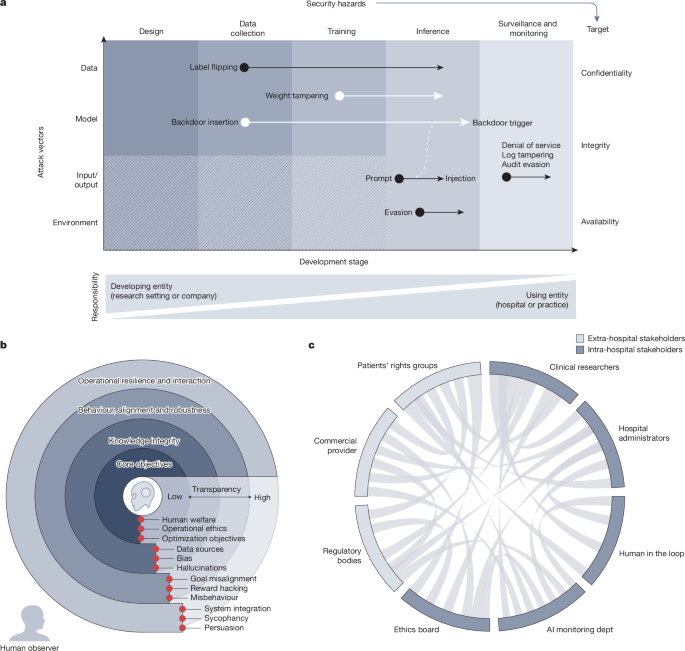
Integration of artificial intelligence methods into clinical care is proceeding rapidly, driven by advances in generative artificial intelligence, most notably large language models. Large language models trained on large amounts of text have shown potential across nearly every domain of healthcare. However, their broad applicability also comes with new responsibilities, vulnerabilities and threats. These need to be assessed and mitigated before widespread clinical adoption. Here we review the available literature on security and safety of large language models themselves as well as their integration with hospital workflows and interactions with human healthcare providers. We systematically map security hazards to development stages of clinical artificial intelligence systems (design, data, model, inference and environment), identify safety layers, from core optimization objectives, knowledge integrity and alignment, to interaction with humans and systems, and classify threats by their current clinical relevance. Finally, we provide a perspective on current mitigation techniques, illustrating respective stakeholders’ responsibilities.
This is a preview of subscription content, access
Access options
- Purchase on SpringerLink
- Instant access to the full article PDF.
Prices may be subject to local taxes which are calculated during checkout
Subjects
References
-
Gommers, J. et al. Interval cancer, sensitivity, and specificity comparing AI-supported mammography screening with standard double reading without AI in the MASAI study: a randomised, controlled, non-inferiority, single-blinded, population-based, screening-accuracy trial. Lancet407, 505–514 (2026).
-
Lu, M. Y. et al. A multimodal generative AI copilot for human pathology. Nature643, 466–473 (2024).
-
Singh, R., Bapna, M., Diab, A. R., Ruiz, E. S. & Lotter, W. How AI is used in FDA-authorized medical devices: a taxonomy across 1,016 authorizations. NPJ Digit. Med.8, 388 (2025).
-
Griot, M., Vanderdonckt, J. & Yuksel, D. Implementation of large language models in electronic health records. PLOS Digital Healthhttps://doi.org/10.1371/journal.pdig.0001141 (2025).
-
Armitage, H. Clinicians can ‘chat’ with medical records through new AI software, ChatEHR. Stanford Medicinehttps://med.stanford.edu/news/all-news/2025/06/chatehr.html (2025).
-
Moor, M. et al. Foundation models for generalist medical artificial intelligence. Nature616, 259–265 (2023).
-
Clusmann, J. et al. The future landscape of large language models in medicine. Commun. Med.3, 141 (2023).
-
Bubeck, S. et al. Sparks of Artificial General Intelligence: Early experiments with GPT-4. Preprint at https://doi.org/10.48550/arXiv.2303.12712 (2023).
-
Singhal, K. et al. Toward expert-level medical question answering with large language models. Nat. Med.31, 943–950 (2025).
-
Gu, Y. et al. The illusion of readiness: stress testing large frontier models on multimodal medical benchmarks. Preprint at https://doi.org/10.48550/arXiv.2509.18234 (2025). This study reveals that medical LLM benchmarks may overestimate real-world readiness as benchmarks fail to capture brittleness and reasoning flaws.
-
Omar, M. et al. Multi-model assurance analysis showing large language models are highly vulnerable to adversarial hallucination attacks during clinical decision support. Commun. Med.5, 330 (2025).
-
Bedi, S., Jiang, Y., Chung, P., Koyejo, S. & Shah, N. Fidelity of medical reasoning in large language models. JAMA Netw. Open8, e2526021 (2025).
-
Goh, E. et al. GPT-4 assistance for improvement of physician performance on patient care tasks: a randomized controlled trial. Nat. Med.31, 1233–1238 (2025).
-
McDuff, D. Towards accurate differential diagnosis with large language models. Nature642, 451–457 (2025).
-
Tu, T. et al. Towards conversational diagnostic artificial intelligence. Nature642, 442–450 (2025).
-
Palepu, A., et al. Exploring large language models for specialist-level oncology care. NEJM AI2, AIcs2500025 (2025).
-
Singhal, K. et al. Large language models encode clinical knowledge. Nature620, 172–180 (2023).
-
Thirunavukarasu, A. J. et al. Large language models in medicine. Nat. Med.29, 1930–1940 (2023).
-
Van Veen, D. et al. Adapted large language models can outperform medical experts in clinical text summarization. Nat. Med.30, 1134–1142 (2024).
-
Tierney, A. A. et al. Ambient artificial intelligence scribes: learnings after 1 year and over 2.5 million uses. NEJM Catal. Innov. Care Deliv.https://doi.org/10.1056/CAT.25.0040 (2025).
-
Heinz, M. V. et al. Randomized trial of a generative AI chatbot for mental health treatment. NEJM AI2, AIoa2400802 (2025).
-
Comanici, G. et al. Gemini 2.5: Pushing the frontier with advanced reasoning, multimodality, long context, and next generation agentic capabilities. Preprint at https://doi.org/10.48550/arXiv.2507.06261 (2025).
-
Zakka, C. et al. Almanac — Retrieval-Augmented Language Models for Clinical Medicine. NEJM AI1, AIoa2300068 (2024).
-
Wiest, I. C. et al. Large language models for clinical decision support in gastroenterology and hepatology. Nat. Rev. Gastroeneterol. Hepatol.22, 773–787 (2025).
-
Ferber, D. et al. Development and validation of an autonomous artificial intelligence agent for clinical decision-making in oncology. Nat. Cancer6, 1337–1349 (2025). This study presents one of the first modular LLM-agent frameworks for healthcare, integrating biomedical tools and knowledge bases for clinical decision-making.
-
Ge, J. et al. Development of a liver disease-specific large language model chat interface using retrieval-augmented generation. Hepatology80, 1158–1168 (2024).
-
Kresevic, S. et al. Optimization of hepatological clinical guidelines interpretation by large language models: a retrieval augmented generation-based framework. NPJ Digit. Med.7, 102 (2024).
-
Masanneck, L., Meuth, S. G. & Pawlitzki, M. Evaluating base and retrieval augmented LLMs with document or online support for evidence based neurology. NPJ Digit. Med.8, 137 (2025).
-
Zakka, C. et al. Almanac Copilot: towards autonomous electronic health record navigation. Preprint at https://doi.org/10.48550/arXiv.2405.07896 (2024).
-
Guo, D. et al. DeepSeek-R1 incentivizes reasoning in LLMs through reinforcement learning. Nature645, 633–638 (2025). This study shows that reinforcement learning can markedly improve LLM reasoning performance and introduces DeepSeek-R1 as a major open-weight model and one of few LLMs in peer-reviewed literature.
-
Angus, D. C. et al. AI, health, and health care today and tomorrow: the JAMA Summit report on artificial intelligence. JAMA334, 1650–1664 (2025).
-
García-García, D., León-Gómez, I., Pérez-Marín, L. & Gómez-Barroso, D. Exploring all-cause mortality surveillance during the Iberian Peninsula power outage, Spain, 28 April 2025. Eurosurveillance30, 2500405 (2025).
-
Larsen, E., Fong, A., Wernz, C. & Ratwani, R. M. Implications of electronic health record downtime: an analysis of patient safety event reports. J. Am. Med. Inform. Assoc.25, 187–191 (2018).
-
Martin, G., Ghafur, S., Kinross, J., Hankin, C. & Darzi, A. WannaCry—a year on. BMJ361, k2381 (2018).
-
Law, R. Cyberattacks on healthcare: Russia’s tool for mass disruption. Medical Device Networkhttps://www.medicaldevice-network.com/features/cyberattacks-on-healthcare-russias-tool-for-mass-disruption/ (2024).
-
Cartwright, A. J. The elephant in the room: cybersecurity in healthcare. J. Clin. Monit. Comput.37, 1123–1132 (2023).
-
Gordon, W. J. et al. Assessment of employee susceptibility to phishing attacks at US health care institutions. JAMA Netw. Open2, e190393 (2019).
-
Li, S., Surineni, K. & Prabhakaran, N. Cyber-attacks on hospital systems: a narrative review. Am. J. Ger. Psychiatry7, 30–39 (2025).
-
Bowsher, G., Sullivan, R. & Lentzos, F. Tackling health disinformation in conflict settings. Lancet405, 1052 (2025).
-
Menz, B. D., Modi, N. D., Sorich, M. J. & Hopkins, A. M. Health disinformation use case highlighting the urgent need for artificial intelligence vigilance: weapons of mass disinformation: weapons of mass disinformation. JAMA Intern. Med.184, 92–96 (2024).
-
Perakslis, E. D., Ranney, M. L. & Goldsack, J. C. Characterizing cyber harms from digital health. Nat. Med.29, 528–531 (2023).
-
Nweke, L. O. Using the CIA and AAA Models to Explain Cybersecurity Activities. Preprint at https://pmworldlibrary.net/wp-content/uploads/2017/05/171126-Nweke-Using-CIA-and-AAA-Models-to-explain-Cybersecurity.pdf (2017).
-
Nasr, M. et al. Scalable Extraction of Training Data from Algined, Production Language Models. ICLR 2025https://openreview.net/forum?id=vjel3nWP2a (2025).
-
Jha, R., Zhang, C., Shmatikov, V. & Morris, J. X. Harnessing the universal geometry of embeddings. NeurIPS 2025 Conferencehttps://neurips.cc/virtual/2025/loc/san-diego/poster/116441 (NeurIPS, 2025).
-
Finlayson, S. G., Chung, H. W., Kohane, I. S. & Beam, A. L. Adversarial attacks against medical deep learning systems. Preprint at https://doi.org/10.48550/arXiv.1804.05296 (2018). This early and influential work identifies adversarial attacks as a fundamental risk for medical machine learning in healthcare.
-
Chakraborty, A., Alam, M., Dey, V., Chattopadhyay, A. & Mukhopadhyay, D. Adversarial attacks and defences: a survey. Preprint at https://doi.org/10.48550/arXiv.1810.00069 (2018).
-
Xu, H. et al. Adversarial attacks and defenses in images, graphs and text: a review. Int. J. Autom. Comput.17, 151–178 (2020).
-
Barreno, M., Nelson, B., Joseph, A. D. & Tygar, J. D. The security of machine learning. Mach. Learn.81, 121–148 (2010).
-
OWASP Top 10 for LLM Applications 2025https://genai.owasp.org/re. This rel safety and security risks in LLMs
-
CVSS v4.0 Specification Document. FIRSThttps://www.first.org/cvss/specification-document (2023).
-
Kaes on AI in medical imaging informatics: A survey. Expert Syst. Appl.198, 116815 (2022)
-
Nagaraja, N. & Bahsi, H. Cyber threat modeling of an LLM-based healthcare system. In Proc. 11th International Conference on Information Systems Security and Privacy 325–336 (SCITEPRESS, 2025).
-
Li, M. Q. & Fung, B. C. M. Security concerns for large language models: a survey. Journal of Information Security and Applications, Volume 95, 2025https://doi.org/10.1016/j.jisa.2025.104284 (2025).
-
Reason, J. Human error: models and management. Brit. Med. J.320, 768–770 (2000).
-
Joint Task Force Transformation Initiative. Guide for Conducting Risk Assessmentshttps://doi.org/10.6028/nist.sp.800-30r1 (US Department of Commerce, 2012).
-
Ashkenazy, S. Why time-to-market is overtaking device security as a top priority. Cybellumhttps://cybellum.com/blog/why-time-to-market-is-overtaking-device-security-as-a-top-priority-in-2025/ (2024).
-
Piao, Y., Li, J. & Woods, D. W. Measuring the vulnerability disclosure policies of AI vendors. Preprint at https://doi.org/10.48550/arXiv.2509.06136 (2025).
-
Bommasani, R. et al. The 2024 Foundation Model Transparency Index. Preprint at https://doi.org/10.48550/arXiv.2407.12929 (2024).
-
Anthropic’s responsible scaling policy. Anthropichttps://www.anthropic.com/rsp-updates (2026).
-
Lindsey, J. et al. On the biology of a large language model. Anthropichttps://transformer-circuits.pub/2025/attribution-graphs/biology.html (2025). This work provides an extensive analysis of internal mechanisms in LLMs and introduces open-
-
Petri: an open-ps://www.anthropic.com/research/petri-open-
-
Joglekar, M. et al. Training LLMs for honesty.08093 (2025)
-
Villalobos, P. et al. Position: will we run out of data? Limits of LLM scaling based on human-generated data. ICML235, 49523–49544 (2024).
-
Alber, D. A. et al. Medical large language models are vulnerable to data-poisoning attacks. Nat. Med.31, 618–626 (2025). This study demonstrates that even minimal data poisoning can induce clinically harmful behaviour in medical LLMs.
-
Hubinger, E. et al. Sleeper agents: training deceptive LLMs that persist through safety training. Preprint at https://doi.org/10.48550/arXiv.2401.05566 (2024). This study characterizes difficult-to-detect and persistent‘sleeper agent’ backdoor behaviours in LLMs.
-
Souri, H., Fowl, L. H., Chellappa, R., Goldblum, M. & Goldstein, T. in Advances in Neural Information Processing Systems 35 (eds Koyejo, S. et al.) 19165–19178 (NeurIPS, 2022).
-
Carlini, N. et al. Poisoning Web-Scale Training Datasets is Practical. in 2024IEEE Symposium on Security and Privacy Vol. 29, 407–425 (IEEE, 2024).
-
Clusmann, J. et al. Incidental prompt injections on vision–language models in real-life histopathology. NEJM AI2, AIcs2500078 (2025).
-
Han, T. et al. Medical large language models are susceptible to targeted misinformation attacks. npj Digit. Med.7, 288 (2024). This study demonstrates the feasibility of targeted model weight manipulation to introduce incorrect biomedical information into LLMs.
-
Rao, P. S. B., Šćepanović, S., Jayagopi, D. B., Cherubini, M. & Quercia, D. The AI model risk catalog: what developers and researchers miss about real-world AI harms. In Proc. AAAI/ACM Conference on AI, Ethics, and Society Vol. 8, 2163–2150 (AAAI/ACM, 2025).
-
Carlini, N. et al. Poisoning web-scale training datasets is practical. ar5ivhttps://ar5iv.labs.arxiv.org/html/2302.10149 (2024).
-
Clusmann, J. et al. Prompt injection attacks on vision language models in oncology. Nat. Commun.16, 1239 (2025). This study demonstrates prompt injection attacks on LLMs through hidden prompt instructions on medical imaging data.
-
Zhang, Z., Qadir, M.I., Carstens, M. et al. Prompt injection attacks on vision-language models for surgical decision support. npj Digit. Surg.1, 15 https://doi.org/10.1038/s44484-026-00014-6 (2026).
-
Lapuschkin, S. et al. Unmasking Clever Hans predictors and assessing what machines really learn. Nat. Commun.10, 1096 (2019).
-
Hou, G. et al. Evaluating robustness of large audio language models to audio injection: an empirical study. Preprint at https://doi.org/10.48550/arXiv.2505.19598 (2025).
-
Rajeev, M. et al. Cats confuse reasoning LLM: query agnostic adversarial triggers for reasoning models. Preprint at https://doi.org/10.48550/arXiv.2503.01781 (2025).
-
Alizadeh, M., Samei, Z., Stetsenko, D. & Gilardi, F. Simple prompt injection attacks can leak personal data observed by LLM agents during task execution. Preprint at https://doi.org/10.48550/arXiv.2506.01055 (2025).
-
Meincke, L. et al. Persuading large language models to comply with objectionable requests. Proc. Natl Acad. Sci. USA123, e2535868123 (2025).
-
Zeng, Y. et al. How Johnny can persuade LLMs to jailbreak them: rethinking persuasion to challenge AI safety by humanizing LLMs. In Proc. 62nd Meeting of the Association for Computational Linguistics Vol. 1, 14322–14350 (ACL, 2024).
-
Schoene, A. M. & Canca, C. ‘For argument’s sake, show me how to harm myself!’: Jailbreaking LLMs in suicide and self-harm contexts. In 2025IEEE International Symposium on Technology and Societyhttps://doi.org/10.1109/ISTAS65609.2025.11269647 (IEEE, 2025).
-
Mehrotra, A. et al. Tree of Attacks: Jailbreaking Black-Box LLMs Automatically. In Advances in Neural Information Processing Systems 37 (eds Globerson, A. et al.) 61065–61105 (NeurIPS, 2024).
-
Jiang, F. et al. ArtPrompt: ASCII art-based jailbreak attacks against aligned LLMs. Preprint at https://doi.org/10.48550/arXiv.2402.11753 (2024).
-
Zhang, H., Lou, Q. & Wang, Y. Towards safe AI clinicians: a comprehensive study on large language model jailbreaking in healthcare. Preprint at https://doi.org/10.48550/arXiv.2501.18632 (2025).
-
Sharma, M. et al. Constitutional classifiers: defending against universal jailbreaks across thousands of hours of red teaming. Preprint at https://doi.org/10.48550/arXiv.2501.18837 (2025).
-
Yuan, Y. et al. From hard refusals to safe-completions: toward output-centric safety training. Superintelligencehttps://doi.org/10.70777/si.v2i6.15625 (2025).
-
Zhang, Y., Juels, A., Reiter, M. K. & Ristenpart, T. Cross-VM side channels and their use to extract private keys. In Proc. 2012 ACM Conference on Computer and Communications Securityhttps://doi.org/10.1145/2382196.2382230 (ACM, 2012).
-
Karim, H., Gupta, D. & Sitharaman, S. Securing LLM workloads with NIST AI RMF in the internet of robotic things. IEEE Access13, 69631–69649 (2025).
-
Huang, H., Meng, T. & Jia, W. Joint optimization of prompt security and system performance in Edge-Cloud LLM systems. Preprint at https://doi.org/10.48550/arXiv.2501.18663 (2025).
-
Schmotz, D., Abdelnabi, S. & Andriushchenko, M. Agent skills enable a new class of realistic and tri.48550/arXiv.2510.26328 (2025)
-
Narajala, V. S. & Habler, I. Enterprise-grade security for the model context protocol (MCP): frameworks and mitigation strategies. Preprint at https://doi.org/10.48550/arXiv.2504.08623 (2025).
-
Thoonsen, A. C. et al. Stimulating implementation of clinical practice guidelines in hospital care from a central guideline organization perspective: A systematic review. Health Policy148, 105135 (2024).
-
Clusmann, J. et al. The barriers for uptake of artificial intelligence in hepatology and how to overcome them. J. Hepatol.83, 1410–1426 (2025).
-
Wong, E. Y. T. et al. ESMO guidance on the use of large language models in clinical practice (ELCAP). Ann. Oncol.36, 1447–1457 (2025).
-
Sarthi, P. et al. RAPTOR: recursive abstractive processing for tree-organized retrieval. ICLRhttps://iclr.cc/virtual/2024/poster/19034 (2024).
-
Greshake, K. et al. Not what you’ve signed up for: compromising real-world LLM-integrated applications with indirect prompt injection. Preprint at https://doi.org/10.48550/arXiv.2302.12173 (2023).
-
Continella, A., Polino, M., Pogliani, M. & Zanero, S. There’s a hole in that bucket!: a large-scale analysis of misconfigured S3 buckets. In Proc. 34th Annual Computer Security Applications Conference 702–711 (ACM, 2018).
-
Cruz, F. & Lombrozo, T. How laypeople evaluate scientific explanations containing jargon. Nat. Hum. Behav.9, 2038–2053 (2025).
-
Measuring the Persuasiveness of Language Models. Anthropichttps://www.anthropic.com/news/measuring-model-persuasiveness (2024).
-
Salvi, F., Horta Ribeiro, M., Gallotti, R. & West, R. On the conversational persuasiveness of GPT-4. Nat. Hum. Behav.9, 1645–1653 (2025).
-
Shekar, S., Pataranutaporn, P., Sarabu, C., Cecchi, G. A. & Maes, P. People overtrust AI-generated medical advice despite low accuracy. NEJM AI2, AIoa2300015 (2025).
-
Li, W. et al. Can a large language model be a gaslighter? In The 13th International Conference on Learning Representations (eds Yue, Y. et al.) https://proceedings.iclr.cc/paper_files/paper/2025/file/0769598fdeb4f23ee86fec1bc0777f44-Paper-Conference.pdf (ICLR, 2024).
-
Yeung, J. A., Dalmasso, J., Foschini, L., Dobson, R. J. B. & Kraljevic, Z. The psychogenic machine: simulating AI psychosis, delusion reinforcement and harm enablement in large language models. Preprint at https://doi.org/10.48550/arXiv.2509.109702025 (2025).
-
Turpin, M., Michael, J., Perez, E. & Bowman, S. R. Language models don’t always say what they think: unfaithful explanations in chain-of-thought prompting. Preprint at https://doi.org/10.48550/arXiv.2305.04388 (2023).
-
Baker, B. et al. Monitoring reasoning models for misbehavior and the risks of promoting obfuscation. Preprint at https://doi.org/10.48550/arXiv.2503.11926 (2025).
-
Perez, E. et al. Discovering language model behaviors with model-written evaluations. Preprint at https://doi.org/10.48550/arXiv.2212.09251 (2022).
-
Xiao, J. et al. On the algorithmic bias of aligning large language models with RLHF: Preference collapse and matching regularization. Preprint at https://doi.org/10.48550/arXiv.2405.16455 (2024).
-
Chen, S. et al. When helpfulness backfires: LLMs and the risk of false medical information due to sycophantic behavior. NPJ Digit. Med.8, 605 (2025). This study identifies sycophantic behaviour in LLMs as a potential
-
Kalai, A. T., Nachum, O., Vempala, S. S. & Zhang, E. Why language models hallucinate. Preprint at https://doi.org/10.48550/arXiv.2509.04664 (2025). This study characterizes hallucinations in LLMs as a consequence of misaligned training objectives that reward plausible guessing over admitting uncertainty.
-
Sharma, M. et al. Towards understanding sycophancy in language models. In The 12th International Conference on Learning Representations (eds Kim, B. et al.) https://proceedings.iclr.cc/paper_files/paper/2024/file/0105f7972202c1d4fb817da9f21a9663-Paper-Conference.pdf (ICLR, 2023).
-
Cheng, M. et al. Sycophantic AI decreases prosocial intentions and promotes dependence. Science391, eaec8352 (2026).
-
Miton, H., Claidière, N. & Mercier, H. Universal cognitive mechanisms explain the cultural success of bloodletting. Evol. Hum. Behav.36, 303–312 (2015).
-
Saposnik, G., Redelmeier, D., Ruff, C. C. & Tobler, P. N. Cognitive biases associated with medical decisions: a systematic review. BMC Med. Inform. Decis. Mak.16, 138 (2016).
-
Huang, L. et al. A survey on hallucination in large language models: principles, taxonomy, challenges, and open questions. ACM Trans. Inf. Syst.43, 42 (2025). This study provides a systematic analysis and taxonomy of hallucinations in LLMs.
-
Ferber, D. et al. In-context learning enables multimodal large language models to classify cancer pathology images. Nat. Commun.15, 10104 (2024).
-
Gourabathina, A., Gerych, W., Pan, E. & Ghassemi, M. The medium is the message: how non-clinical information shapes clinical decisions in LLMs. In Proc.2025ACM Conference on Fairness, Accountability, and Transparency 1805–1828 (ACM, 2025).
-
Coda-Forno, J. et al. Inducing anxiety in large language models can induce bias. Preprint at https://doi.org/10.48550/arXiv.2304.11111 (2023).
-
Corbeil, J.-P., Kim, M., Sordoni, A., Beaulieu, F. & Vozila, P. Medical red teaming protocol of language models: on the importance of user perspectives in healthcare settings. Preprint at https://doi.org/10.48550/arXiv.2507.07248 (2025).
-
Callahan, A. et al. Standing on FURM ground: a framework for evaluating fair, useful, and reliable AI models in health care systems. NEJM Catal. Innov. Care Deliv.https://doi.org/10.1056/CAT.24.0131 (2024).
-
Huang, Y. et al. Position: TrustLLM: trustworthiness in large language models. In Proc. 41st International Conference on Machine Learning 20166–20270 (PMLR, 2024).
-
Gabriel, I. Artificial intelligence, values, and alignment. Minds Mach.30, 411–437 (2020).
-
Mökander, J., Schuett, J., Kirk, H. R. & Floridi, L. Auditing large language models: a three-layered approach. AI Ethics4, 1085–1115 (2023).
-
Wu, D. et al. First, do NOHARM: towards clinically safe large language models. Preprint at https://doi.org/10.48550/arXiv.2512.01241 (2025).
-
Bedi, S. et al. Holistic evaluation of large language models for medical tasks with MedHELM. Nat. Med.32, 943–951 (2026). This work proposes MedHELM, a comprehensive holistic evaluation suite for LLMs for medicine.
-
Han, T., Kumar, A., Agarwal, C. & Lakkaraju, H. in ICML 2024 Workshop on Models of Human Feedback for AI Alignmenthttps://icml.cc/virtual/2024/39424 (2024).
-
Shihab, I. F., Akter, S. & Sharma, A. Detecting and mitigating reward hacking in Reinforcement Learning systems: A comprehensive empirical study. Preprint at https://doi.org/10.48550/arXiv.2507.05619 (2025).
-
Wu, S. et al. A comparative study on reasoning patterns of OpenAI’s o1 model. Preprint at https://doi.org/10.48550/arXiv.2410.13639 (2024).
-
El, B. & Zou, J. Moloch’s bargain: emergent misalignment when LLMs compete for audiences. Preprint at https://doi.org/10.48550/arXiv.2510.06105 (2025).
-
Betley, J. et al. Training large language models on narrow tasks can lead to broad misalignment. Nature649, 584–589 (2026). This study characterizes‘emergent misalignment’ and shows that that fine-tuning LLMs on narrow tasks can induce broad, unintended and harmful behaviours.
-
Truhn, D., Reis-Filho, J. S. & Kather, J. N. Large language models should be used as scientific reasoning engines, not knowledge databases. Nat. Med.29, 2983–2984 (2023).
-
Asgari, E. et al. A framework to assess clinical safety and hallucination rates of LLMs for medical text summarisation. NPJ Digit. Med.8, 274 (2025).
-
Kim, Y. et al. Medical hallucinations in foundation models and their impact on healthcare. Preprint at https://doi.org/10.48550/arXiv.2503.05777 (2025).
-
Bang, Y. et al. HalluLens: LLM hallucination benchmark. In Proc. 63rd Meeting of the Association for Computational Linguistics Vol. 1, 24128–24156 (ACL, 2025).
-
Soffer, S., Sorin, V., Nadkarni, G. N. & Klang, E. Pitfalls of large language models in medical ethics reasoning. NPJ Digit. Med.8, 461 (2025).
-
Xu, H. et al. Reducing tool hallucinatione on Machine Learning 2799 (ACM, 2025)
-
Chung, P. et al. Verifying facts in patient care documents generated by large language models using electronic health records. NEJM AI3, AIdbp2500418 (2025).
-
World Medical Association. WMA Declaration of Helsinki—Ethical Principles for Medical Research Involving Human Participants. WMA https://www.wma.net/policies-post/wma-declaration-of-helsinki (2024).
-
Yu, K.-H., Healey, E., Leong, T.-Y., Kohane, I. S. & Manrai, A. K. Medical artificial intelligence and human values. N. Engl. J. Med.390, 1895–1904 (2024).
-
Mazeika, M. et al. Utility engineering: Analyzing and controlling emergent value systems in AIs. Preprint at https://doi.org/10.48550/arXiv.2502.08640 (2025).
-
Greenblatt, R. et al. Alignment faking in large language models. Preprint at https://doi.org/10.48550/arXiv.2412.14093 (2024).
-
Bedi, S. et al. Testing and evaluation of health care applications of large language models: A systematic review: A systematic review. JAMA 333, 319–328 (2024).
-
Zack, T. et al. Assessing the potential of GPT-4 to perpetuate racial and gender biases in health care: a model evaluation study. Lancet Digit. Health6, e12–e22 (2024). This study highlights that LLMs can perpetuate racial and gender biases beyond evidence-based variation.
-
Omar, M. et al. Sociodemographic biases in medical decision making by large language models. Nat. Med.31, 1873–1881 (2025). This study assesses sociodemographic biases in medical LLMs, demonstrating differences in clinical decision-making that extend beyond evidence-based variation.
-
Gruber, V.-E. et al. A women’s health benchmark for large language models. Preprint at https://doi.org/10.48550/arXiv.2512.17028 (2025).
-
Yang, J., Soltan, A. A. S., Eyre, D. W., Yang, Y. & Clifton, D. A. An adversarial training framework for mitigating algorithmic biases in clinical machine learning. NPJ Digit. Med.6, 55 (2023).
-
Gichoya, J. W. et al. AI pitfalls and what not to do: mitigating bias in AI. Br. J. Radiol.96, 20230023 (2023).
-
Ktena, I. et al. Generative models improve fairness of medical classifiers under distribution shifts. Nat. Med.30, 1166–1173 (2024).
-
Xu, Z. Mitigating social bias in large language models: a multi-objective approach within a multi-agent framework. In Proc. 39th Conf. AAAI Artificial Intelligence 25587–25579 (AAAI, 2025).
-
Binz, M. et al. A foundation model to predict and capture human cognition. Nature644, 1002–1009 (2025).
-
Mendu, S. K., Yenala, H., Gulati, A., Kumar, S. & Agrawal, P. Towards safer pretraining: analyzing and filtering harmful content in webscale datasets for responsible LLMs. Preprint at https://doi.org/10.48550/arXiv.2505.02009 (2025).
-
Griot, M., Hemptinne, C., Vanderdonckt, J. & Yuksel, D. Large language models lack essential metacognition for reliable medical reasoning. Nat. Commun.16, 642 (2025). This study reveals a gap between benchmark performance and metacognitive awareness in LLMs.
-
van Buchem, M. M. et al. Impact of a digital scribe system on clinical documentation time and quality: Usability study. JMIR AI3, e60020 (2024).
-
Ma, S. P. et al. Ambient artificial intelligence scribes: utilization and impact on documentation time. J. Am. Med. Inform. Assoc.32, 381–385 (2025).
-
You, J. G. et al. Ambient documentation technology in clinician experience of documentation burden and burnout. JAMA Netw. Open8, e2528056 (2025).
-
Blease, C. R., Locher, C., Gaab, J., Hägglund, M. & Mandl, K. D. Generative artificial intelligence in primary care: an online survey of UK general practitioners. BMJ Health Care Inform.31, e101102 (2024).
-
Eppler, M. et al. Awareness and use of ChatGPT and large language models: a prospective cross-sectional global survey in urology. Eur. Urol.85, 146–153 (2024).
-
Poon, E. G., Lemak, C. H., Rojas, J. C., Guptill, J. & Classen, D. Adoption of artificial intelligence in healthcare: survey of health system priorities, successes, and challenges. J. Am. Med. Inform. Assoc.32, 1093–1100 (2025).
-
Egli, S. B., Arpagaus, A., Amacher, S. A., Hunziker, S. & Bassetti, S. Use, knowledge and perception of large language models in clinical practice: a cross-sectional mixed-methods survey among clinicians in Switzerland. BMJ Health Care Inform.32, e101470 (2025).
-
Castiblanco Jimenez, I. A., Gomez Acevedo, J. S., Marcolin, F., Vezzetti, E. & Moos, S. Towards an integrated framework to measure user engagement with interactive or physical products. Int. J. Interact. Des. Manuf.17, 45–67 (2023).
-
Chang, C. T. et al. Red teaming ChatGPT in medicine to yield real-world insights on model behavior. NPJ Digit. Med.8, 149 (2025).
-
Artsi, Y. et al. Large language models in real-world clinical workflows: a systematic review of applications and implementation. Front. Digit. Health7, 1659134 (2025).
-
Bondi-Kelly, E. et al. Taking off with AI: lessons from and Access in Algorithms, Mechanisms, and Optimizationhttps://doi.org/10.1145/3617694.3623224 (ACM, 2023)
-
Kolbinger, F. R. & Kather, J. N. Adaptive validation strategies for real-world clinical artificial intelligence. Nat. Comput. Sci.5, 980–986 (2025).
-
Crowe, B. et al. Recommendations for clinicians, technologists, and healthcare organizations on the use of generative artificial intelligence in medicine: a position statement from the Society of General Internal Medicine. J. Gen. Intern. Med.40, 694–702 (2025).
-
Zhou, A. et al. AutoRedTeamer: autonomous red teaming with lifelong attack integration. NeurIPS 2025 Conferencehttps://openreview.net/forum?id=xQH4lDLIC0 (NeurIPS, 2025).
-
Bastani, H. et al. Generative AI without guardrails can harm learning: evidence from high school mathematics. Proc. Natl Acad. Sci. USA122, e2422633122 (2025).
-
Mollick, E. R. et al. AI Agents and Education: Simulated Practice at Scale. The Wharton School Research Paper https://doi.org/10.2139/ssrn.4871171 (SSRN, 2024).
-
Kosmyna, N. et al. Your brain on ChatGPT: Accumulation of cognitive debt when using an AI assistant for essay writing task. Preprint at https://doi.org/10.48550/arXiv.2506.08872 (2025).
-
Hoffmann, M., Boysel, S., Nagle, F., Peng, S. & Xu, K. Generative AI and the nature of work. Harvard Business School Working Paper 25-021 https://doi.org/10.2139/ssrn.5007084 (SSRN, 2024).
-
Wekenborg, M. K., Gilbert, S. & Kather, J. N. Examining human–AI interaction in real-world healthcare beyond the laboratory. NPJ Digit. Med.8, 169 (2025).
-
Berzin, T. M. & Topol, E. J. Preserving clinical skills in the age of AI assistance. Lancet406, 1719 (2025).
-
Budzyń, K. et al. Endoscopist deskilling risk after exposure to artificial intelligence in colonoscopy: a multicentre, observational study. Lancet Gastroenterol. Hepatol.10, 896–903 (2025).
-
Huo, W., Li, Q., Liang, B., Wang, Y. & Li, X. When healthcare professionals use AI: exploring work well-being through psychological needs satisfaction and job complexity. Behav. Sci.15, 88 (2025).
-
Rafailov, R. et al. Direct preference optimization: your language model is secretly a reward model. NeurIPS 2023 Conferencehttps://neurips.cc/virtual/2023/poster/72164 (NeurIPS, 2023).
-
Zou, A. et al. Representation engineering: a top-down approach to AI transparency https://doi.org/10.48550/arXiv.2310.01405 (2023).
-
Zou, A. et al. Improving alignment and robustness with circuit breakers. Preprint at https://doi.org/10.48550/arXiv.2406.04313 (2024).
-
Inan, H. et al. Llama Guard: LLM-based input–output safeguard for Human–AI conversations. Preprint at https://doi.org/10.48550/arXiv.2312.06674 (2023).
-
Rebedea, T., Dinu, R., Sreedhar, M. N., Parisien, C. & Cohen, J. NeMo guardrails: a toolkit for controllable and safe LLM applications with programmable rails. In Proc. 2023 Conference on Empirical Methods in Natural Language Processing: System Demonstrations 431–445 (Association for Computational Linguistics, 2023).
-
Alaa, A. et al. Position: medical large language model benchmarks should prioritize construct validity Oral. In Proc. International Conference on Machine Learning 2025https://icml.cc/virtual/2025/oral/40130 (ICML, 2025).
-
Gallifant, J. & Bitterman, D. S. Humanity’s next medical exam: preparing to evaluate superhuman systems. NEJM AI2, AIe2501008 (2025).
-
Freyer, O. et al. Consideration of cybersecurity risks in the benefit-risk analysis of medical devices: scoping review. J. Med. Internet Res.26, e65528 (2024).
-
Ostermann, M. et al. Cybersecurity requirements for medical devices in the EU and US—a comparison and gap analysis of the MDCG 2019-16 and FDA premarket cybersecurity guidance. Comput. Struct. Biotechnol. J.28, 259–266 (2025).
-
Moberly, T. Doctors must stop using unregistered AI scribe tools, says NHS England. Brit. Med. J.389, r1302 (2025).
-
Freyer, O., Wiest, I. C., Kather, J. N. & Gilbert, S. A future role for health applications of large language models depends on regulators enforcing safety standards. Lancet Digit. Health6, e662–e672 (2024).
-
Biasin, E., Kamenjašević, E. & Ludvigsen, K. R. in Research Handbook on Health, AI and the Law (eds Solaiman, B. & Cohen, I. G.) 57–74 (Edward Elgar, 2024).
-
Freyer, O., Jayabalan, S., Kather, J. N. & Gilbert, S. Overcoming regulatory barriers to the implementation of AI agents in healthcare. Nat. Med.31, 3239–3243 (2025).
-
Mathias, R., Schonfelder, A., Welzel, C. & Gilbert, S. Letter to the editor on ‘From concept to clinic: living labs and regulatory sandboxes for health system digitalization and the integration of innovative devices into clinical workflows’. IEEE J. Transl. Eng. Health Med.13, 214–215 (2025).
-
Adler-Milstein, J. et al. Electronic health record adoption in US hospitals: the emergence of a digital ‘advanced use’ divide. J. Am. Med. Inform. Assoc.24, 1142–1148 (2017).
-
Hwang, Y.-M., Ng, M. Y., Pillai, M., Sahai, M. P. & Hernandez-Boussard, T. The landscape of AI implementation in US hospitals. Nat. Health1, 99–112 (2026).
-
Shanahan, M. Talking about large language models. Commun. ACM67, 68–79 (2024).
-
Ferber, D. et al. Towards autonomous medical artificial intelligence agents. Nature655, 1282–1291 (2026).
Acknowledgements
Disclaimer: our work highlights significant threats to healthcare. By publicly disclosing the vulnerabilities and attacks explored in this manuscript, our goal is to encourage robust mitigation and defence mechanisms and promote transparency regarding risks associated with LLMs in healthcare. We strongly emphasize that the disclosed attack techniques should under no circumstances be used in real-world scenarios without proper authorization. Throughout this Review, we aim to avoid anthropomorphic language where possible, particularly when referring to LLMs as statistical models. However, especially when LLMs are embedded in systems, such distinctions can be difficult to maintain190, and established terminology from the literature is sometimes retained for clarity and consistency. Such phrasing does not imply human-like emotions, intentions or agency.
Funding
J.C. is supported by the Mildred-Scheel-Postdoktorandenprogramm of the German Cancer Aid (grant 70115730) and has received a DZG-overarching translational research project grant. J.N.K. is supported by the German Cancer Aid DKH (DECADE, 70115166), the German Federal Ministry of Research, Technology and Space BMFTR (PEARL, 01KD2104C; CAMINO, 01EO2101; TRANSFORM LIVER, 031L0312A; TANGERINE, 01KT2302 through ERA-NET Transcan; Come2Data, 16DKZ2044A; DEEP-HCC, 031L0315A; DECIPHER-M, 01KD2420A; NextBIG, 01ZU2402A), the German Research Foundation DFG (TRR 412/1, 535081457; SFB 1709/1 2025, 533056198), the German Academic Exchange Service DAAD (SECAI, 57616814), the German Federal Joint Committee G-BA (TransplantKI, 01VSF21048), the European Union EU’s Horizon Europe research and innovation programme (ODELIA, 101057091; GENIAL, 101096312), the European Research Council ERC (NADIR, 101114631), the Breast cancer Research Foundation (BELLADONNA, BCRF-25-225) and the National Institute for Health and Care Research NIHR (Leeds Biomedical Research Centre, NIHR203331). The views expressed are those of the author(s) and not necessarily those of the NHS, the NIHR or the Department of Health and Social Care. This work was funded by the European Union. Views and opinions expressed are, however, those of the author(s) only and do not necessarily reflect those of the European Union. Neither the European Union nor the granting authority can be held responsible for them. D.T. is supported by the German Federal Ministry of Education and Research (SWAG, 01KD2215A; TRANSFORM LIVER), the European Union’s Horizon Europe and innovation programme (ODELIA, 101057091). C.V.S. is supported by a grant from the Interdisciplinary Centre for Clinical Research within the faculty of Medicine at the RWTH Aachen University (PTD 1-13/IA 532313), the Junior Principal Investigator Fellowship programme of RWTH Aachen Excellence strategy and the NRW Rueckkehr Programme of the Ministry of Culture and Science of the German State of North Rhine-Westphalia, by the CRC 1382 project A11 and B09 funded by Deutsche Forschungsgesellschaft (DFG) project ID 403224013, SFB 1382. S.F. is supported by the German Federal Ministry of Research, Technology and Space (SWAG, 01KD2215C and DECIPHER-M, 01KD2420E), the German Cancer Aid (DECADE, 70115166 and TargHet, 70115995), and the German Research Foundation (504101714). S.G. was supported by the German Federal Ministry of Research, Technology and Space (BMFTR) under grant number 16KISA100K “PATH—Personal Mastery of Health and Wellness Data” and by the European Union—Next GenerationEU. S.G., O.F. and M.O. were supported by the German Federal Ministry of Research, Technology and Space (BMFTR) as part of the Zukunftscluster SEMECO (03ZU1210BA) and by the European Commission under the Horizon Europe programme as part of the Enhanced cybersecurity for networked medical devices through optimization of guidelines, standards, risk management and security by design (CYMEDSEC) project (grant 101094218). The views and opinions expressed are those of the authors only and do not necessarily reflect those of the European Union. Neither the European Union nor the granting authorities can be held responsible for them. Responsibility for the information and views expressed herein lies entirely with the authors. A.D. was supported by The Light Collective, a USA-based nonprofit advocating for patient privacy and digital rights in healthcare, through funding from the Gordon & Betty Moore Foundation (GBMF) and small public donations. The views and opinions expressed are those of the authors only and do not necessarily reflect those of The Light Collective. Neither GBMF nor the granting authorities can be held responsible for them. Responsibility for the information and views expressed herein lies entirely with the authors. F.R.K. receives support from the German Cancer Research Center (CoBot 2.0), the Joachim Herz Foundation (Add-On Fellowship for Interdisciplinary Life Science), the Central Indiana Corporate Partnership AnalytiXIN Initiative, the Evan and Sue Ann Werling Pancreatic Cancer Research Fund, and the Indiana Clinical and Translational Sciences Institute (EPAR4157) funded, in part, by grant UM1TR004402 from the National Institutes of Health, National Center for Advancing Translational Sciences, Clinical and Translational Sciences Award. The content is solely the responsibility of the authors and does not necessarily represent the official views of the National Institutes of Health.
Authors and Affiliations
Contributions
J.C., I.C.W. and J.N.K. conceptualized the study. J.C. wrote the manuscript. O.F., M.O., D.F., N.G.L., L.H., F.R.K., S.G., S.F., D.T., I.C.W. and J.N.K. edited the manuscript. J.C. created the display items. O.F., M.O. and S.G. provided regulatory affairs and cybersecurity input. All authors provided invaluable feedback and revised the manuscript. The models GPT-5 (OpenAI), Claude 4 and Claude 4.5 Sonnet were used for spell checking, grammar correction and programming assistance during the writing of this article, in accordance with the COPE (Committee on Publication Ethics) position statement of 13 February 2023.
Ethics declarations
Competing interests
J.C. has received honoraria from Johnson & Johnson. O.F. has a leadership role and holds stock in WhalesDontFly GmbH, and has had consulting relationships with Prova Health Ltd. M.O., N.G.L., L.H. and C.V.S. declare no competing interests. D.F. holds shares in Synagen. F.R.K. declares advisory roles for Radical Healthcare and the Surgical Data Science Collective, and has received research funding from Novartis. S.G. is an advisory group member of the Ernest & Young-coordinated ‘Study on Regulatory Governance and Innovation in the field of Medical Devices’ conducted on behalf of the Directorate-General for Health and Food Safety of the European Commission. S.G. has or has had consulting relationships with Una Health GmbH, Lindus Health Ltd, Flo Ltd, Thymia Ltd, FORUM Institut für Management GmbH, High-Tech Gründerfonds Management GmbH, and Ada Health GmbH, and holds share options in Ada Health GmbH. S.F. received honoraria from MSD, BMS and AstraZeneca. D.T. holds shares in StratifAI and Synagen, and has received honoraria from Bayer, Astrazeneca, Philips, Roche and Gilead. I.C.W. has received honoraria from AstraZeneca. J.N.K. declares ongoing consulting services for AstraZeneca and Bioptimus, holds shares in StratifAI, Synagen Spira Labs, Tremont AI and Saterra AI, has received an institutional research grant from GSK and AstraZeneca, and honoraria from AstraZeneca, Bayer, Daiichi Sankyo, Eisai, Janssen, Merck, MSD, BMS, Roche, Pfizer and Fresenius.
Peer review
Peer review information
Nature thanks the anonymous reviewers for their contribution to the peer review of this work.
Additional information
Publisher’s note Springer Nature remains neutral with regard to jurisdictional claims in published maps and institutional affiliations.
Rights and permissions
Springer Nature or its licensor (e.g. a society or other partner) holds exclusive rights to this article under a publishing agreement with the author(s) or other rightsholder(s); author self-archiving of the accepted manuscript version of this article is solely governed by the terms of such publishing agreement and applicable law.
About this article
Cite this article
Clusmann, J., Freyer, O., Ostermann, M. et al. Safety and security of large language models in healthcare.
Nature656, 577–589 (2026). https://doi.org/10.1038/s41586-026-10687-1
-
Version of record:19 August 2026
-
DOI
:https://doi.org/10.1038/s41586-026-10687-1
