

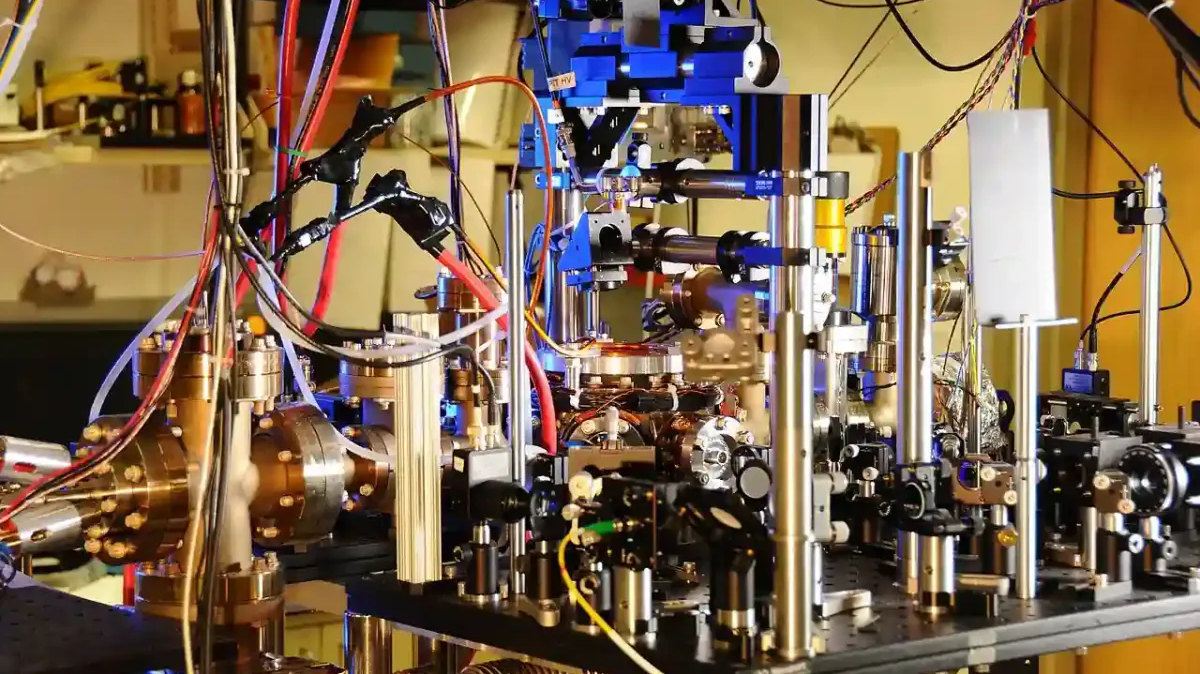
India’s efforts to strengthen domestic capabilities in advanced timing technology have gained momentum after Pune-based deep-tech startup QuPrayog Private Limited developed a laboratory-scale atomic clock prototype on November 21, 2026. The development addresses growing restrictions on access to imported technologies essential for satellite navigation, telecommunications, space missions and strategic systems.
The company developed the Rubidium-87 atomic clock using Coherent Population Trapping (CPT) technology over seven months. According to The Hindu, the prototype has reached Technology Readiness Level (TRL) 4, with development now focused on producing a miniature, integrated device before the end of 2027.
Experimental measurements released by the company indicate that its prototype achieved nearly 50 times better timekeeping stability than a conventional free-running crystal oscillator over a period of 1,000 seconds. The results represent an early milestone in developing domestically manufactured precision timing equipment.
International export controls on dual-use technologies have made
International export controls on dual-use technologies have made access to advanced atomic clocks increasingly challenging. These restrictions have highlighted the importance of establishing domestic manufacturing capabilities and dependable supply chains for critical components.
Dr Jay Mangaonkar, CEO and co-founder of QuPrayog, described the company’s objective as reducing dependence on imported equipment and making advanced timing technology available to Indian industries.
“Our objective is to reduce India’s dependence on imported atomic clocks and establish a reliable domestic supply chain for high-performance timing systems developed and manufactured in India. We want these critical technologies to be accessible to Indian companies building the next generation of navigation, space and strategic systems,” said Dr Jay Mangaonkar, CEO and co-founder of QuPrayog.
Atomic clocks provide highly precise time measurements
Atomic clocks provide highly precise time measurements by tracking the natural behavior of atoms. Their stability makes them essential for satellite navigation systems, where even extremely small timing errors can produce substantial positioning inaccuracies.
According to Jagran Josh, GPS satellites carry multiple atomic clocks based on rubidium technology. These clocks maintain timing accuracy of approximately three billionths of a second, allowing receivers on Earth to calculate their distance from satellites using radio signals traveling at approximately 300,000 kilometers per second.
A GPS-enabled smartphone generally requires signals from at least four satellites to determine its latitude, longitude and altitude. The fourth satellite also helps correct differences between the receiver’s clock and satellite timing signals. According to the US National Institute of Standards and Technology (NIST), GPS can generally provide positioning accuracy of approximately 4.9 meters under suitable conditions.
India’s domestic research efforts also receive support
India’s domestic research efforts also receive support from the National Quantum Mission, launched by the central government in 2023. The initiative carries an allocation of ₹6,003.65 crore over eight years and aims to develop indigenous capabilities in quantum technologies, including sensing, metrology and precision measurement.
QuPrayog is now working to advance its laboratory prototype into a miniature, integrated atomic clock product targeted for completion before the end of 2027.
Follow demokratis.co.idAdd to preferred
- Atomic Clock
- Indian Technology
- Quantum Computing

0Like
0Dislike
0Funny
0Angry
0Sad
0Wow
