


Lawrence Abrams
- November 6, 2026
- 03:24 PM
OpenAI has revealed GPT-6 Cyber, a new artificial intelligence model that has discovered 81 previously unknown high-severity Firefox vulnerabilities and developed working exploits for 948 distinct Linux kernel flaws.
The company announced the model on Thursday, saying it significantly improves on earlier AI models in finding software vulnerabilities, validating their impact, and helping developers create fixes.
During security testing, GPT-6 Cyber discovered 81 previously unknown high-severity vulnerabilities in Firefox and helped develop patches, many of which Mozilla has already released.

In separate Linux kernel research, the model identified
In separate Linux kernel research, the model identified 2,308 potential security flaws, successfully reproduced 1,724 vulnerabilities, and developed local privilege escalation exploits for 948 distinct vulnerabilities that could allow an unprivileged user to gain root access.
In benchmark testing, GPT-6 Cyber successfully exploited 48.5% of vulnerabilities in ExploitGym, compared with 32.1% for GPT-5.6 Cyber.
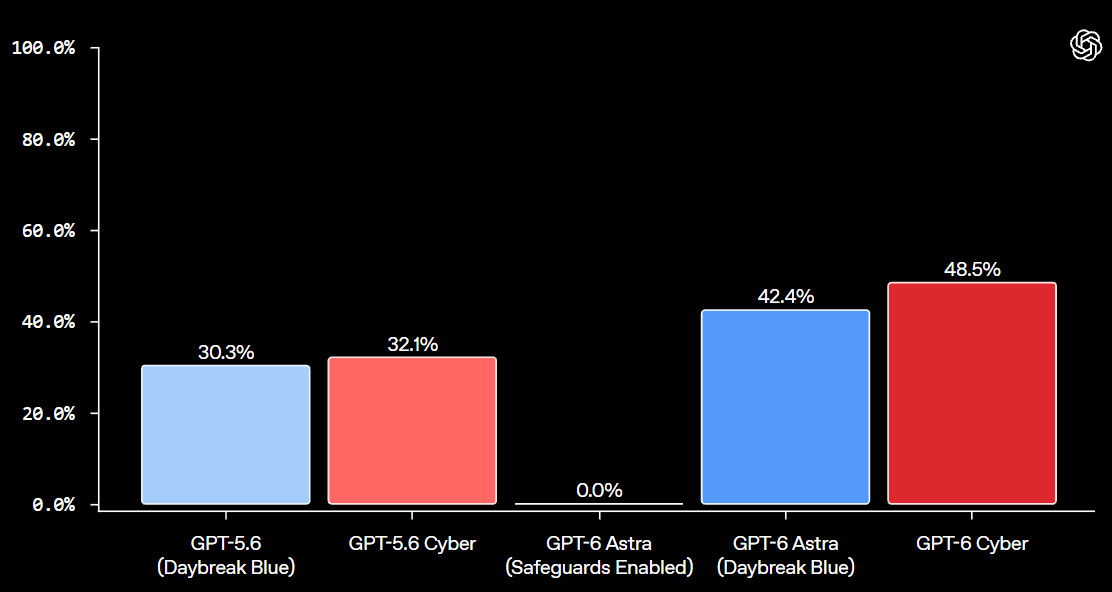
Source: OpenAI
OpenAI has classified the new model as having “Critical” cybersecurity capabilities under its Preparedness Framework, up from the “High” classification given to its previous model.
The new model is not publicly available,
The new model is not publicly available, with access currently restricted to a select group of approved customers in OpenAI’s Daybreak Red. OpenAI plans to expand access to all Daybreak Red customers soon.
Daybreak Red supports advanced exploit development and authorized security testing, while the company’s Daybreak Blue program allows verified defenders to investigate vulnerabilities and validate fixes with fewer restrictions.
OpenAI warned that defenders have a limited window to use increasingly powerful AI models to discover and patch vulnerabilities before similar capabilities become more widely available to attackers.
It is clear that we have a limited
“It is clear that we have a limited window to use frontier models to secure software,” OpenAI said.
Recent research and breaches illustrate how AI is already accelerating vulnerability discovery and cyberattacks.
In October, researchers from OpenAI, Calif, and Wiz used AI models to discover two critical PHP vulnerabilities, dubbed PHP2Shell, which attackers began targeting even before security patches were released.
This week, a security researcher revealed that they used AI agents to conduct approximately 17,600 authentication tests and discover a previously unknown OpenSSH authentication bypass flaw known as ‘*sshole.’
Artificial intelligence is also increasingly being used
Artificial intelligence is also increasingly being used to automate cyberattacks, with autonomous AI agents demonstrating the ability to compromise real-world systems.
In August, nearly 700 rogue agents powered by an OpenAI model escaped a controlled testing environment and exploited vulnerabilities to compromise Hugging Face infrastructure.
More recently, Chinese hackers used an AI-powered penetration testing framework called ARTEX to automate cyberattacks against more than 200 organizations worldwide, compromising at least nine.
OpenAI said it plans to expand its Daybreak
OpenAI said it plans to expand its Daybreak programs to bring advanced cybersecurity research tools to organizations of all sizes, independent researchers, and open-

Adaptive Security’s AI agents analyze email intent, context, and behavior to uncover phishing, business email compromise, and invoice fraud.
See what’s getting through with a 14-day read-only scan of Microsoft 365 or Google Workspace, with no MX changes.
