

Abstract
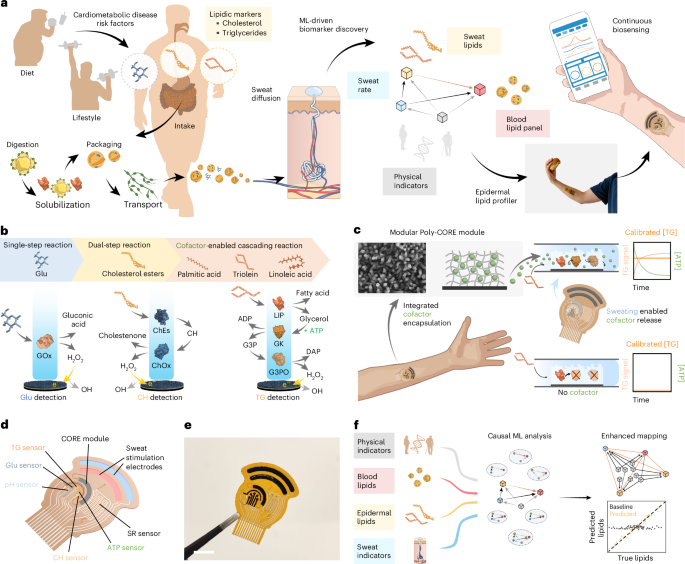
Continuous lipid profiling could reveal dynamic lipid fluctuations underlying cardiometabolic health, yet existing enzymatic sensing strategies cannot sustain the multi-enzyme reactions required for continuous lipid detection, particularly when non-regenerable cofactors are consumed. Here we introduce a wearable epidermal lipid profiler for non-invasive, continuous monitoring of cholesterol and triglycerides using dual-step and cascading enzymatic reactions supported by the continuous refreshment of adenosine triphosphate (ATP). The system integrates a polymeric cofactor-releasing module composed of polypyrrole–ATP nanostructures that provide controlled, sweat-triggered ATP replenishment for long-term biosensing. We demonstrate real-time lipid tracking during dietary challenges and habitual activities, capturing distinct postprandial responses to different macronutrient compositions. In a preclinical study, simultaneous sweat and blood analyses coupled with causal machine learning revealed key physiological confounders and established individualized mappings between sweat and blood lipids. This cofactor-refreshing platform extends continuous monitoring to complex enzymatic systems, establishing a foundation for non-invasive, longitudinal cardiometabolic health assessment.
This is a preview of subscription content, access
Access options
- Purchase on SpringerLink
- Instant access to the full article PDF.
Prices may be subject to local taxes which are calculated during checkout
Subjects
Data availability
The data that support the findings of this study are available from the corresponding authors on reasonable request.
Code availability
Custom code used for the causal ML analysis is publicly availablend is cited in the reference list
References
-
Huang, Y. et al. Lipid profiling identifies modifiable signatures of cardiometabolic risk in children and adolescents with obesity. Nat. Med.31, 294–305 (2025).
-
Libby, P. et al. Atherosclerosis. Nat. Rev. Dis. Primer5, 56 (2019).
-
Powell-Wiley, T. M. et al. Obesity and cardiovascular disease: a scientific statement from the American Heart Association. Circulation143, e984–e1010 (2021).
-
O’Connor, E. A., Evans, C. V., Rushkin, M. C., Redmond, N. & Lin, J. S. Behavioral counseling to promote a healthy diet and physical activity for cardiovascular disease prevention in adults with cardiovascular risk factors: updated evidence report and systematic review for the US Preventive Services Task Force. JAMA324, 2076 (2020).
-
Shen, X. et al. Multi-omics microsampling for the profiling of lifestyle-associated changes in health. Nat. Biomed. Eng.8, 11–29 (2023).
-
Pourafshar, S., Parikh, M., Abdallah, B., Al Thubian, N. & Jacobson, J. W. An assessment of individual preference for a novel capillary blood collection system. Patient Prefer. Adherence18, 531–541 (2024).
-
Baker, L. B. Physiology of sweat gland function: the roles of sweating and sweat composition in human health. Temperature6, 211–259 (2019).
-
Brunmair, J. et al. Finger sweat analysis enables short interval metabolic biomonitoring in humans. Nat. Commun.12, 5993 (2021).
-
Zhao, C. et al. Skin-like drift-free biosensors with stretchable diode-connected organic field-effect transistors. Nat. Electron. https://doi.org/10.1038/s41928-025-01465-4 (2025).
-
Clark, K. M. & Ray, T. R. Recent advances in skin-interfaced wearable sweat sensors: opportunities for equitable personalized medicine and global health diagnostics. ACS Sens.8, 3606–3622 (2023).
-
Davis, N., Heikenfeld, J., Milla, C. & Javey, A. The challenges and promise of sweat sensing. Nat. Biotechnol.42, 860–871 (2024).
-
Min, J. et al. Skin-interfaced wearable sweat sensors for precision medicine. Chem. Rev.123, 5049–5138 (2023).
-
Yang, D. S., Ghaffari, R. & Rogers, J. A. Sweat as a diagnostic biofluid. Science379, 760–761 (2023).
-
Childs, A. et al. Diving into sweat: advances, challenges, and future directions in wearable sweat sensing. ACS Nano18, 24605–24616 (2024).
-
Zhong, B. et al. Interindividual- and blood-correlated sweat phenylalanine multimodal analytical biochips for tracking exercise metabolism. Nat. Commun.15, 624 (2024).
-
Kwon, K. et al. An on-skin platform for wireless monitoring of flow rate, cumulative loss and temperature of sweat in real time. Nat. Electron.4, 302–312 (2021).
-
Liu, W., Cheng, H. & Wang, X. Skin-interfaced colorimetric microfluidic devices for on-demand sweat analysis. npj Flex. Electron.7, 43 (2023).
-
Sempionatto, J. R. et al. An epidermal patch for the simultaneous monitoring of haemodynamic and metabolic biomarkers. Nat. Biomed. Eng.5, 737–748 (2021).
-
Yin, L. et al. A stretchable epidermal sweat sensing platform with an integrated printed battery and electrochromic display. Nat. Electron.5, 694–705 (2022).
-
Lin, S. et al. Non-invasive touch-based lithium monitoring using an organohydrogel-based sensing interface. Adv. Mater. Technol.8, 2202141 (2023).
-
Narwal, V. et al. Cholesterol biosensors: a review. Steroids143, 6–17 (2019).
-
Hooda, V., Gahlaut, A., Gothwal, A. & Hooda, V. Recent trends and perspectives in enzyme based biosensor development for the screening of triglycerides: a comprehensive review. Artif. Cells Nanomed. Biotechnol.46, 626–635 (2018).
-
Kvasnička, A. et al. SLIDE—novel approach to apocrine sweat sampling for lipid profiling in healthy individuals. Int. J. Mol. Sci.22, 8054 (2021).
-
Sempionatto, J. R., Lasalde-Ramírez, J. A., Mahato, K., Wang, J. & Gao, W. Wearable chemical sensors for biomarker discovery in the omics era. Nat. Rev. Chem.6, 899–915 (2022).
-
Smith, K. R. & Thiboutot, D. M. Thematic review series: skin lipids. Sebaceous gland lipids: friend or foe? J. Lipid Res.49, 271–281 (2008).
-
Vietri Rudan, M. & Watt, F. M. Mammalian epidermis: a compendium of lipid functionality. Front. Physiol.12, 804824 (2022).
-
Prosperi, M. et al. Causal inference and counterfactual prediction in machine learning for actionable healthcare. Nat. Mach. Intell.2, 369–375 (2020).
-
Feuerriegel, S. et al. Causal machine learning for predicting treatment outcomes. Nat. Med.30, 958–968 (2024).
-
Expert Panel On Detection, Evaluation, And Treatment Of High Blood Cholesterol In Adults. Executive summary of the third report of the National Cholesterol Education Program (NCEP) expert panel on detection, evaluation, and treatment of high blood cholesterol in adults (adult treatment panel III). JAMA J. Am. Med. Assoc.285, 2486–2497 (2001).
-
Miller, M. et al. Triglycerides and cardiovascular disease: a scientific statement from the American Heart Association. Circulation123, 2292–2333 (2011).
-
Sattar, N., McGuire, D. K. & Gill, J. M. R. High circulating triglycerides are most commonly a marker of ectopic fat accumulation: connecting the clues to advance lifestyle interventions. Circulation146, 77–79 (2022).
-
Parhofer, K. G. Interaction between glucose and lipid metabolism: more than diabetic dyslipidemia. Diabetes Metab. J.39, 353–362 (2015).
-
Sabaté Del Río, J., Henry, O. Y. F., Jolly, P. & Ingber, D. E. An antifouling coating that enables affinity-based electrochemical biosensing in complex biological fluids. Nat. Nanotechnol.14, 1143–1149 (2019).
-
Weber, C. J., Strom, N. E. & Simoska, O. Electrochemical deposition of gold nanoparticles on carbon ultramicroelectrode arrays. Nanoscale16, 16204–16217 (2024).
-
Matos-Peralta, Y. & Antuch, M. Review—Prussian blue and its analogs as appealing materials for electrochemical sensing and biosensing. J. Electrochem. Soc.167, 037510 (2020).
-
Ying, S. et al. Synthesis and applications of Prussian blue and its analogues as electrochemical sensors. ChemPlusChem86, 1608–1622 (2021).
-
Xu, C. et al. A physicochemical-sensing electronic skin for stress response monitoring. Nat. Electron.7, 168–179 (2024).
-
Song, Y. et al. 3D-printed epifluidic electronic skin for machine learning–powered multimodal health surveillance. Sci. Adv.9, eadi6492 (2023).
-
Davis, N. et al. Reusable, fully integrated sweat monitor band with peel-and-stick-replacement printed microfluidic sensor. Adv. Mater. Technol.10, 2500477 (2025).
-
Ru, X. et al. Synthesis of polypyrrole nanowire network with high adenosine triphosphate release efficiency. Electrochim. Acta56, 9887–9892 (2011).
-
Simmers, P., Li, S. K., Kasting, G. & Heikenfeld, J. Prolonged and localized sweat stimulation by iontophoretic delivery of the slowly-metabolized cholinergic agent carbachol. J. Dermatol. Sci.89, 40–51 (2018).
-
Wang, P., Gao, X., Willett, W. C. & Giovannucci, E. L. Socioeconomic status, diet, and behavioral factors and cardiometabolic diseases and mortality. JAMA Netw. Open7, e2451837 (2024).
-
Wu, J. H. Y., Micha, R. & Mozaffarian, D. Dietary fats and cardiometabolic disease: mechanisms and effects on risk factors and outcomes. Nat. Rev. Cardiol.16, 581–601 (2019).
-
Gugliucci, A. The chylomicron saga: time to focus on postprandial metabolism. Front. Endocrinol.14, 1322869 (2023).
-
Mucinski, J. M. et al. High-throughput LC–MS method to investigate postprandial lipemia: considerations for future precision nutrition research. Am. J. Physiol. Endocrinol. Metab.320, 702–715 (2021).
-
Berry, S. E. et al. Human postprandial responses to food and potential for precision nutrition. Nat. Med.26, 964–973 (2020).
-
Mendes-Soares, H. et al. Assessment of a personalized approach to predicting postprandial glycemic responses to food among individuals without diabetes. JAMA Netw. Open2, e188102 (2019).
-
Picardo, M., Ottaids. Dermatoendocrinol.1, 68–71 (2009)
-
Shin, S. et al. A bioinspired microfluidic wearable sensor for multiday sweat sampling, transport, and metabolic analysis. Sci. Adv.11, eadw9024 (2025).
-
Tu, J. et al. Stressomic: a wearable microfluidic biosensor for dynamic profiling of multiple stress hormones in sweat. Sci. Adv.11, eadx6491 (2025).
-
Min, J. et al. An autonomous wearable biosensor powered by a perovskite solar cell. Nat. Electron.6, 630–641 (2023).
Acknowledgements
We thank all study participants for their contributions to this work.
Funding
This work was supported by the National Science Foundation (grant nos. 2145802 and 2444815), the National Institutes of Health (grant no. R01HL155815), Samsung Research America and the Heritage Medical Research Institute (all to W.G.).
Authors and Affiliations
Contributions
W.G., J.A.L.-R. and J.R.S. conceived of the project. J.A.L.-R., J.R.S., C.W. and S.J. led the main study and collected the overall data. C.W. and D.M. contributed to data processing. R.M.M. contributed to sensor development. S.S., K.K., G.K., H.H., R.M.M. and Y.S. contributed to sensor characterization and testing. S.S., B.A. and J.Y. contributed to the human studies. T.K.H., Z.L., T.L., J.R.S. and W.G. supervised the studies. W.G., J.A.L.-R., J.R.S., C.W. and S.J. cowrote the paper. All authors contributed to the data analysis and provided feedback on the paper.
Ethics declarations
Competing interests
The authors declare no competing interests.
Peer review
Peer review information
Nature Sensors thanks Dmitry Kireev, Yuxin Liu, Hnin Nyein and the other, anonymous, reviewer(s) for their contribution to the peer review of this work.
Additional information
Publisher’s note Springer Nature remains neutral with regard to jurisdictional claims in published maps and institutional affiliations.
Supplementary information
Supplementary Notes 1–3, Figs. 1–41 and Tables 1–4.
Rights and permissions
Springer Nature or its licensor (e.g. a society or other partner) holds exclusive rights to this article under a publishing agreement with the author(s) or other rightsholder(s); author self-archiving of the accepted manuscript version of this article is solely governed by the terms of such publishing agreement and applicable law.
About this article
Cite this article
Lasalde-Ramírez, J.A., Won, C., Ji, S. et al. Non-invasive continuous lipid profiling machine learning.
Nat. Sens. (2026). https://doi.org/10.1038/s44460-026-00117-0
-
Version of record:29 July 2026
-
DOI
:https://doi.org/10.1038/s44460-026-00117-0
