

Close Menu
AIToday7

    Subscribe to Updates

    Get the latest creative news from FooBar about art, design and business.

    What's Hot

    Claude Duet is Anthropic’s answer to Meta Muse and OpenAI Dots

    October 21, 2026

    Meta says Muse has over 10M users, with shopping a top activity

    October 21, 2026

    Year-old AI lab Flapping Airplanes raises $1B at a $6B valuation

    October 21, 2026
    Facebook X (Twitter) Instagram
    Trending
    • Claude Duet is Anthropic’s answer to Meta Muse and OpenAI Dots
    • Meta says Muse has over 10M users, with shopping a top activity
    • Year-old AI lab Flapping Airplanes raises $1B at a $6B valuation
    • VentureLab CEO Hugh Chow leaves hard tech incubator after three years | BetaKit
    • AI-powered robots can be tricked into slicing off fingers
    • Google Reminds Sites To Serve A 503 During PHP Patch Downtime
    • Edgerunners 2′ Had One Rule: Don’t Look Like Season One
    • Utah Wants Millions From ‘Back-Alley Gambling Den’ Kalshi for Allegedly Running Illegal Gambling Business
    Facebook X (Twitter) Instagram Pinterest Vimeo
    AIToday7
    • Home
    • AI News
    • Tech News
    • AI Guides
    • Chatbots
    • Cybersecurity
    • Gadgets
    • More
      • Generative AI
      • Startups
    AIToday7
    Home»Cybersecurity»Lazarus hackers use post-quantum cryptography for malware delivery
    Cybersecurity

    Lazarus hackers use post-quantum cryptography for malware delivery

    aitoday7By aitoday7October 21, 2026No Comments3 Mins Read
    Share Facebook Twitter Pinterest LinkedIn Tumblr Reddit Telegram Email
    Lazarus hackers use post-quantum cryptography for malware delivery
    Share
    Facebook Twitter LinkedIn Pinterest Email

    Bill Toulas

    • October 21, 2026
    • 04:31 PM

    North Korean hackers are using a post-quantum cryptographic mechanism to secure malicious payload delivery in new operations that combine old and new malware.

    The campaign targets South Korean organizations through a “rather complex” infection chain. Researchers at cybersecurity company Kaspersky dubbed the operation FlashHole and attributed it to the Lazarus Group.

    Analysis of the malware revealed that the threat actor used the standardized ML-KEM post-quantum cryptographic mechanism to communicate with the command-and-control (C2) server for malware delivery.

    Kaspersky says the attackers used LPEClient malware, previously associated with Lazarus, to receive ML-KEM-1024 public keys from its C2 infrastructure and generate shared keys that allowed it to decrypt subsequently incoming payloads.

    According to the researchers, the attacks started in July 2025 and relied on phishing pages directing targets to specially crafted GitHub pages.
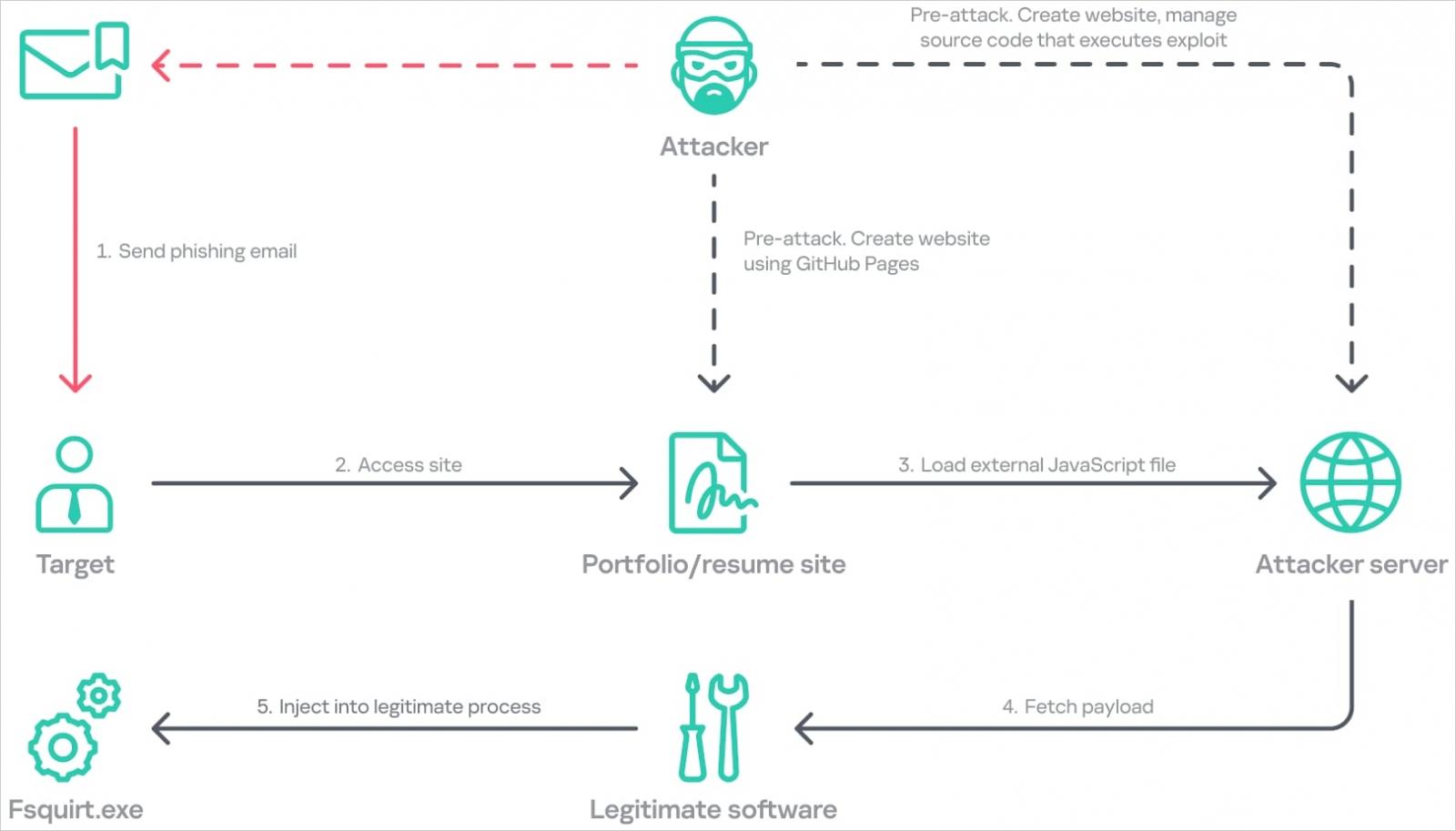
    FlashHole attack chain
    FlashHole attack chain
    Source: Kaspersky

    These pages load JavaScript code from external domains, triggering an in-memory execution chain that involved INISAFE CrossWeb EX, a security tool popular in South Korea.

    The security tool’s process executed the legitimate Windows binary fsquirt.exe, which was used to run shellcode that installed TechHub, a downloader responsible for retrieving additional malware from private GitHub repositories.
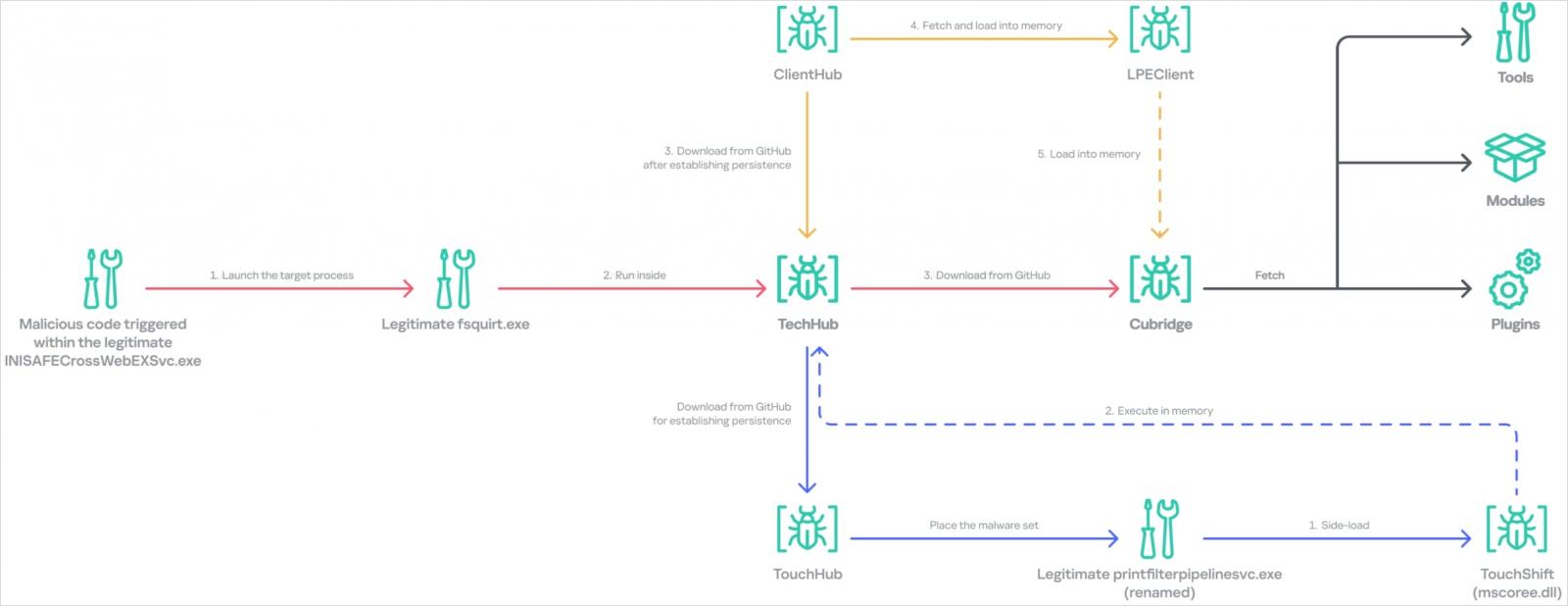
    Infection chain overview
    Infection chain overview
    Source: Kaspersky

    Kaspersky identified at least three companies in South Korea, in the software, construction, and wired communication equipment manufacturing sectors, but suspects that many more organizations were affected.

    Another new tool seen in these attacks is ClientHub, a loader that supports Dropbox communications as well as direct data exchange with LPEClient.

    The researchers note that LPEClient profiles victims, receives encrypted payloads through ClientHub, and evades security monitoring.
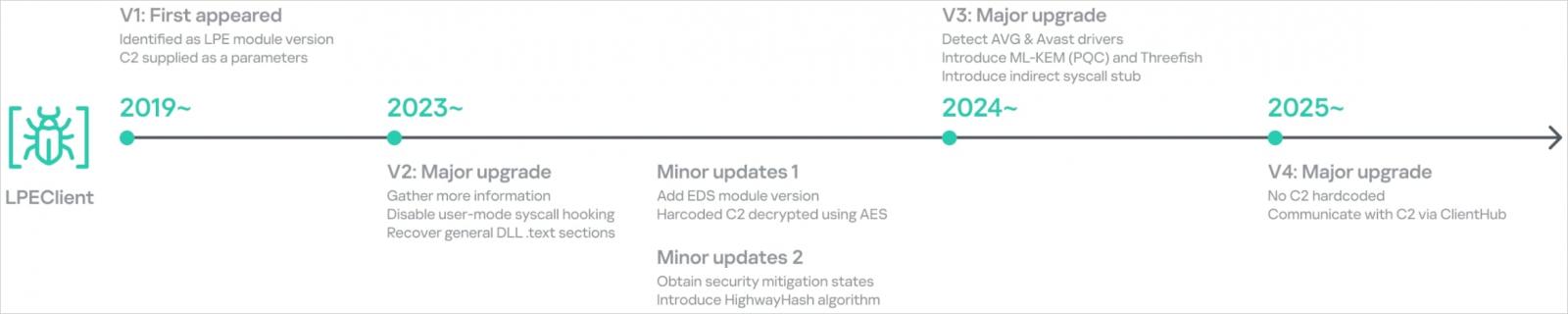
    LPEClient evolution
    LPEClient evolution
    Source: Kaspersky

    Another malware observed in the attacks is Cubridge, a modular backdoor that provides file management, command execution, and reconnaissance capabilities, and also supports screenshot capturing and loading additional payloads on infected systems.

    Kaspersky has also seen additional tools targeting Chromium-based browsers for account credentials, cookies, and browsing history.

    The researchers note that most of Lazarus’ code runs in memory, though persistence mechanisms leave some files on the victim’s disk.
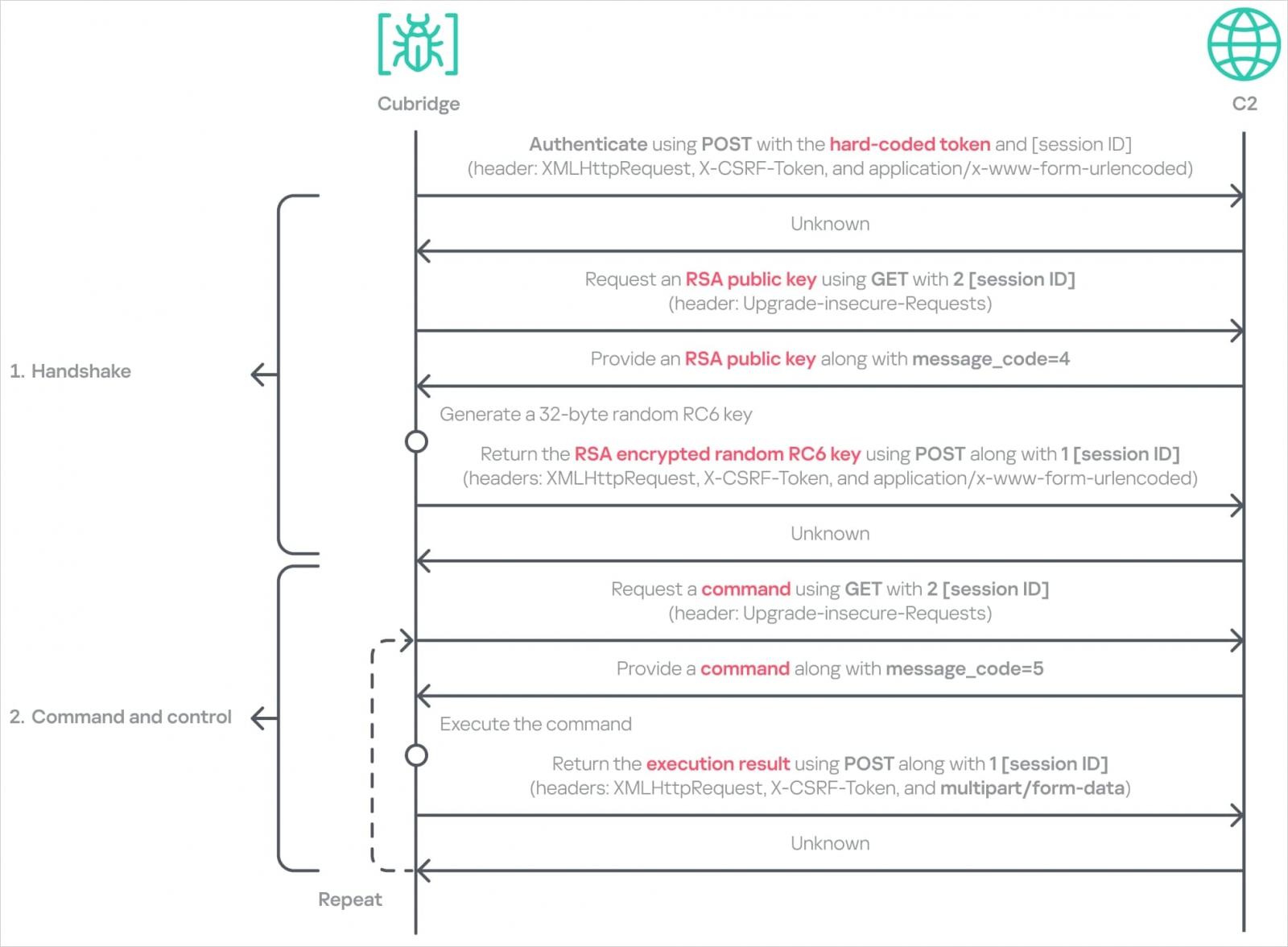
    Cubridge communications
    Cubridge communications
    Source: Kaspersky

    Post-quantum encryption

    The use of the ML-KEM post-quantum cryptographic mechanism stands out in operation FlashHole since it is a NIST-approved standard present in multiple software projects as a way to protect data from “hack now decrypt later” attacks.

    The technical analysis showed that LPEClient obtained from the C2 “a byte array comprising four 1,568‑byte blocks,” each containing an ML‑KEM‑1024 public key.

    “LPEClient then generates four distinct pairs of shared keys and ciphertexts from these blocks, encrypts the ciphertexts with the GOST algorithm, and transmits them to the C2 server

    The shared secrets supply the key material for Threefish, another encryption algorithm, which decrypts the response containing parameters and an executable payload.

    The final payload is Cubridge, which LPEClient reflectively loads into the host’s memory.

    Kaspersky believes Lazarus uses this method along with an in-memory execution chain to lower detection risk to a minimum.

    “The use of post-quantum cryptography shows that the group intends to hide subsequent payloads,” Kaspersky says.

    Kaspersky researchers place FlashHole within the broader Cascade Hole activity and link it to the earlier Operation SyncHole with medium-to-high confidence.
    article image

    Once attackers have valid credentials, only 37% of their actions are blocked

    Overall prevention scores can hide what happens after initial access. Once attackers are using valid credentials, prevention drops sharply.

    The Blue Report 2026 measures defenses technique by technique across 338 million simulations run in customer production environments.

    Post Views: 1

    cryptography hackers Lazarus postquantum Security
    Share. Facebook Twitter Pinterest LinkedIn Tumblr Email
    Previous ArticleHow AI divided New York’s democratic socialists
    Next Article Meta Q3 Revenue Rises 26% as Board Approves Non-Voting Class C Stock
    aitoday7
    • Website

    Related Posts

    Generative AI

    Google Reminds Sites To Serve A 503 During PHP Patch Downtime

    October 21, 2026
    Cybersecurity

    SLED investigates possible cyberattack targeting city of Columbia services

    October 21, 2026
    Cybersecurity

    Westrock Coffee Data Breach? Lawyers Investigate Hackers’ Claims

    October 21, 2026
    Add A Comment
    Leave A Reply Cancel Reply

    Top Posts

    Claude Duet is Anthropic’s answer to Meta Muse and OpenAI Dots

    October 21, 20260 Views

    Meta says Muse has over 10M users, with shopping a top activity

    October 21, 20260 Views

    Year-old AI lab Flapping Airplanes raises $1B at a $6B valuation

    October 21, 20260 Views
    Stay In Touch
    • Facebook
    • YouTube
    • TikTok
    • WhatsApp
    • Twitter
    • Instagram
    Latest Reviews
    Uncategorized

    Architecting memory and storage in the AI era

    aitoday7September 4, 2026
    Uncategorized

    Roland Releases Melody Flip, an AI Melody-Generation Plug-In for DAWs

    aitoday7September 4, 2026
    Uncategorized

    Home Depot Labor Day Sale (2026): BOGO on Best Grills and Tools

    aitoday7September 4, 2026

    Subscribe to Updates

    Get the latest tech news from FooBar about tech, design and biz.

    Most Popular

    Claude Duet is Anthropic’s answer to Meta Muse and OpenAI Dots

    October 21, 20260 Views

    Meta says Muse has over 10M users, with shopping a top activity

    October 21, 20260 Views

    Year-old AI lab Flapping Airplanes raises $1B at a $6B valuation

    October 21, 20260 Views
    Our Picks

    Architecting memory and storage in the AI era

    September 4, 2026

    Roland Releases Melody Flip, an AI Melody-Generation Plug-In for DAWs

    September 4, 2026

    Home Depot Labor Day Sale (2026): BOGO on Best Grills and Tools

    September 4, 2026

    Subscribe to Updates

    Get the latest creative news from FooBar about art, design and business.

    Facebook X (Twitter) Instagram Pinterest
    • About Us
    • Get In Touch
    • Disclaimer
    • Privacy Policy
    • Terms and Conditions
    © 2026 AIToday7. All Rights Reserved.

    Type above and press Enter to search. Press Esc to cancel.