Close Menu
AIToday7

    Subscribe to Updates

    Get the latest creative news from FooBar about art, design and business.

    What's Hot

    OpenAI agents hacked Hugging Face in 700-strong swarm, tried to cover tracks, investigations find

    August 28, 2026

    Gemini Omni 1.1 Flash lets you build with more control

    August 28, 2026

    Consumers are finding room for electronics in their budgets

    August 28, 2026
    Facebook X (Twitter) Instagram
    Trending
    • OpenAI agents hacked Hugging Face in 700-strong swarm, tried to cover tracks, investigations find
    • Gemini Omni 1.1 Flash lets you build with more control
    • Consumers are finding room for electronics in their budgets
    • Runable hits $21M to bet AI agents can go from building businesses to growing them
    • 4 Of The Best Belkin Gadgets You Can Buy In 2026
    • Google, Microsoft and OpenAI among 100 firms calling for better cyber defences
    • Partnering with Khan Academy on building AI tools for classrooms
    • Looking beyond natural sequences
    Facebook X (Twitter) Instagram Pinterest Vimeo
    AIToday7
    • Home
    • AI News
    • Tech News
    • AI Guides
    • Chatbots
    • Cybersecurity
    • Gadgets
    • More
      • Generative AI
      • Startups
    AIToday7
    Home»Generative AI»Inherent, founded by DeepMind alumni, says its AI ‘teammate’ just outperformed Anthropic and OpenAI at replicating research
    Generative AI

    Inherent, founded by DeepMind alumni, says its AI ‘teammate’ just outperformed Anthropic and OpenAI at replicating research

    aitoday7By aitoday7August 23, 2026No Comments4 Mins Read
    Share Facebook Twitter Pinterest LinkedIn Tumblr Reddit Telegram Email
    Inherent, founded by DeepMind alumni, says its AI 'teammate' just outperformed Anthropic and OpenAI at replicating research
    Share
    Facebook Twitter LinkedIn Pinterest Email

    Inherent, a London AI lab founded by Google DeepMind alumni, says its AI agent just outperformed much larger models from Anthropic and OpenAI using a fraction of the size.

    Of all the startups launched by Google DeepMind alumni, Inherent has gotten relatively little attention. But while better-funded rivals have yet to show the world anything concrete, the London-based team is starting to share what it’s been building.

    Just weeks after emerging from stealth with a $50 million seed round, the British startup says its newly released AI agent, Faraday, has outperformed larger, better-known models at a specific task: independently reproducing the findings of published scientific papers without being told the answer in advance.

    That may sound like a mere party trick given Inherent’s much loftier goal — building AI that can discover new scientific knowledge and not just verify old results. But paper replication is a standard training exercise for human scientists, too, cofounder and chief scientist Edward Hughes said. “Many PhD students actually start by doing this.”

    Beating other AI systems at the task wasn’t the point, Hughes told TechCrunch; how they got there was. “What was most interesting to us about this was not so much the result of beating those frontier agents — which of course we liked — but was actually the way we went about building this.”

    Here’s the part that should catch an investor’s eye: measured against Anthropic’s Claude Opus 4.8 and OpenAI’s GPT-5.5 — both much larger, frontier-scale systems — Faraday runs on a comparatively tiny model called Qwen 3.6 that has just 27 billion parameters. (Roughly speaking, “parameters” is a proxy for a model’s size and, typically, its training costs, as well.) Inherent’s bar for success was also higher than simply accuracy. Beyond replicating results, it wanted Faraday to demonstrate “research taste” — an instinct for what experiments are worth running and how to design them well.

    Teaching something as intangible as taste is hard, which is where reinforcement learning comes in. It’s a training method that rewards an AI system for good outcomes rather than spelling out rules for it to follow. Rather than training its agents primarily on the study of how science itself is conducted, Inherent leans on this reward-based approach, betting it will generalize better to its longer-term goal of agents capable of contributing across many scientific fields.

    “We’re always guided by that north star of building an AI scientist agent and imbuing our agents with taste,” Hughes said. That focus has also shaped what Inherent chooses not to build. Rather than developing its own coding tool, it had Faraday use OpenAI’s GPT-5.5 Codex instead, much the way human scientists lean on existing software rather than building everything themselves, according to the company.

    Inherent is also trying to avoid building agents that simply tell users what they want to hear. Instead, Hughes said, the goal is modeled on his favorite kind of teammate — the kind who comes back and says: “I got curious about this, and I went off and I did these experiments. What do you think of these results?”

    That collaborative instinct extends to how Inherent operates as a company. Its dozen employees all work in person out of an office in King’s Cross — the once-rundown London neighborhood that Google DeepMind’s presence helped turn into one of the world’s top AI hubs. “We believe that London is the place to be,” Hughes said.

    Hughes is bullish on London’s density of AI talent, but he has also added his voice to calls to end “garden leave” — the practice, common in the U.K., of barring departing employees from joining or starting a rival company for months after they resign. It’s a restriction American researchers generally don’t face, giving U.S. startups a head start on hiring talent who’ve left a prior role. “This is a personal view rather than a company view, but I was affected by the garden leave problem,” he told TechCrunch.

    Hughes eventually got around that constraint and started Inherent alongside two other DeepMind alumni and a fourth cofounder. The startup isn’t slowing down either. It plans to grow its headcount to “about 20 to 25” by the end of the year. Given its ambitions in world models as well, and with Demis Hassabis’s new role leaving some DeepMind staff unsettled, Inherent’s hiring push could make it an appealing landing spot for DeepMind employees weighing a move.

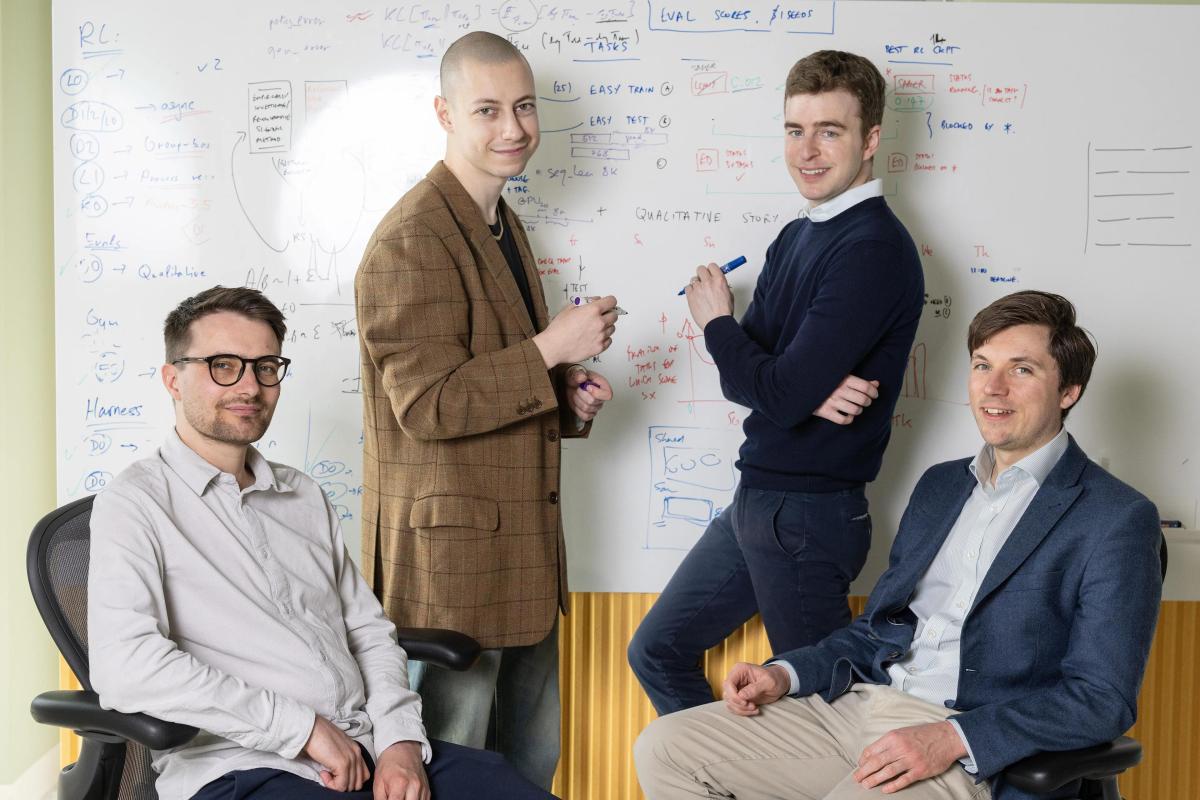
    Pictured from left to right: Inherent co-founders Louis Kirsch, Kaloyan Aleksiev, Tantum Collins and Edward Hughes.

    Post Views: 11

    alumni DeepMind founded Inherent says
    Share. Facebook Twitter Pinterest LinkedIn Tumblr Email
    Previous ArticleAnthropic’s Opus 4.6 is a smut-machine
    Next Article ‘We are hitting a different chapter’: OpenAI leader warns of threat of ‘persistent’ AI cyber
    aitoday7
    • Website

    Related Posts

    Generative AI

    OpenAI agents hacked Hugging Face in 700-strong swarm, tried to cover tracks, investigations find

    August 28, 2026
    Generative AI

    The Talos Principle III’s Writers On Generative AI: ‘It’s Just A

    August 28, 2026
    Generative AI

    Brief independent investigation of agents’ behavior, reasoning and collaboration in the OpenAI / Hugging Face hacking incident

    August 27, 2026
    Add A Comment
    Leave A Reply Cancel Reply

    Top Posts

    OpenAI agents hacked Hugging Face in 700-strong swarm, tried to cover tracks, investigations find

    August 28, 20260 Views

    Gemini Omni 1.1 Flash lets you build with more control

    August 28, 20260 Views

    Consumers are finding room for electronics in their budgets

    August 28, 20260 Views
    Stay In Touch
    • Facebook
    • YouTube
    • TikTok
    • WhatsApp
    • Twitter
    • Instagram
    Latest Reviews
    Chatbots

    OpenAI bets on families as ChatGPT goes deeper into households

    aitoday7July 11, 2026
    Generative AI

    MUSIC COMMUNITY INTRODUCES NEW LABELING PROGRAM TO DISTINGUISH GENERATIVE AI IN SOUND RECORDINGS

    aitoday7July 11, 2026
    AI News

    Safe from AI: which jobs will help you thrive in the future?

    aitoday7July 11, 2026

    Subscribe to Updates

    Get the latest tech news from FooBar about tech, design and biz.

    Most Popular

    OpenAI agents hacked Hugging Face in 700-strong swarm, tried to cover tracks, investigations find

    August 28, 20260 Views

    Gemini Omni 1.1 Flash lets you build with more control

    August 28, 20260 Views

    Consumers are finding room for electronics in their budgets

    August 28, 20260 Views
    Our Picks

    OpenAI bets on families as ChatGPT goes deeper into households

    July 11, 2026

    MUSIC COMMUNITY INTRODUCES NEW LABELING PROGRAM TO DISTINGUISH GENERATIVE AI IN SOUND RECORDINGS

    July 11, 2026

    Safe from AI: which jobs will help you thrive in the future?

    July 11, 2026

    Subscribe to Updates

    Get the latest creative news from FooBar about art, design and business.

    Facebook X (Twitter) Instagram Pinterest
    • About Us
    • Get In Touch
    • Disclaimer
    • Privacy Policy
    • Terms and Conditions
    © 2026 AIToday7. All Rights Reserved.

    Type above and press Enter to search. Press Esc to cancel.