
Deep Dive
A battle over ‘Italian brainrot’ could shape who owns AI art
Who owns Italian Brainrot?
- Download
- Embed
<iframe src="https://www.npr.org/player/embed/nx-s1-5867638/nx-s1-9896485" width="100%" height="290" frameborder="0" scrolling="no" title="NPR embedded audio player"> - Transcript
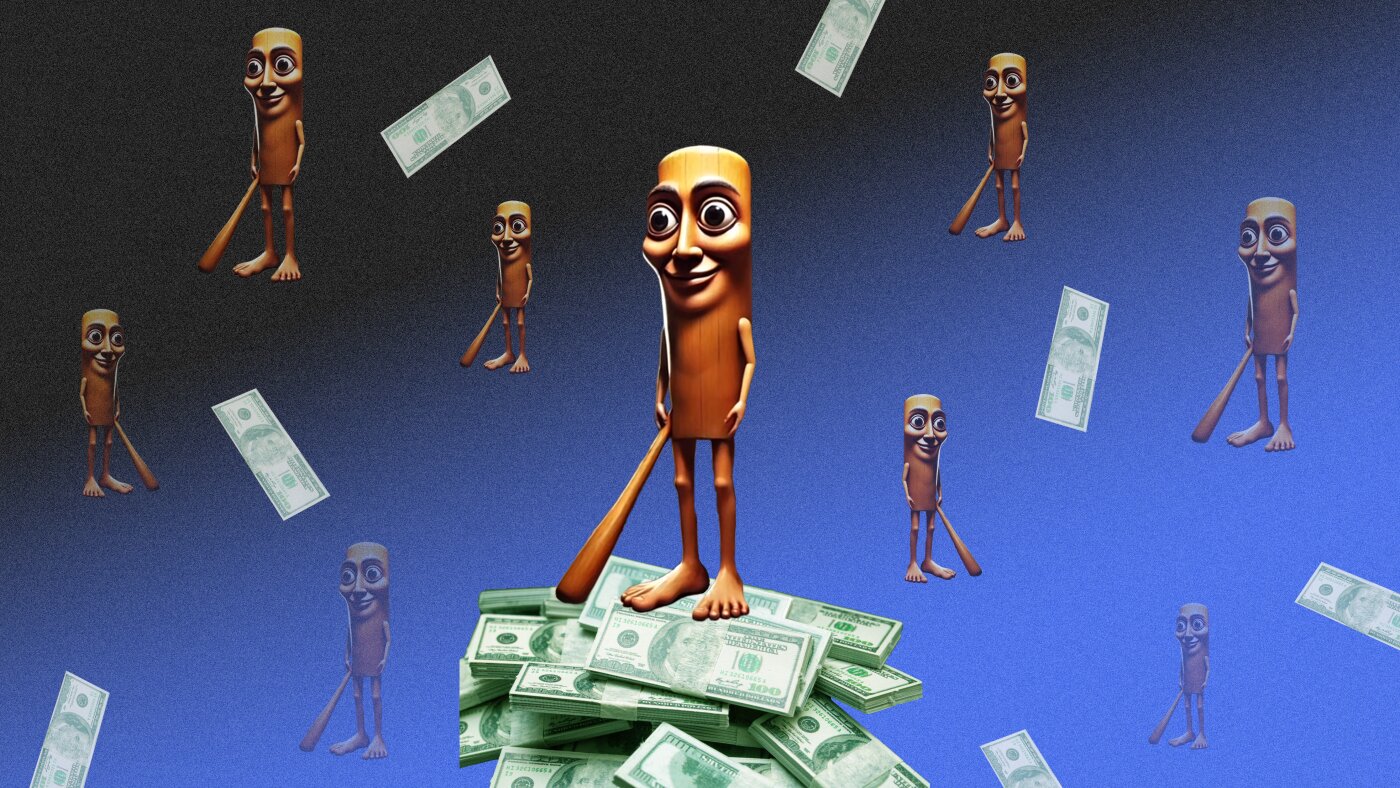
Tung Tung Sahur, one of the world’s best-known “Italian brainrot” characters, was created using seven prompts in an AI image generator. A legal battle is underway to determine who, if anyone, can claim ownership.
AFP
Around the world, kids are going crazy for a set of characters collectively known as “Italian brainrot.” These memes are generated using artificial intelligence, and they’re appearing on social media and YouTube, as well as in video games.
Now their popularity has sparked a fight over who, if anyone, owns them.
A legal battle unfolding in a California courtroom could determine whether several prominent brainrot characters can be used in games and other media without paying or acknowledging their creators. On one side is a company that made a hit game using Italian brainrot characters. On the other is a French startup representing the young creators of several of the characters that appear in the game. At stake is potentially many millions of dollars in revenue.
Books
Writer Thoreau warned of brain rot in 1854. Now it’s the Oxford Word of 2024
The fight comes at a crossroads for AI-generated art and raises the question of whether prompts to a chatbot can be considered artistic expression. A 2024 case ruled that a chatbot cannot be the sole inventor of a product or piece of art, but it left open the possibility of humans using AI to produce copyrightable works. Last year, the U.S. Copyright Office affirmed that AI-assisted work could be copyrighted but added: “Whether human contributions to AI-generated outputs are sufficient to constitute authorship must be analyzed on a case-by-case basis.”
“We’re still in the middle of figuring out, as a copyright matter, how much human involvement there has to be” for AI art to be legally protected, said Mark McKenna, a law professor at the University of California, Los Angeles who co-directs the university’s Institute for Technology, Law and Policy. McKenna thinks the day will come when an AI drawing, story or song is copyrighted, but he said, “I don’t have some specific prediction of how many prompts it’s going to take.”
Ballerina Cappuccina
Italian brainrot burst forth on the internet in early 2025. The memes are weird, AI-generated characters with faux Italian-sounding names. A cow with the body of the planet Saturn and large human feet is known as La Vaca Saturno Saturnita, while a frothy coffee in a tutu is called Ballerina Cappuccina.
Grown-ups can find Italian brainrot confusing, but kids love the Dadaist characters. And sensing an opportunity, products geared toward a younger audience are regularly using brainrot characters.
That includes Steal a Brainrot, a video game made by a company called Do Big Studios and launched last year, shortly after brainrots took the youth internet by storm. In the game, different brainrot characters come out on a conveyor belt and players pick them up. But they can also steal brainrots from each other. Steal a Brainrot is one of the top games on the online gaming platform Roblox, with hundreds of thousands of players logging on at any moment to steal each other’s characters.
Steal a Brainrot is a game on Roblox where players can steal each other’s brainrot characters. It rocketed to the top of the charts last year and remains a top game on the Roblox platform.
Screenshot by NPR/YouTubehide caption
toggle caption
Screenshot by NPR/YouTube
After Steal a Brainrot rocketed to the top of the charts, Sam Brakta (aka SpyderSammy), the creator of Steal a Brainrot and owner of Do Big, received a letter from a French company called Mementum Lab asking the company to enter into licensing negotiations for one of the characters in the game: Tung Tung Sahur.
Tung Tung Sahur (sometimes called Tung Tung Tung Sahur) is among the biggest characters in Italian brainrot. He looks like a wooden stick with a face, human feet and human arms, holding a baseball bat.
Licensing requests are nothing new: If someone wanted to put Darth Vader in a video game, for example, they’d have to pay a fee to Disney, which currently owns the intellectual property for Star Wars.
But rather than pay a license fee, Do Big decided to take Mementum Lab to court. In an amended complaint filed in July, the company stated that “Mementum’s claimed rights do not exist. Under established law, copyright protection requires human authorship, and AI-generated material does not qualify.”
Gaming
With new safety update, Roblox aims to boost protection for young gamers
“It’s our client’s position that the various brainrots that are featured in this game, because they were created by AI, are not protectable — they’re not owned by anybody,” said Aaron Moss, a copyright lawyer at the firm Mitchell Silberberg & Knupp, which is representing Do Big and SpyderSammy.
Young creators use AI
Mementum Lab, the company representing the creators of several characters that appear in Steal a Brainrot, takes a different view. Brainrot characters are already known to millions of children globally and are potentially worth hundreds of millions of dollars in revenue, argues Eben Jeda, a co-founder of Mementum.
“Our position has always been that if these characters become global entertainment franchises, the original creators should be part of that success,” he wrote to NPR in an email.
In the case of Tung Tung Sahur, Jeda argues, there’s a lot more to him than meets the eye.
According to court records, Tung Tung Sahur’s creator is a young Indonesian man named Fernanda Bagas Indrastata who goes by the online name Noxa. Noxa made the character in 15 minutes using just seven prompts with an AI image generator.
It turns out the character isn’t a wooden stick after all. It’s actually a type of Indonesian drum called a kentongan. During Ramadan, kentongans are used to wake up people for sahur, the early-morning pre-fast meal. The “tung tung” noise that the drums make became Tung Tung Sahur’s first name.
Indonesian Muslims strike kentongans, which are traditional drums, to wake people up for sahur, the early-morning pre-fast meal during Ramadan, on July 3, 2014, in Semarang, Central Java. The “tung tung tung” sound made by the drum is what gives Tung Tung Sahur his name.
Anadolu
Steven Stein, a partner at Greenberg Glusker, the law firm representing Mementum Lab in U.S. court, said that Tung Tung Sahur’s origin story proves the character was made by a human and that even if it didn’t take much effort to create it, that still counts under the law.
“If I sat here right now and drew a picture of something and spent 30 seconds doing that, that could be copyrightable,” he told NPR.
Copyright vs. trademark
While Do Big Studios, the creator of Steal a Brainrot, is trying to invalidate any copyright for Tung Tung Sahur, Mementum has countersued, claiming trademark infringement. The difference is significant: Copyright is typically used to protect creative works (like the Harry Potter books and characters) from being plagiarized or duplicated without permission, while trademark has historically been used to protect consumer brands (like Coca-Cola).
Stein said that Mementum is using trademark law because, so far at least, it has not tried to register a copyright for Tung Tung Sahur in the United States. The trademark claim, he asserts, allows the company to focus more directly on whether the company can receive damages from unauthorized use of Tung Tung Sahur, without pursuing the larger philosophical question of whether an AI-generated character is copyrightable under U.S. law.
“Mementum has to be strategic about the fights it has in this litigation while preserving its full suite of rights to pursue claims abroad,” he said.
Moss, representing Do Big, said he believes the other side is pursuing a trademark claim because it knows it will lose under current copyright law. “The U.S. Copyright Office has been clear that simply typing prompts into an image generator is not authorship,” he said.
Because of the counterclaims by both sides, it remains unclear how the case will shape the legal understanding of AI art, but UCLA legal expert McKenna says cases like these will likely be pivotal in creating precedent in the courts.
McKenna said using trademark law to sidestep copyright questions is not an uncommon strategy, but he thinks it’s an abuse of the system. “Trademark is supposed to identify the origin of tangible goods and services,” he said. “Falling back on trademark so as to avoid the hard questions in copyright, to me, is a misuse of trademark law.”
At the same time, McKenna said, he thinks Tung Tung Sahur could have a shot at securing a copyright under U.S. law.
“In general, the standard for originality is pretty low,” he said. “It doesn’t have to be, like, the most creative thing in the history of the world.”
- Artificial Intelligence
- copyright
- video games
