
The PhD student works to give young people an active role in shaping digital technologies that can support their own well-being.
Gitana Savage|MIT News correspondent
Publication Date:
September 1, 2026
Press Contact:
Abby
Abazorius
Email:abbya@mit.edu
Phone:617-253-2709
MIT News Office
Close

Caption:
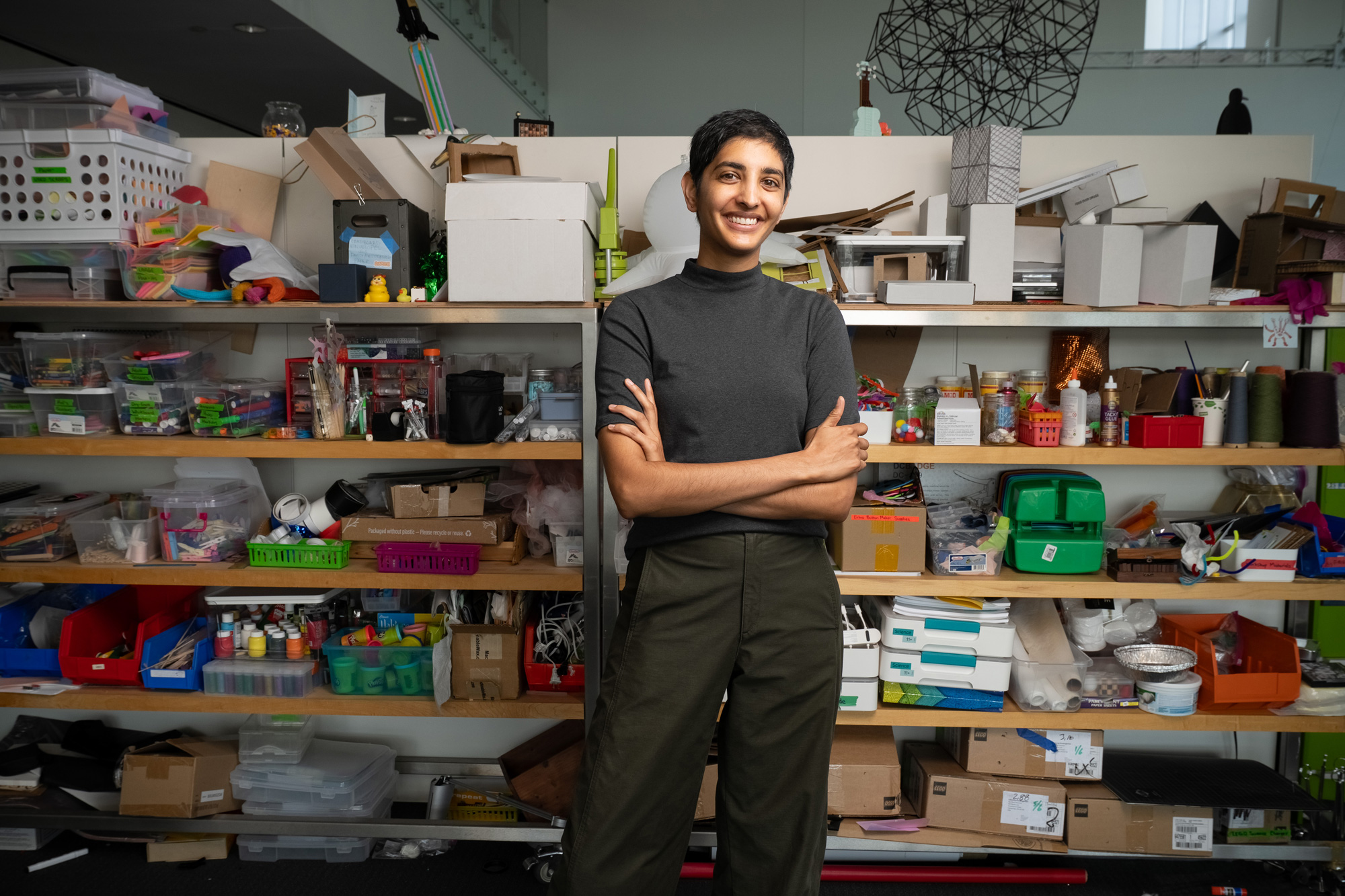
MIT PhD student Ila Kumar works alongside young people who have gone through the child welfare system, to reimagine how technology can support healing, connection, and independence.
Credits:
Credit: Bryce Vickmark
Before Ila Kumar thinks about how to build technology, she asks a different question: What is the context that technology will operate in, and who needs to be involved in the design?
For Kumar, meaningful innovation doesn’t result from engineers or designers working in isolation. Instead, she believes the best innovations emerge when the people who stand to benefit from a technology help create it from the very beginning.
That philosophy has guided her research in the Lifelong Kindergarten group, where she works alongside young people who have experienced trauma during childhood, particularly those involved in the child welfare system, to reimagine how technology can support healing, connection, and independence.
“I really think that community-based design is the only way that we can make technology that accounts for communities’ needs, but also their barriers, their cultures, their concerns,” Kumar says. “It’s the only way that we can make really sustainable and positively impactful technology.”
Today, Kumar is preparing to enter the sixth and final year of her PhD. But when she first arrived at MIT in 2021, she envisioned staying only long enough to complete a master’s degree. However, Kumar quickly fell in love with her work and decided to stay at MIT and pursue her doctorate.

“I really think that community-based design is the only way that we can make technology that accounts for communities’ needs, but also their barriers, their cultures, their concerns,” Ila Kumar says.
Credit: Bryce Vickmark
Before graduate school, Kumar grew up in Philadelphia, attended the University of Pennsylvania, and worked on several projects at the intersection of technology and mental health or psychology research.
Through those experiences, Kumar began to question whether the technology she was helping to develop was having the sustained impact she hoped for. “I had done a number of projects that were ‘tech for good,’” she says. “And I wasn’t seeing that what I was doing had a long-term impact.”
Rather than walking away from technology altogether, Kumar began to rethink how it was created. “If we design technology in community-based ways and really think about holistic well-being,” she says, “maybe we can actually create things that help people.”
That conviction eventually became the foundation of her doctoral research, and over the course of her PhD, Kumar has increasingly moved from simply listening to communities to building with them.
Public conversations about technology often present a choice: Embrace it or reject it. Kumar believes that it’s not that simple.
Kumar sees the way digital platforms have the potential to both harm young people’s mental health and development, and help young people process emotions, strengthen relationships, and practice healthy vulnerability — if those tools are designed thoughtfully and embedded in the systems where young people already receive care and support.
Much of her work explores exactly what that could look like.
One project Kumar worked on, in partnership with Stepping Forward LA and with the input of the young people who would use the app, replaces text-heavy communication with a visual collage system to help young people impacted by trauma and the child welfare system to express emotions that may be difficult to put into words, and to build a sense of connectedness with one another.
In an ongoing project, Kumar is collaborating with the Justice Reing an active role in their treatment-planning process and helps them work toward the goals they set outside of the therapy office. The group is working with clinicians and youth to design and evaluate the system
“We are not sitting at MIT designing tools and just throwing them at people,” Kumar says. “We’re designing it together. We need to actually have the folks that are relevant to providing the care in the room.”
That idea became even clearer to Kumar through a 10-month technology leadership circle she co-facilitated with Foster America. The program brought together people with lived experience of foster care and technology experts to envision how digital technologies could fill gaps in care for young people in the child welfare system.
This project surfaced the importance of not just designing tools that center youths’ needs but also considering the ways in which social services need to be brought into the innovation process.
Those ideas have also led Kumar to explorations that involve one of technology’s newest frontiers: artificial intelligence. She began asking questions after she realized that young people who had experienced trauma had already been turning to AI to make critical life decisions, even as many caregivers were not aware of it.
As a result, Kumar has increasingly focused on supporting care providers in talking with young people about AI. She has led training workshops with organizations that serve young people impacted by trauma or involved in the child welfare system.
“If we design technology in community-based ways and really think about holistic well-being,” Kumar says, “maybe we can actually create things that help people.”
Credit: Bryce Vickmark
Kumar’s passion for advocating for young people extends far beyond the lab. She also volunteers as a court-appointed special advocate, working one-on-one with a young person in the child welfare system while pursuing her PhD.
The role has deepened both her understanding of the challenges young people face and her belief that lasting change depends on relationships.
Some of her most meaningful moments have come while working directly with young people. Last summer, she, alongside another graduate student in her lab, mentored two interns with foster care experience during a six-week program that blended technology, creativity, and personal growth.
“It felt like a real privilege,” Kumar says. “Even the six weeks was not enough.”
Those relationships have also inspired Kumar to address how community-based research is conducted at MIT.
Recognizing that many students interested in community-engaged work often feel isolated, she collaborated with the Priscilla King Gray Public Service Center to co-teach a course on community-driven innovation. She later established a biweekly community of practice connecting researchers across MIT and Harvard University who are navigating the benefits and challenges of conducting research alongside communities rather than simply studying them.
Outside of research, Kumar enjoys birdwatching, cooking with friends, and creating graphic illustrations — creative pursuits that, much like her research, reward patience, observation, and careful attention.
As technology becomes increasingly woven into young people’s lives, Kumar hopes innovation will move beyond the lab and into the communities it is meant to serve.
“The future of actually impactful technologies,” Kumar says, “is when researchers are making decisions with communities instead of for them.”
