

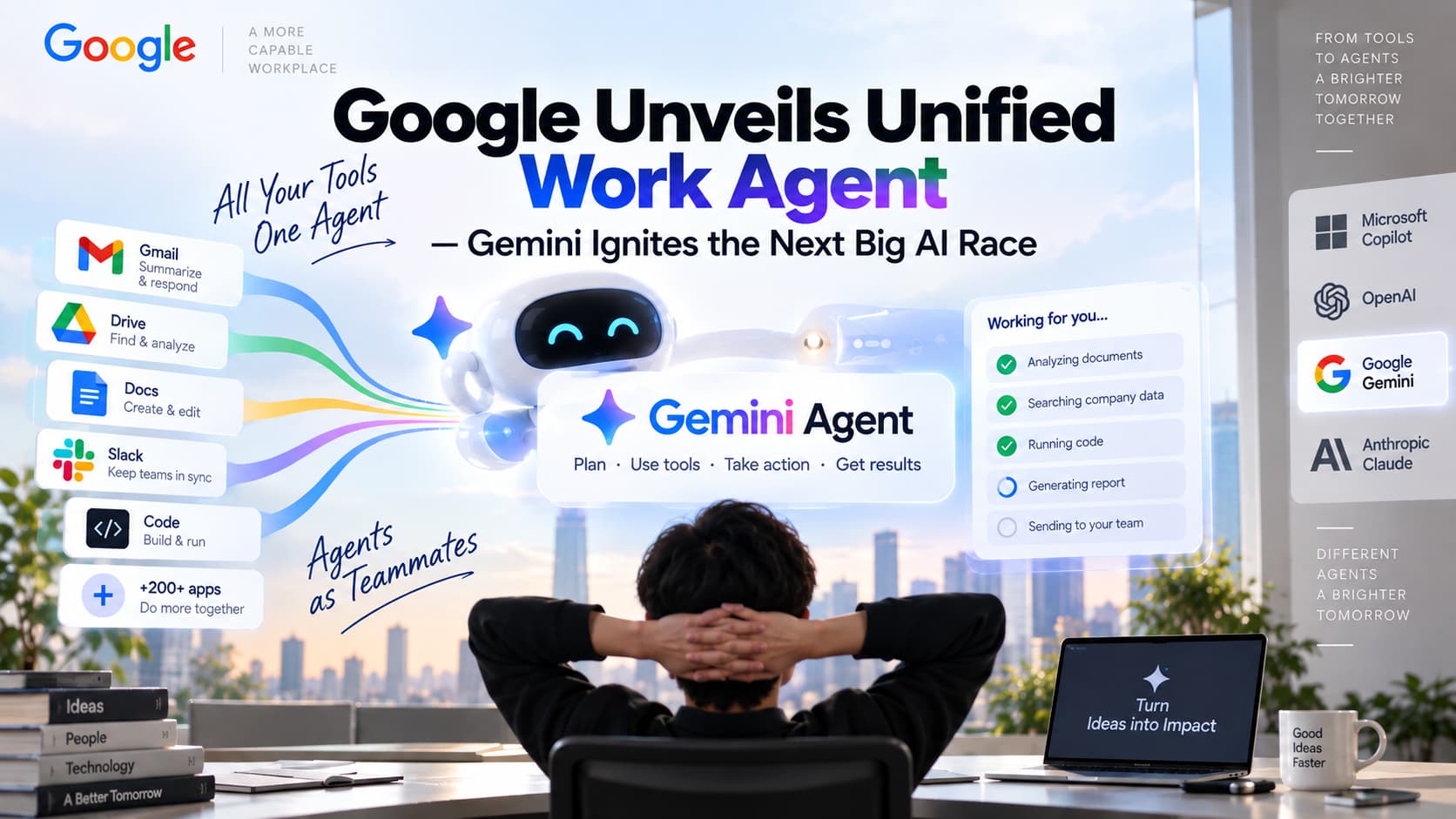
AI at work is still scattered. A draft gets written with a chatbot, code gets written in a separate tool, meeting notes get summarized somewhere else — and none of these tools know about each other. Pasting a chatbot’s answer into a document still means copy-and-paste, yesterday’s instructions have to be re-explained today, and the boring follow-up work still lands on a human. As WOWTALE noted last month, becoming a genuine “work agent” means stitching these scattered tools into one real workflow — and each Big Tech company is solving that problem at a different layer. Google Cloud’s answer, unveiled October 9 at “Gemini at Work 2026,” is the Gemini agent.
What it takes to be a work agent: identity, memory, model choice
Google laid the groundwork in April at Google Cloud Next ’26, when it folded Vertex AI, Agentspace, and Gemini Code Assist Enterprise into the Gemini Enterprise Agent Platform — introducing Agent Studio and ADK for building agents, Agent Runtime and Memory Bank for running long-lived ones, and an identity/registry/gateway layer for governance. The Gemini agent announced this week builds on that foundation, unifying Gmail, Drive, Docs, Slack, and code execution behind a single agent and a single API. You give it objectives rather than instructions, and it plans the work, picks tools, and brings back something finished. A “coworker agent” that takes on a defined role gets its own @agents.company.com email address and dedicated storage, so colleagues can @mention it like any team member; it keeps four kinds of memory — session, semantic, procedural, and episodic — so work survives a closed laptop.
Model choice is the other pillar. The Gemini agent routes work not just to Google’s own models but to Anthropic’s Claude, depending on the task — an extension of the “Model Garden” that already listed Claude among 200-plus models when Gemini Enterprise launched in April. Google’s argument is explicit: the biggest model isn’t always the best one for a given job.
The second requirement: can you control it, can you afford it
As agents start touching production systems on a person’s behalf, governability has become the second test of a work agent. Every agent gets a cryptographically attested identity and least-privilege permissions managed like an employee’s; permissions propagate through standards like OAuth; every action is logged under the agent’s name, not a person’s. All traffic runs through Agent Gateway, an AI-specific network firewall that lets administrators write a policy once and apply it across every agent in the company.
On cost, Google introduced Smart Routing, which sends each task to the model with the best performance per dollar, and real-time spend caps that pause a project’s agents once a budget is hit. Per-token prices have dropped 98% since 2024, Google says, but usage has grown even faster. Following April’s training-focused TPU 8t, the new inference-focused TPU 8i delivers an 80% price-performance gain over the prior generation. Where April’s numbers showed Gemini Enterprise’s paid monthly active users up 40% quarter-over-quarter and 75% of Google Cloud customers on AI products, this week’s update puts those figures at 90% of the Fortune 100 and 80% of Google Cloud customers.
Same homework, four different answers
Microsoft, OpenAI, Salesforce, and Amazon are solving the same problem — stitching scattered AI tools into daily workflows — at four different layers.
Microsoft introduced Agent 365, its agent-governance layer, at Ignite last November, then rebuilt the Copilot app itself into three tabs — Home, Code, and Autopilot — last month. Tellingly, Home, the tab most people will actually use, has no Microsoft model option at all; it runs on OpenAI’s GPT or Anthropic’s Claude. With a paid-Copilot attach rate under 7% across more than 450 million commercial Office 365 seats, the bet looks less like “build the smartest model” and more like “own the window people already have open.”
OpenAI doesn’t have a productivity suite already installed anywhere. So instead of embedding itself in someone else’s office, it launched Frontier in February to hire agents like full employees with system access of their own. HP, Intuit, Oracle, State Farm, Thermo Fisher, and Uber were early adopters, and OpenAI is aiming to push enterprise’s share of its revenue from 40% to 50% by year-end. The no-code AgentKit it shipped last October, by contrast, is being shut down by the end of November — the second time OpenAI has changed its flagship enterprise product in a year.
Salesforce launched Agentforce 360 last October and says it has signed 12,000 customers. Its four pieces — the agent-building platform, Data 360, Customer 360 Apps, and Slack — are model-agnostic too: Slack connects to Anthropic, Google’s Gemini, and OpenAI’s models through Amazon Bedrock. By staying inside the narrower lane of CRM workflows, Salesforce has converted fastest to hard revenue, with standalone Agentforce annualized recurring revenue topping $800 million as of its most recent quarter.
Amazon is fighting at a different layer entirely. Bedrock AgentCore, unveiled at re:Invent last December, isn’t a finished agent employees talk to — it’s runtime, memory, identity, and policy infrastructure for running agents built on any framework or model in production. Rather than sell a finished agent, Amazon is betting it can own the infrastructure layer underneath whoever wins.
Whoever wins, this company doesn’t lose
That Anthropic sits underneath this entire fight is something WOWTALE has pointed out before. Google’s Model Garden has included Claude since April; Microsoft didn’t just build Copilot Cowork with Anthropic — its own Researcher agent pairs OpenAI’s GPT, which drafts, with Claude, which fact-checks; and Salesforce offers Claude as a default option in Slack too. Anthropic isn’t only the quiet supplier underneath, either — last October it signed Deloitte to roll Claude out to 500,000 employees worldwide and struck a strategic partnership with IBM, going after enterprise customers directly as well. Whichever platform wins this war, Anthropic gets paid either way — sometimes by supplying the model underneath, sometimes by landing the deal itself. This week’s Google announcement raises the sophistication of the identity and governance layer that defines a “work agent,” without changing who’s quietly profiting underneath it.
Image reoducts/ai-machine-learning/welcome-to-gemini-at-work-2026
– Google Images search: https://www.google.com/search?q=Gemini+agent+Google+Cloud+Thomas+Kurian+2026
