
Close Menu
AIToday7

    Subscribe to Updates

    Get the latest creative news from FooBar about art, design and business.

    What's Hot

    OpenAI’s head of safety is reportedly leaving as part of company reorganization

    July 11, 2026

    Apple files lawsuit accusing ChatGPT maker OpenAI of stealing trade secrets

    July 11, 2026

    SK Hynix rises 14% in debut on Wall Street as demand for memory chips soars

    July 11, 2026
    Facebook X (Twitter) Instagram
    Trending
    • OpenAI’s head of safety is reportedly leaving as part of company reorganization
    • Apple files lawsuit accusing ChatGPT maker OpenAI of stealing trade secrets
    • SK Hynix rises 14% in debut on Wall Street as demand for memory chips soars
    • PitchBook: US venture funding hits $412.7B in first half as AI deals dominate
    • 8 Cool Consumer Reports Approved Gadgets Under $50
    • CISA looks to remedy ailments from big May credential leak
    • What Is Context Engineering (and Why It Is Replacing Prompt Engineering)
    • Apple accuses OpenAI of using stolen trade secrets to create its upcoming AI gadgets in new lawsuit
    Facebook X (Twitter) Instagram Pinterest Vimeo
    AIToday7
    • Home
    • AI News
    • Tech News
    • AI Guides
    • Chatbots
    • Cybersecurity
    • Gadgets
    • More
      • Generative AI
      • Startups
    AIToday7
    Home»Gadgets»AI Is Consuming the World’s Memory Supply –
    Gadgets

    AI Is Consuming the World’s Memory Supply –

    stamilhstgr0518@gmail.comBy stamilhstgr0518@gmail.comJuly 11, 2026No Comments4 Mins Read
    Share Facebook Twitter Pinterest LinkedIn Tumblr Reddit Telegram Email
    AI Is Consuming the World's Memory Supply -
    Share
    Facebook Twitter LinkedIn Pinterest Email

    Artificial intelligence has become the technology industry’s biggest customer, and that shift is changing far more than data centers. Every new AI server requires enormous amounts of high-bandwidth memory (HBM) and advanced DRAM, leaving chipmakers racing to expand production. Yet new factories take years to build, not months. The result is a supply squeeze that is spreading beyond AI infrastructure and into everyday electronics. 

    For investors, the important question is no longer whether memory prices will rise, but which companies can handle the pressure better than everyone else.Apple(NASDAQ:AAPL | AAPL Price Prediction) sits squarely in that debate.

    AI Is Winning the Battle for Memory

    Appearing on WisdomTree’sThe Next Big Thingpodcast, SemiAnalysis founder Dylan Patel argued that many investors underestimate howsevere the memory shortagecould become. According to Patel, memory manufacturers are expanding production capacity by roughly 20% to 30% annually, while demand tied to AI is doubling every year. That math simply doesn’t work.

    His conclusion was straightforward: memoryprices are likely to keep climbingbecause supply cannot catch demand.

    Patel also warned that AI customers will increasingly outbid consumer electronics companies for available memory. If that happens, smartphones, laptops, and tablets may become less attractive customers for suppliers, with capacity redirected toward AI accelerators that generate much higher profits.

    To put that into perspective, if memory becomes the limiting factor, consumer electronics companies won’t just pay more — they may receive fewer chips regardless of price.

    Apple Has More Advantages Than Most Rivals

    For Apple, the picture is mixed but far from disastrous. The company enters this cycle with several advantages that many Android manufacturers lack.

    Apple has reportedly secured priority memory allocation through long-term supplier agreements and has even paid premiums to lock in LPDDR supply. Counterpoint Research has also noted that Apple andSamsungare among the companies best positioned to navigate the shortage.

    The company also has another advantage many competitors lack: services, which continues generating record revenue with margins well above hardware, reducing the company’s dependence on iPhone profits alone.

    That said, higher costs are already appearing. Apple acknowledged during its fiscal second-quarter 2026 earnings report that memory costs increased during the June quarter and are expected to create additional pressure going forward. Industry estimates cited by Patel suggest memory costs for premium smartphones could rise from roughly $50 per device to more than $150 if pricing continues climbing.

    Apple has already raised prices on certain Mac and iPad models, with increases reaching $300 on some configurations. Tim Cook has also indicated thathigher prices are becoming unavoidableunder current market conditions.
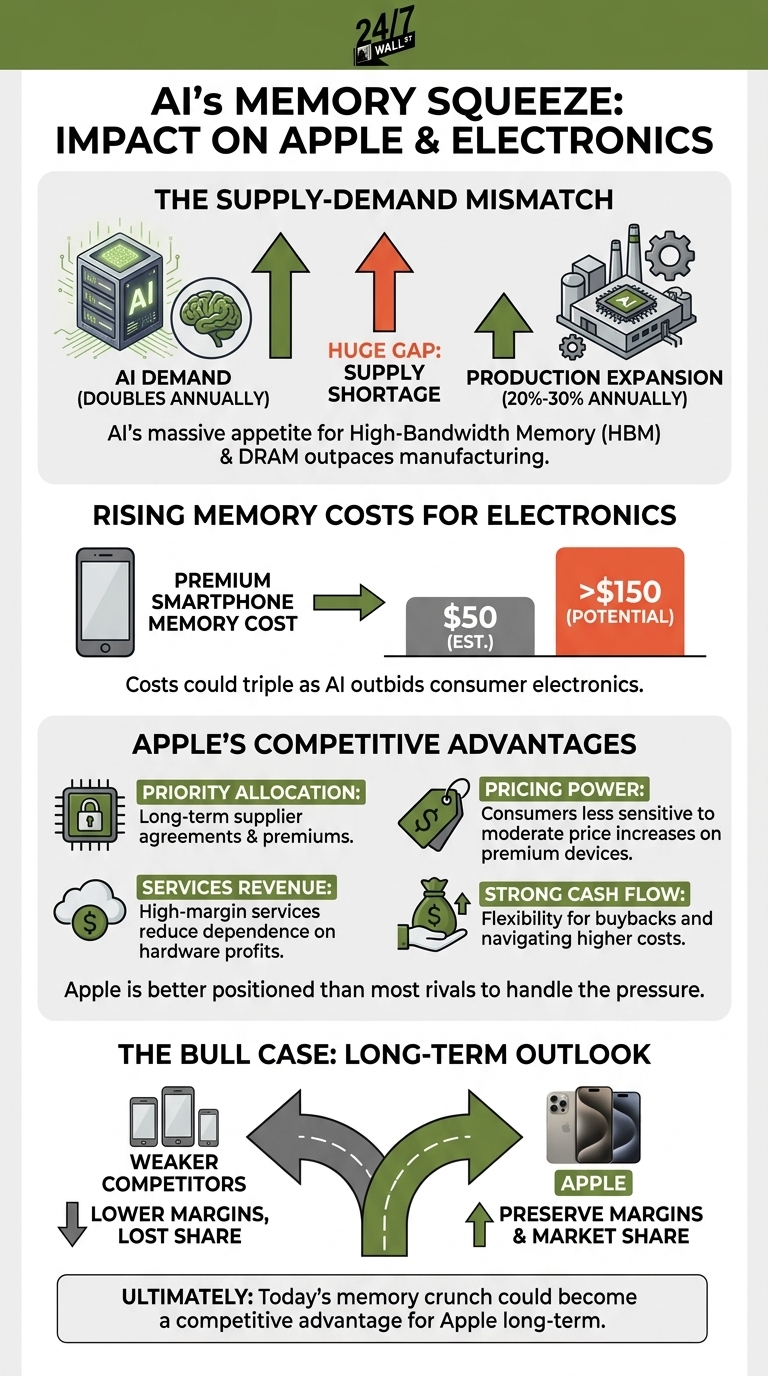
    A data-rich infographic explaining how the shortage of high-bandwidth memory for AI is driving up costs for electronics and positioning Apple for a competitive advantage.
    AI is devouring the global memory supply, threatening to triple smartphone costs and crush every tech giant except one.
    © 24/7 Wall St.

    The Bull Case Still Carries More Weight

    The bear case isn’t difficult to understand. Higher component costs could compress margins. More expensive iPhones could slow upgrade cycles. Global smartphone shipments are already expected to soften, particularly in lower-priced segments.

    Those are legitimate concerns. Ironically, though, the same forces hurting the broader smartphone market may strengthen Apple’s competitive position.

    Consumers purchasing premium devices are generally less sensitive to moderate price increases. Meanwhile, lower-margin competitors have fewer options when memory costs surge. They either accept lower profits or lose customers by raising prices.

    Apple also continues returning tens of billions of dollars to shareholders through buybacks while generating enormous free cash flow, giving management flexibility that many rivals simply don’t have.

    Granted, Apple trades at a premium valuation, meaning any sustained pressure on gross margins could create periods of stock volatility. 

    Key Takeaway

    In short, Patel’s warning deserves attention because it highlights an industrywide imbalance that may persist for years rather than quarters.AI’s appetite for memoryappears poised to outgrow manufacturing capacity, pushing costs higher across consumer electronics.

    For Apple, that creates near-term headwinds through higher component costs and potentially slower hardware sales. Yet the bullish case remains stronger. Apple’s premium brand, pricing power, supply chain scale, and rapidly growing services business make it one of the best-equipped consumer electronics companies to weather a prolonged memory shortage.

    Ultimately, if AI forces weaker hardware makers to retreat while Apple preserves margins and market share, today’s memory crunch could become less of a threat and more of a competitive advantage for long-term shareholders.

    Contact [email protected] for any questions or corrections.

    Consuming Memory Supply Worlds
    Share. Facebook Twitter Pinterest LinkedIn Tumblr Email
    Previous ArticleMillions of Driver’s License Numbers Exposed in Massive Data Breach
    Next Article Billionaire exodus? California drew 10 times more venture capital than any other state this year
    stamilhstgr0518@gmail.com
    • Website

    Related Posts

    Gadgets

    8 Cool Consumer Reports Approved Gadgets Under $50

    July 11, 2026
    Gadgets

    University of Chicago Law to ban phones, laptops in classroom for first

    July 11, 2026
    Gadgets

    Laptops, smartphones, gaming consoles get costlier as AI fuels chip demand: Report

    July 11, 2026
    Add A Comment
    Leave A Reply Cancel Reply

    Top Posts

    OpenAI’s head of safety is reportedly leaving as part of company reorganization

    July 11, 20261 Views

    Apple files lawsuit accusing ChatGPT maker OpenAI of stealing trade secrets

    July 11, 20260 Views

    SK Hynix rises 14% in debut on Wall Street as demand for memory chips soars

    July 11, 20260 Views
    Stay In Touch
    • Facebook
    • YouTube
    • TikTok
    • WhatsApp
    • Twitter
    • Instagram
    Latest Reviews
    Chatbots

    OpenAI bets on families as ChatGPT goes deeper into households

    stamilhstgr0518@gmail.comJuly 11, 2026
    Generative AI

    MUSIC COMMUNITY INTRODUCES NEW LABELING PROGRAM TO DISTINGUISH GENERATIVE AI IN SOUND RECORDINGS

    stamilhstgr0518@gmail.comJuly 11, 2026
    AI News

    Safe from AI: which jobs will help you thrive in the future?

    stamilhstgr0518@gmail.comJuly 11, 2026

    Subscribe to Updates

    Get the latest tech news from FooBar about tech, design and biz.

    Most Popular

    OpenAI’s head of safety is reportedly leaving as part of company reorganization

    July 11, 20261 Views

    Apple files lawsuit accusing ChatGPT maker OpenAI of stealing trade secrets

    July 11, 20260 Views

    SK Hynix rises 14% in debut on Wall Street as demand for memory chips soars

    July 11, 20260 Views
    Our Picks

    OpenAI bets on families as ChatGPT goes deeper into households

    July 11, 2026

    MUSIC COMMUNITY INTRODUCES NEW LABELING PROGRAM TO DISTINGUISH GENERATIVE AI IN SOUND RECORDINGS

    July 11, 2026

    Safe from AI: which jobs will help you thrive in the future?

    July 11, 2026

    Subscribe to Updates

    Get the latest creative news from FooBar about art, design and business.

    Facebook X (Twitter) Instagram Pinterest
    • About Us
    • Get In Touch
    • Disclaimer
    • Privacy Policy
    • Terms and Conditions
    © 2026 AIToday7. All Rights Reserved.

    Type above and press Enter to search. Press Esc to cancel.