

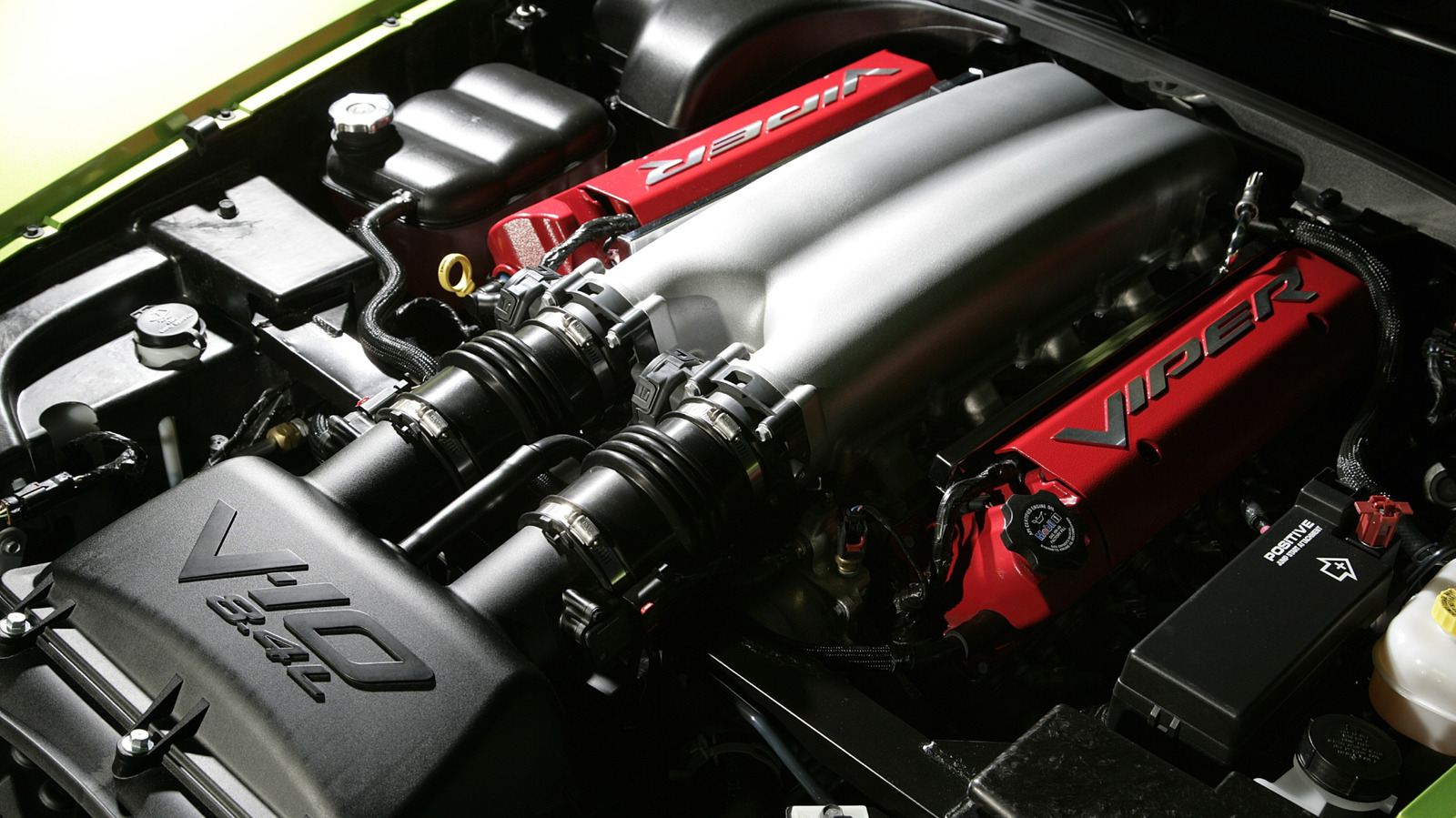
The Dodge (later SRT) Viper V10 is perhaps one of the most well-known V10s in automotive history. It’s up on the pantheon of 10-cylinder greats like the engines of the Lexus LFA and Lamborghini Gallardo. There was, however, another Dodge V10: the 10-cylinder version of the Magnum. It was available in the second-generation Dodge Ram 2500 and 3500 trucks and vans, which first debuted for the 1994 model year. Both engines existed at the same time, but they couldn’t be more different when it comes to architecture, power, and use cases.
It’s important to note that both the Viper and Magnum V10s are performance engines, but not for the same kind of performance. The original 8.0-liter Viper V10 was, obviously, meant for race track or otherwise more conventional performance, and it had 400 horsepower when it launched in 1992. The also 8.0-liter Magnum V10’s party trick was putting out an obscene amount of torque (for the mid-1990s) — 450 pound-feet to be exact. The Viper V10 was for speed; the Magnum V10 was for pulling.
Different construction and use cases
Now there’s the construction of both engines. The Viper engine, which was developed in the late 1980s into the early 1990s, was an all-aluminum design with cooling help from Lamborghini. As was the case with Magnum V8 engines like the 5.9-liter, the Magnum V10 was a cast-iron block. Cast iron might work for a utility truck that needs to pull a trailer, but it’s far too heavy of a material for a sports car as light as the Viper and not as good at dissipating heat.
Lastly, there are temporal differences. The Magnum V10 wasn’t around as long as the various permutations of the Viper V10. The next generation of Dodge Ram 2500, introduced for the 2004 model year, did away with the V10 altogether and instead started using the Hemi V8s that we all know and love today. By the last generation of Viper, the V10 had grown to 8.4 liters — bigger than a W16 engine in a Bugatti — and made 645 horsepower.
So while the Viper V10 and Magnum V10 are similarly sized, their totally different materials, application, and optimal use cases mean that the engines only share the basic V10 shape.
