

Key Takeaways
-
The DF-61 completed trial deployment and reliability checks before its public debut
-
The missile works with existing command, communications and logistics networks
-
China’s first domestically built missile, the DF-1, never entered operational service
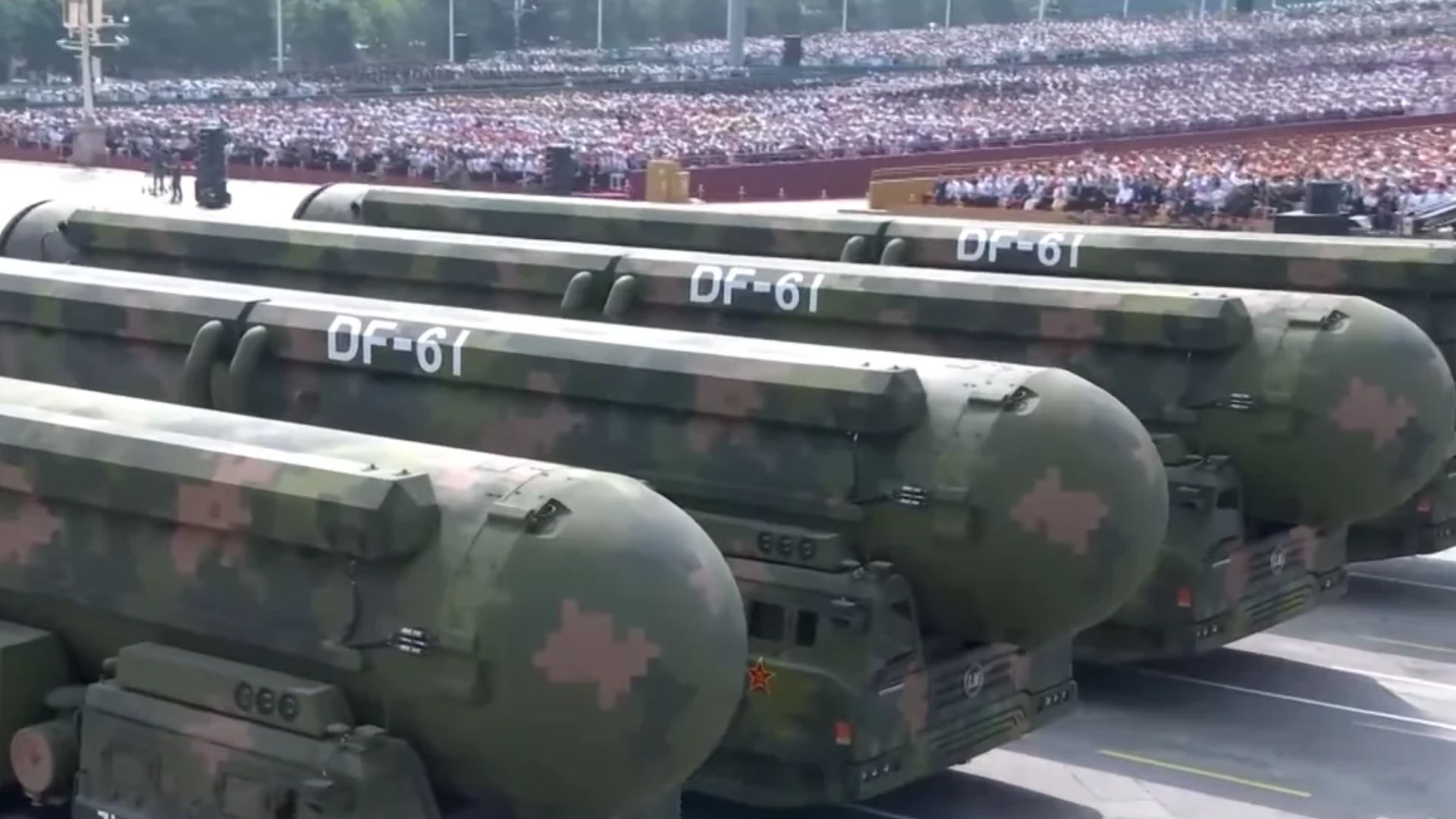
China’s People’s Liberation Army Rocket Force has inducted the DF-61 intercontinental ballistic missile and begun using it in routine training, state broadcaster China Central Television (CCTV) reported on November 5, 2026.
Military commentator Shao Yongling said the missile strengthens China’s land-based nuclear counterstrike capability by making it harder to destroy on the ground and better able to penetrate defenses.
The DF-61, claimed to have an estimated range of up to 9,300 miles, made its public debut at a military parade in Beijing on September 3, 2025. Shao said the transition from the parade to regular drills was unusually fast for an intercontinental ballistic missile.
She attributed the pace to development and testing completed before the unveiling and to the Rocket Force’s experience training crews on similar systems.
DF-61 completed key checks before its unveiling
“Firstly, this shows that it had already completed development, finalization, trial deployment and reliability verification before its appearance, indicating a high level of technological maturity,” Shao was quoted as saying in the CCTV report.
The DF-61 can use the Rocket Force’s existing command, communications and logistics networks, Shao said.
The service was also able to draw on its experience organizing exercises with other intercontinental ballistic missiles. Together, those factors helped units become familiar with the new equipment more quickly after they received it.
More from Military
See All
MilitaryUS Army successfully drops standard mortar from moving drones with new kit
MilitaryUS military’s 16,000-lb helicopter recovered from altitude of 10,000-foot in major rescue operation
MilitaryUS Navy to deploy 3,000-mph PAC-3 MSE interceptor on warships to hunt ballistic missiles
MilitarySubmarine-hunters with new modifications, advanced systems to boost US’ future battle power
Military72,000-ton British aircraft carrier launches attack drones in historic naval first
Rocket Force crews rehearse field operations
Shao said regular training with the DF-61 includes moving the missile system in the field, changing positions and rehearsing launch procedures. The drills cover both how crews maneuver the system and how they prepare it for launch.
Shao linked the missile’s rapid integration to the Rocket Force’s broader mandate to conduct nuclear and conventional operations and provide deterrence across multiple domains.
At the Beijing parade, the DF-61 appeared in the strategic strike formation alongside the air-launched Jinglei-1, or JL-1, the submarine-launched Julang-3, or JL-3, and the land-based DF-31BJ intercontinental ballistic missile. The display brought together missile systems launched from the air, sea and land.
A milestone 66 years after the DF-1 launch
CCTV reported the DF-61’s induction on the 66th anniversary of China’s first successful launch of a domestically manufactured short-range surface-to-surface missile.
The missile, initially designated 1059 and later named the DF-1, lifted off from the Jiuquan missile test site in the Gobi Desert on November 5, 1960.
China reverse-engineered the DF-1 from the Soviet Union’s R-2 missile. The DF-1 never entered operational service, but developing and testing it gave China technical expertise, infrastructure and institutional experience that carried over into later missile programs, Shao said.
That experience supported China’s subsequent “Eight Years, Four Missiles” development plan and helped lay the groundwork for the independently developed DF-2.
Shao said the early work also supported efforts to fit nuclear warheads to missiles and eventually to develop intercontinental and submarine-launched weapons.
Six decades after the DF-1’s first test flight, Rocket Force crews are now training with a domestically developed missile built to reach intercontinental distances.
Atharva is a full-time content writer with a post-graduate degree in media & amp; entertainment and a graduate degree in electronics & telecommunications. He has written in the sports and technology domains respectively. In his leisure time, Atharva loves learning about digital marketing and watching soccer matches. His main goal behind joining Interesting Engineering is to learn more about how the recent technological advancements are helping human beings on both societal and individual levels in their daily lives.
- 1US launches new Super Intelligence Task Force to protect American tech leadership
- 2US military’s 16,000-lb helicopter recovered from altitude of 10,000-foot in major rescue operation
- 3US Navy to deploy 3,000-mph PAC-3 MSE interceptor on warships to hunt ballistic missiles
- 4Submarine-hunters with new modifications, advanced systems to boost US’ future battle power
- 572,000-ton British aircraft carrier launches attack drones in historic naval first
