


Key Takeaways
-
The system also incorporates an integrated diesel generator, providing up to four days of independent operation between refueling.
-
This allows RD-SUADS to function at remote locations where conventional electrical infrastructure may be unavailable.
-
Trust Automation built it to be shipped and set up quickly without relying on local power.
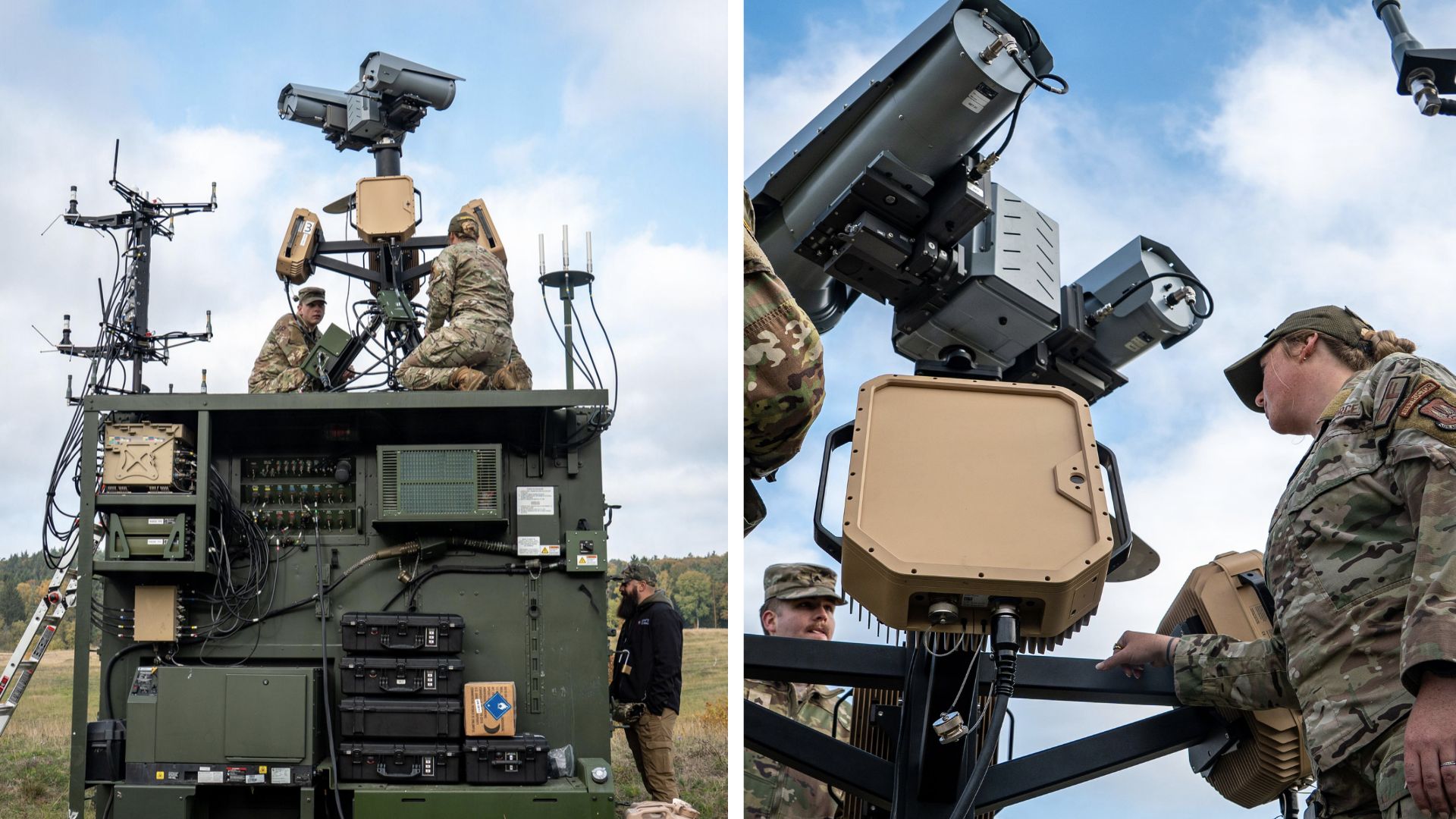
Soldiers in the United States are testing rapidly deployable counter-drone systems. They trained on Trust Automation’s Rapidly Deployable Small-Unmanned Air Defense System, or RD-SUADS, a palletized counter-drone system.
RD-SUADS is the air-transportable member of Trust Automation’s Small-Unmanned Air Defense System family, designed to detect, track, identify and defeat small drones at bases and deployed sites. The company built it to be shipped and set up quickly without relying on local power.
Counter drone system can fit on standard 463L military cargo pallet
One of the most significant features of RD-SUADS is its compact, palletized configuration. The entire system is designed to fit on a standard 463L military cargo pallet, allowing it to be transported aboard military aircraft such as the C-130 Hercules and C-17 Globemaster III.
This configuration significantly simplifies transportation and deployment, enabling U.S. forces to move counter-drone capabilities to operational locations without requiring specialised transport arrangements.
The system also incorporates an integrated diesel generator, providing up to four days of independent operation between refueling. This allows RD-SUADS to function at remote locations where conventional electrical infrastructure may be unavailable.
“Soldiers and Airmen at Grafenwoehr Training Area are assessing how multi-service training can strengthen the response to evolving unmanned aircraft system threats. Train together. Adapt faster. Build readiness,” said the U.S. Army in a post on X.
Counter drone system has integrated diesel generator
Promoting combat agility, this C‑sUAS is a self-contained, self-powered system that fits within a 463L pallet, enabling easy transport via military aircraft. Equipped with an integrated diesel generator with standalone operational capacity for four days between refueling. Additionally, the shore power interface allows sites with power infrastructure operate the system utilizing standard DoD generator connections and base power connections.
For deployment at permanent military installations, the fixed-site C-sUAS tower can be integrated as a group or for smaller bases be standalone enabling diverse base protection and 360-degree security. The base command located SUADS server manages all base C-sUAS sensors, fuses their data into a common operating picture, and allows various mitigation techniques to be activated for a layered base defense solution.
Recently, the U.S. military announced the successful completion of a U.S. Army operational assessment of its Small-Unmanned Air Defense System (SUADS).
Trust Automation’s SUADS detected and engaged UAS between approximately two and six kilometers away, with potential coverage extending to approximately seven kilometers under favorable conditions. Defeat effectiveness exceeded approximately 75 to 80 percent, while operator observations indicated the system was even more effective at preventing hostile UAS from successfully completing their missions. Interview participants were also not aware of any enemy UAS that penetrated the defended area as a threat within the identified operational ranges without first being detected by the system.
“UAS are increasingly being used to find, track and target forces on the battlefield, making early awareness critical to protecting soldiers and keeping operations moving,” said MAJ Patrick Smith, Battalion Executive Officer. “The system consistently provided layered surveillance, early warning, positive target identification, and electronic defeat of hostile UAS before enemy systems could successfully conduct reconnaissance, target acquisition, or attack missions.”
More from Military
See All
MilitaryUS military bases gear up for major war, plan to survive 90 days cut off from critical supply
MilitaryUS Navy warship power systems to get zero-trust shield to protect fleet from cyberattacks
Military71,600-ton aircraft carrier trains Chinook helicopters for heavy-lift missions at sea
MilitaryUncrewed MQ-9B tests long-range radar to track multiple aircraft and maritime targets
Military24,000-ton nuclear-powered submarine fires 5,160-mile-range missile while submerged
Get the latest in engineering, tech, space & science – delivered daily to your inbox.
By subscribing, you agree to ourTerms of UseandPolicies
You may unsubscribe at any time.
Subscribe to
Today!
Access to exclusive content, expert insights and a deeper dive into engineering and tech. No ads, no limits.
Explore Now!
ByPrabhat Ranjan Mishra
Prabhat, an alumnus of the Indian Institute of Mass Communication, is a tech and defense journalist. While he enjoys writing on modern weapons and emerging tech, he has also reported on global politics and business. He has been previously associated with well-known media houses, including the International Business Times (Singapore Edition) and ANI.
- 115 MW microreactor deployment in US advances as Hyundai partners with NANO Nuclear
- 2New catalyst matches platinum in hydrogen production using 75% less metal
- 3Solar planes at 60,000 feet could fly for months with 500 Wh/kg batteries: US study
- 4Massive 442-foot tunneling machine building world’s longest undersea railway tunnel
- 524,000-ton nuclear-powered submarine fires 5,160-mile-range missile while submerged
