

Add preferred source
As AI-driven HBM capacity expansion sharply cuts general-purpose DRAM supply, DDR4 contract prices have jumped 24% over three months, outpacing DDR5 gains. Big Tech is scaling back specs—Tesla is weighing reduced memory capacity for its next-gen chips. HBM designs with fewer stacked layers are boosting demand for logic base dies, a windfall for foundries. Samsung Electronics will break ground on Taylor Fab 2 in Texas in November, targeting 2030 mass production. Samsung and SK Hynix posted record quarterly results, but warnings that the supply imbalance could persist through 2029—and China’s CXMT closing the gap—remain key variables.
Key Elements
As global fab capacity converges on expanding high-bandwidth memory (HBM) for AI accelerators, the general-purpose DRAM market is facing a supply cliff. The fallout is surfacing in unexpected places. Contract prices for the older DDR4 standard are rising faster than those for the latest DDR5, and Big Tech companies unable to secure memory are even considering “de-speccing”—deliberately lowering their own product specifications. Paradoxically, these design changes are increasing demand for logic base dies and opening new opportunities for the foundry industry.
According to a Barclays report, DDR4 contract prices jumped 24% over the past three months, outpacing the 20% gain in DDR5 over the same period. That is the exact opposite of the normal cycle, in which older products get cheaper once a new standard takes hold in the market. The cause: major suppliers—South Korea’s Samsung Electronics (005930), South Korea’s SK Hynix (000660) and Micron—have sharply cut mature DRAM production lines as they pour wafers into HBM and cutting-edge server products.
The shortage is pushing automakers and finished IT-product
The shortage is pushing automakers and finished IT-product manufacturers to the brink. A representative case is Tesla CEO Elon Musk weighing a reduction in the memory capacity for the company’s next-generation autonomous-driving chip, AI5. This is less a simple cost-cutting move than a forced downgrade because the volumes available in the market simply aren’t sufficient. In the long-term supply contract market, the buffers between price ceilings and floors are collapsing, and spot price increases are clearly being passed through to contract unit prices.
Global financial firms warn that the memory supply-demand imbalance ratio will peak at 13.9% in the fourth quarter of 2027 and that the supply crunch could last through 2029. That means the de-speccing that constrains performance improvements in finished products could drag on for a long time.
HBM with Fewer Stacked Layers Directly Drives Logic Die Demand
The design changes brought on by the DRAM shortage and soaring prices are handing the foundry business a clue to a rebound. Global Big Tech companies developing next-generation AI accelerators are simultaneously pursuing designs with fewer stacked layers—8 or 12—to avoid the procurement costs and supply constraints of ultra-high-layer products.
To hit the same total memory system capacity,
To hit the same total memory system capacity, more HBM packages must be installed to make up for the lower layer count. That leads to an explosion in physical demand for the logic base die, which controls communications at the very bottom of the package. In particular, starting with sixth-generation HBM4, cutting-edge 4-nanometer-class logic processes are mandatory for base die production, sharply increasing foundry wafer input per finished unit.
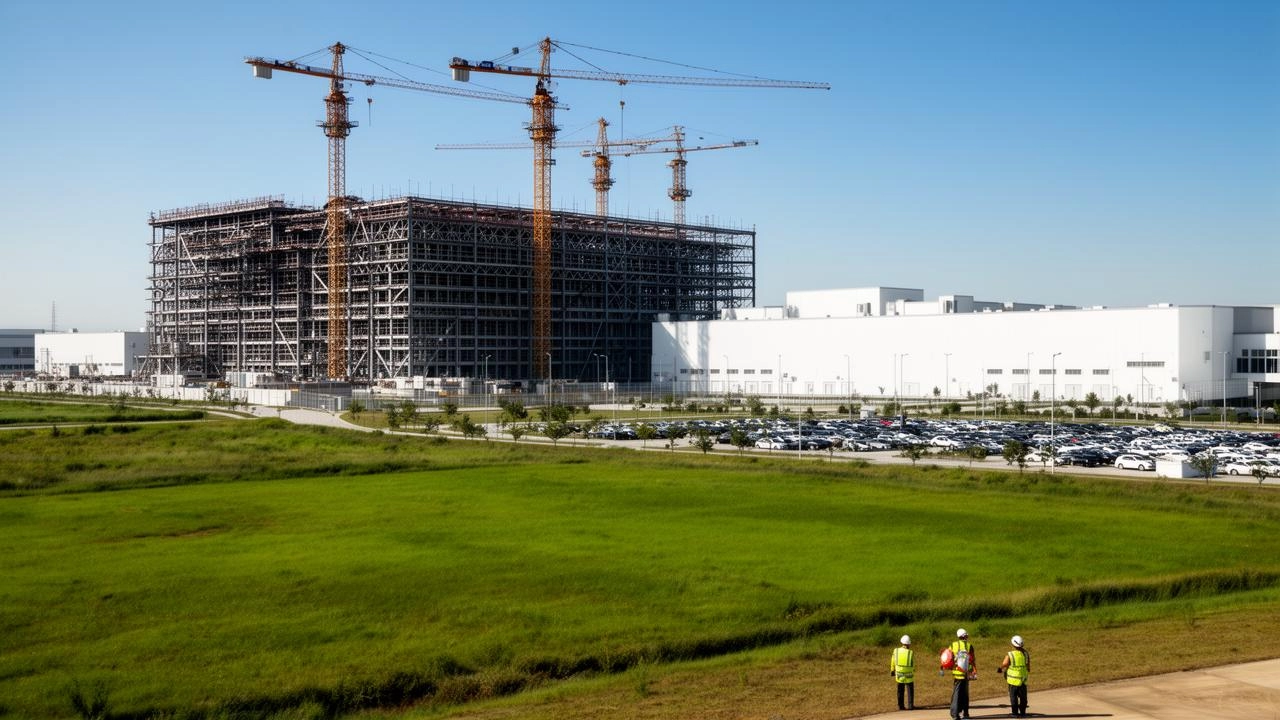
To capture this order opportunity, Samsung Electronics will begin construction in earnest in November on Taylor Fab 2, its second foundry production facility, in Taylor, Texas. Fab 2, to be built on a site adjacent to the existing Fab 1 at roughly 1.5 times its size, aims for mass production in 2030 and is designed to absorb demand for AI and high-performance computing (HPC) chips. Samsung’s total investment in the Taylor site is $37 billion.
With Fab 1, now preparing to start operations, ready to ramp 2-nanometer process utilization on the back of Tesla’s next-generation AI6 chip volumes, securing orders from the likes of AMD and Qualcomm—with which memory supply linkage is under discussion—and strategic partner Broadcom is seen as the key task for Fab 2. As talks accelerate on 3D stacked DRAM, which vertically combines memory directly atop the processor, and zHBM, Samsung’s turnkey competitiveness—handling everything from DRAM design to cutting-edge foundry logic die production and advanced packaging in one stop—is emerging as a weapon to sustain fab utilization and defend integrated delivery pricing. Some observers say stabilizing 2-nanometer process yields early to secure large Big Tech volumes in practice will be the watershed for a foundry swing to profit.
Supply Crunch Drives Results, but Longevity Is an Open Question
For now, the scorecard points to a boom
For now, the scorecard points to a boom. Samsung Electronics reported preliminary third-quarter consolidated revenue of 195 trillion won (approximately $147.1 billion) and operating profit of 107.4 trillion won (approximately $81.0 billion). Operating profit rose 782.5% from a year earlier, the largest ever for a quarter. SK Hynix also posted record quarterly results with second-quarter revenue of 79.3187 trillion won (approximately $59.8 billion) and operating profit of 60.5426 trillion won (approximately $45.7 billion), and is expected to exceed that in the third quarter.
The supply crunch also delivered record results to Taiwanese DRAM makers. Nanya Technology, which has been increasing DDR4 supply, saw third-quarter revenue of NT$133.649 billion (approximately $4.1 billion), more than six times the year-earlier level, while net profit hit a record quarterly high of NT$87.627 billion (approximately $2.7 billion). The share of AI-related revenue also topped 20%.
| Item | Figure |
|---|---|
| DDR4 contract price gain (past 3 months) | 24% |
| DDR5 contract price gain (past 3 months) | 20% |
| Projected peak in memory supply-demand imbalance | 13.9% in Q4 2027 |
| Taylor Fab 2 groundbreaking | November 2026 |
| Taylor Fab 2 mass production target | 2030 |
Note: DDR4 and DDR5 gains are based on the Barclays report; the supply-demand imbalance forecast is based on estimates from global financial firms.
Behind the earnings improvement are expanding sales
Behind the earnings improvement are expanding sales of high-value-added AI memory and broad-based memory price increases. As DRAM makers prioritize allocating capacity to high-performance server products, DRAM supply for other uses has tightened, and NAND flash prices are also on the rise as demand for enterprise SSDs for AI data centers grows. TrendForce forecast that general-purpose DRAM contract prices will rise 10-15% in the fourth quarter from the prior quarter, with NAND flash up 15-20%.
The NAND price rally was also evident in the results of Japan’s Kioxia. Kioxia Holdings’ revenue for the April-June 2026 period was ¥1.7671 trillion (approximately $11.3 billion), more than five times the year-earlier level, while operating profit was ¥1.27 trillion (approximately $8.1 billion) and net profit ¥842.1 billion (approximately $5.4 billion), all record highs. Its operating margin reached about 72%.
With suppliers holding the upper hand, securing memory has become a major challenge even for Big Tech such as Apple and Tesla. Musk, during SpaceX’s earnings presentation, cited memory as a constraint on the business and said memory production is growing 20% a year while demand is surging more than 200%. AMD CEO Lisa Su’s meeting with the semiconductor chiefs of Samsung Electronics and SK Hynix during her visit to South Korea in early October is also seen as part of efforts to build high-performance memory partnerships.
Forecasts of higher profits and the judgment
Still, forecasts of higher profits and the judgment that current high profitability will be sustained over the long term are two different things. The key question is how long the supply shortage and pricing power advantage will last. SK Securities assessed that expanding long-term supply contracts will raise the price floor and reduce earnings volatility, while BNK Investment & Securities cautioned that high memory prices will prompt customers to cut their content per device and that future capacity additions could outstrip demand.
Some argue that to gauge the longevity of the supercycle, attention must shift from supplier earnings to customer profitability. Data center investment boosts chipmaker revenue but leaves Big Tech with the task of earning back its AI investment. If AI service revenue fails to keep pace with infrastructure investment, server deployment schedules could be adjusted and memory orders affected.
China’s pursuit complicates the calculation further. CXMT, China’s largest DRAM maker, has said it will launch server products using a next-generation DRAM structure by the end of the year. In the second quarter, global DRAM revenue share stood at 39.4% for Samsung Electronics, 24.9% for SK Hynix, 23.3% for Micron and 9.5% for CXMT. Yangtze Memory Technologies (YMTC), China’s largest NAND maker, has risen to third place in global NAND shipments, chasing Samsung Electronics and SK Hynix. Musk, after publicly criticizing memory makers’ pricing, noted that China will produce enormous amounts of RAM by 2028, hinting at the possibility of using alternative suppliers.
Semiconductor stocks also wobbled as questions arose about future profitability. From October 12-16, Samsung Electronics shares fell 17.8% and SK Hynix 24.3%, both posting their biggest weekly declines since the 2008 financial crisis. Still, some say it is premature to treat China’s technology announcements as an immediate supply shock. Kim Dong-won, head of research at KB Securities, said the DRAM process technology gap between Samsung Electronics and CXMT amounts to five to seven years based on mass-production timing, and that the 4F² structure DRAM CXMT unveiled demonstrates technological progress but is premature to interpret as securing real market competitiveness.
