
Artificial intelligence is transforming countless fields, and mathematics is no exception. AI is now tackling problems once thought beyond its reach, prompting mathematicians to consider how the discipline, and their role in it, will evolve alongside this rapidly advancing technology.
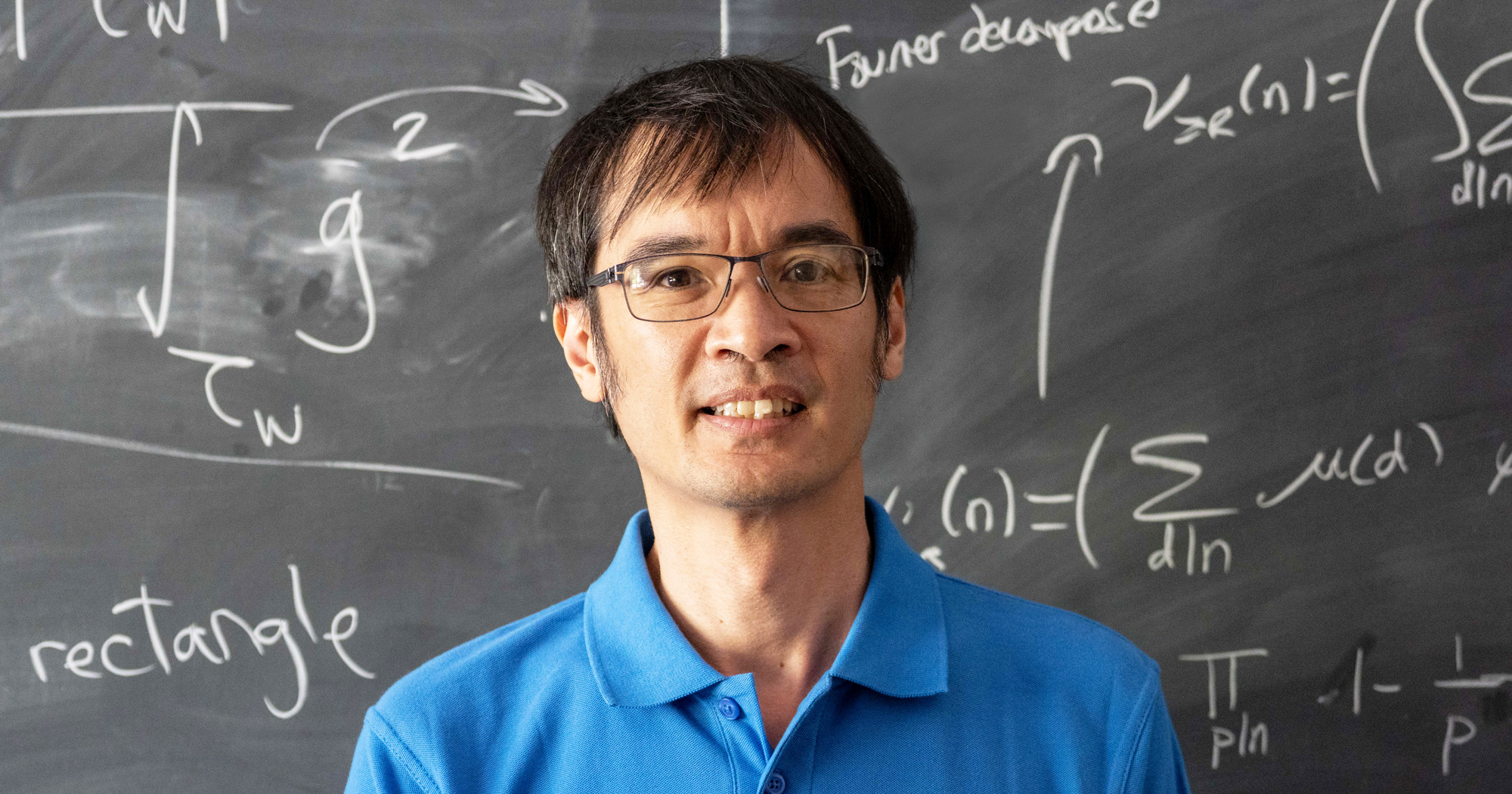
At July’s <a href="https://www.icm2026.org/event/ac193975-5d24-4628-8c30-ddb23de19a8b/HOME?environment=P2″ rel=”nofollow noopener” target=”_blank”>International Congress of Mathematicians in Philadelphia, 2006 Fields Medalist and UCLA mathematician Terence Tao reflected on this pivotal moment for the field during a talk titled “Mathematics in the Age of AI.” While many conversations center on how good AI will become, Tao argued that we need to ask a more philosophical question.
“Let’s assume that soon, AI will be able to perform a reasonable fraction of mathematical tasks successfully,” he said. “If you condition for that, it becomes clear that we now have to think about our goals and our values.”
In short: Why do we do mathematics? And what counts as successful mathematics?
For his talk, Tao focused on a single aspect of mathematics: problem solving. While there is much more to mathematics than simply toiling away at a stack of unsolved problems, Tao chose to focus on this facet of the work because it is the area AI has impacted most.
To Tao, problem solving occurs in several different stages. First, there is providing and verifying a proof. AI, he said, is pretty good at this. Large models can often produce candidate proofs or crucial ideas, and AI systems can rigorously check very long or intricate proofs. The problem occurs in the next stage of the process, in which humans evaluate and explain the proof.
“We can have these 100,000-line proofs that we have to verify, but no one understands them,” he said. “Even the humans who entered in the prompts to generate the proofs might not understand them. It is not enough to generate and verify the proofs. The proofs need to be explained well enough that they can be communicated and understood by the community.”
If no one understands a proof, the likelihood of it reaching the next stage of problem solving, community acceptance, becomes very slim. A successful result, Tao argued, is one that other people value and want to use in their work. AI might be good at finding a result, but it doesn’t always provide the context that will make people care.
“You can induce people to read your work. Telling good stories helps. Showing the process and describing how you arrived at a result — what worked, what didn’t and how you went about it,” he said. “In the past, we didn’t emphasize the process. We let the outcomes speak for themselves. This worked until we figured out a way to automate outcomes without process. Current [AI] tools are very opaque about their process.”
Tao argued that without all these previous steps, a result can’t make it to the epitome of success — canonicalization. In other words, making it into a textbook.
“If you want a field of math to become useful to engineers or physicists or others, they’re not going to dig through the most recent papers in the Annals of Mathematics,” he said. “They want the textbooks. The most valuable applications of math only get unlocked once you have reached this kind of state.”
AI itself, he noted, wouldn’t exist without these textbooks.
“A big reason why AI is so successful in mathematics is because, for centuries, we’ve been building these canonical definitions,” said Tao. “We have all these very mature theories and textbooks, and that’s what AI uses for its success.”
So where do we go from here? Tao encourages the mathematics community to continue discussing their goals and values regarding problem solving, education, publication and community culture. Most importantly, he challenges mathematicians to lead — rather than passively react to — the integration of AI into mathematics.
“There will be some places where we should use AI, but we should take initiative and decide what those are,” he said. “We set the rules on what’s acceptable or not, and we should not let external actors define those for us.”
About the International Congress of Mathematicians
The ICM is the most important and prestigious conference in the mathematical community, hosted every four years by the International Mathematical Union. The 2026 congress, which ran from July 23 to July 30 in Philadelphia, featured hundreds of invited talks, panels and presentations on cutting-edge developments across mathematics.
