

Abstract
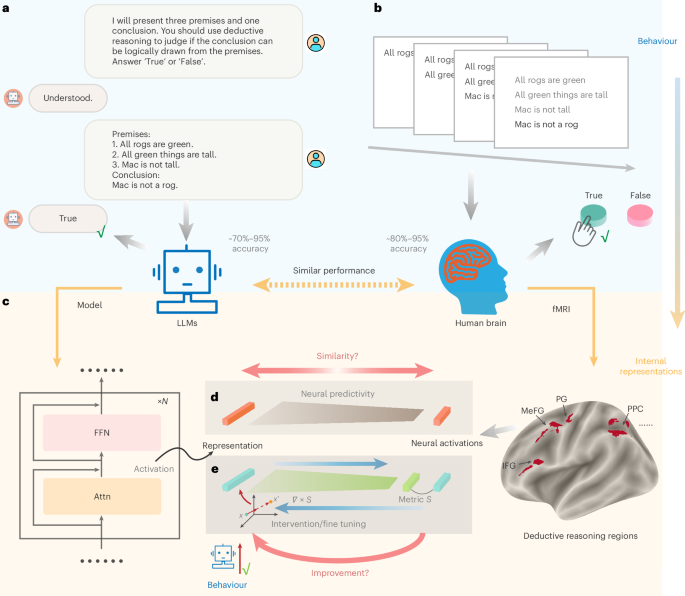
The correspondence between large language models (LLMs) and the neural mechanisms underlying human higher-order cognition remains insufficiently characterized. Given that language and reasoning in the human brain appear dissociable, an open question is whether LLMs align with neural signals from reasoning-related regions and whether such signals can improve them. Here, focusing on deductive reasoning, we show that LLM internal representations are not only partially aligned with task-based functional magnetic resonance imaging activity but can also be directly enhanced by these signals. Using a neural predictivity metric, we find that LLMs explain a substantial fraction of the explainable variance in reasoning-related regions at the aggregate level, whereas predictivity within specific reasoning types is lower, indicating both alignment and divergence. Building on this, we propose a brain-guided framework: we steer model representations along directions induced by the joint structure of model and brain representations, applying intervention at inference and fine tuning during training. We demonstrate that task-evoked brain signals can directly enhance LLM reasoning, yielding gains orthogonal to language-only supervision across ten LLMs (1.5B–72B parameters), with transfer across reasoning types and up to 13% absolute accuracy gain. Our results advance LLM–brain correspondences from correlation to guidance, establishing a brain-signal-driven pathway towards more robust and cognitively aligned artificial intelligence.
This is a preview of subscription content, access
Access options
- Purchase on SpringerLink
- Instant access to the full article PDF.
Prices may be subject to local taxes which are calculated during checkout
Subjects
- Cognitive neuroscience
- Computational science
- Learning algorithms
Data availability
All the datasets used in this Article are publicly available or generated by the code. The fMRI dataset of deductive reasoning is available via OpenNeuro at https://openneuro.org/datasets/ds003076. The fMRI dataset of Human Connectome Project relational processing task is available on www.humanconnectome.org. The generated data are available via GitHub at https://github.com/pkuxmq/Brain-guided_LLM and via Zenodo at https://doi.org/10.5281/zenodo.19536182 (ref. 66). Source data are provided with this paper.
Code availability
The implementation code is available Zenodo at https://doi.org/10.5281/zenodo.19536182 (ref. 66)
References
-
Wei, J. et al. Emergent abilities of large language models. Trans. Mach. Learn. Res. (2022).
-
Wei, J. et al. Chain-of-thought prompting elicits reasoning in large language models. In Proc. Advances in Neural Information Processing Systems 24824–24837 (Curran Associates, 2022).
-
Webb, T., Holyoak, K. J. & Lu, H. Emergent analogical reasoning in large language models. Nat. Hum. Behav.7, 1526–1541 (2023).
-
Saparov, A., Pang, R. Y., Padmakumar, V., Joshi, N. & Kazemi, M. Testing the general deductive reasoning capacity of large language models using OOD examples. In Proc. Advances in Neural Information Processing Systems 3083–3105 (Curran Associates, 2023).
-
Rips, L. J. The Psychology of Proof: Deductive Reasoning in Human Thinking (MIT Press, 1994).
-
Prado, J., Chadha, A. & Booth, J. R. The brain network for deductive reasoning: a quantitative meta-analysis of 28 neuroimaging studies. J. Cogn. Neurosci.23, 3483–3497 (2011).
-
Tarski, A. Introduction to Logic and to the Methodology of the Deductive Sciences (Oxford Univ. Press, 1994).
-
Monti, M. M., Parsons, L. M. & Osherson, D. N. The boundaries of language and thought in deductive inference. Proc. Natl Acad. Sci. USA106, 12554–12559 (2009).
-
Fedorenko, E., Piantadosi, S. T. & Gibson, E. A. F. Language is primarily a tool for communication rather than thought. Nature630, 575–586 (2024).
-
Seals, S. & Shalin, V. Evaluating the deductive competence of large language models. In North American Chapter of the Association for Computational Linguistics: Human Language Technologies (NAACL-HLT) 8614–8630 (2024).
-
Mitchell, M. & Krakauer, D. C. The debate over understanding in AI’s large language models. Proc. Natl Acad. Sci. USA120, e2215907120 (2023).
-
Gurnee, W. & Tegmark, M. Language models represent space and time. In Proc. International Conference on Learning Representations 2483–2503 (2024).
-
Mahowald, K. et al. Dissociating language and thought in large language models. Trends Cogn. Sci.28, 517–540 (2024).
-
Chen, X., Chi, R. A., Wang, X. & Zhou, D. Premise order matters in reasoning with large language models. In Proc. Forty-first International Conference on Machine Learning 6596–6620 (PMLR, 2024).
-
Malek, A. et al. Frontier LLMs still struggle with simple reasoning tasks. Preprint at https://arxiv.org/abs/2507.07313 (2025).
-
Schrimpf, M. et al. Brain-Score: which artificial neural network for object recognition is most brain-like? Preprint at bioRxivhttps://doi.org/10.1101/407007 (2018).
-
Yamins, D. L. K. et al. Performance-optimized hierarchical models predict neural responses in higher visual cortex. Proc. Natl Acad. Sci. USA111, 8619–8624 (2014).
-
Schrimpf, M. et al. The neural architecture of language: integrative modeling converges on predictive processing. Proc. Natl Acad. Sci. USA118, e2105646118 (2021).
-
Zhuang, C. et al. Unsupervised neural network models of the ventral visual stream. Proc. Natl Acad. Sci. USA118, e2014196118 (2021).
-
Wang, A. Y., Kay, K., Naselaris, T., Tarr, M. J. & Wehbe, L. Better models of human high-level visual cortex emerge from natural language supervision with a large and diverse dataset. Nat. Mach. Intell.5, 1415–1426 (2023).
-
Caucheteux, C. & King, J. Brains and algorithms partially converge in natural language processing. Commun. Biol.5, 134 (2022).
-
Goldstein, A. et al. Shared computational principles for language processing in humans and deep language models. Nat. Neurosci.25, 369–380 (2022).
-
Kumar, S. et al. Shared functional specialization in transformer-based language models and the human brain. Nature Communications15, 5523 (2024).
-
Goldstein, A. et al. A unified acoustic-to-speech-to-language embedding space captures the neural basis of natural language processing in everyday <a href="https://aitoday7.com/how-to-keep-your-conversations-with-chatgpt-gemini-copilot-or-claude-as-private-as-possible/” title=”How to keep your conversations with ChatGPT, Gemini, Copilot or Claude as private as possible”>conversations. Nat. Hum. Behav.9, 1041–1055 (2025).
-
Du, C. et al. Human-like object concept representations emerge naturally in multimodal large language models. Nat. Mach. Intell.7, 860–875 (2025).
-
Tuckute, G. et al. Driving and suppressing the human language network using large language models. Nat. Hum. Behav.8, 544–561 (2024).
-
Li, Z. et al. Learning from brains how to regularize machines. In Proc. Advances in Neural Information Processing Systems 9529–9539 (Curran Associates, 2019).
-
Dapello, J. et al. Aligning model and macaque inferior temporal cortex representations improves model-to-human behavioral alignment and adversarial robustness. In Proc. The Eleventh International Conference on Learning Representations (2023).
-
Moussa, O., Klakow, D. & Toneva, M. Improving semantic understanding in speech language modelsRepresentations 59823–59849 (2025)
-
Yang, A. et al. Qwen2 technical report. Preprint at https://arxiv.org/abs/2407.10671 (2024).
-
Yang, A. et al. Qwen3 technical report. Preprint at https://arxiv.org/abs/2505.09388 (2025).
-
Touvron, H. et al. Llama 2: open foundation and fine-tuned chat models. Preprint at https://arxiv.org/abs/2307.09288 (2023).
-
Dubey, A. et al. The Llama 3 herd of models. Preprint at https://arxiv.org/abs/2407.21783 (2024).
-
Jiang, A. Q. et al. Mistral 7B. Preprint at https://arxiv.org/abs/2310.06825 (2023).
-
Abouelenin, A. et al. Phi-4-mini technical report: compact yet powerful multimodal language models43 (2025)
-
Gemma Team et al. Gemma 2: improving open language models at a practical size. Preprint at https://arxiv.org/abs/2408.00118 (2024).
-
AlKhamissi, B., Tuckute, G., Bosselut, A. & Schrimpf, M. The LLM language network: a neuroscientific approach for identifying causally task-relevant units. In Proc. 2025 Conference of the North American Chapter of the Association for Computational Linguistics: Human Language Technologies (Volume 1: Long Papers) 10887–10911 (Association for Computational Linguistics, 2025).
-
AlKhamissi, B., Tuckute, G., Tang, Y. et al. From language to cognition: how LLMs outgrow the human language network. In Proc. 2025 Conference on Empirical Methods in Natural Language Processing 24321–24339 (Association for Computational Linguistics, 2025).
-
Duncan, J. The multiple-demand (MD) system of the primate brain: mental programs for intelligent behaviour. Trends Cogn. Sci.14, 172–179 (2010).
-
Vaswani, A. et al. Attention is all you need. In Proc. Advances in Neural Information Processing Systems 5998–6008 (Curran Associates, 2017).
-
Templeton, A. et al. Scaling monosemanticity: extracting interpretable features from Claude 3 Sonnet. Transformer Circuits Thread (2024).
-
Højer, B., Jarvis, O. S. & Heinrich, S. Improving reasoning performance in large language modelsional Conference on Learning Representations (2025)
-
Tan, D., Chanin, D., Lynch, A., Paige, B. & Kanoulas, D. Analysing the generalisation and reliability of steering vectors. In Proc. Advances in Neural Information Processing Systems 139179–139212 (Curran Associates, 2024).
-
Da Silva, P. Q., Sethuraman, H., Rajagopal, D., Hajishirzi, H. & Kumar, S. Steering off course: Reliability challenges in steering language models. In Proc. 63rd Annual Meeting of the Association for Computational Linguistics (Volume 1: Long Papers) 19856–19882 (Association for Computational Linguistics, 2025).
-
Guo, D. et al. DeepSeek-R1 incentivizes reasoning in LLMs through reinforcement learning. Nature645, 633–638 (2025).
-
Han, S. et al. FOLIO: natural language reasoning with first-order logic. In Proc. 2024 Conference on Empirical Methods in Natural Language Processing 22017–22031 (Association for Computational Linguistics, 2024).
-
Van Essen, D. C. et al. The WU-Minn human connectome project: an overview. NeuroImage80, 62–79 (2013).
-
Li, K., Hopkins, A. K., Bau, D., Viégas, F. & Wattenberg, M. Emergent world representations: exploring a sequence model trained on a synthetic task. In Proc. The Eleventh International Conference on Learning Representations (2023).
-
Binz, M. et al. A foundation model to predict and capture human cognition. Nature644, 1002–1009 (2025).
-
Lytle, M. N., Prado, J. & Booth, J. R. A neuroimaging dataset of deductive reasoning in school-aged children. Data Brief33, 106405 (2020).
-
Roy, K., Jaiswal, A. & Panda, P. Towards spike-based machine intelligence with neuromorphic computing. Nature575, 607–617 (2019).
-
Rao, A., Plank, P., Wild, A. & Maass, W. A long short-term memory for AI applications in spike-based neuromorphic hardware. Nat. Mach. Intell.4, 467–479 (2022).
-
Hasani, R. et al. Closed-form continuous-time neural networks. Nat. Mach. Intell.4, 992–1003 (2022).
-
Kudithipudi, D. et al. Biological underpinnings for lifelong learning machines. Nat. Mach. Intell.4, 196–210 (2022).
-
Wang, L. et al. Incorporating neuro-inspired adaptability for continual learning in artificial intelligence. Nat. Mach. Intell.5, 1356–1368 (2023).
-
Xiao, M., Meng, Q., Zhang, Z., He, D. & Lin, Z. Hebbian learning based orthogonal projection for continual learning of spiking neural networks. In Proc. The Twelfth International Conference on Learning Representations (2024).
-
Achterberg, J., Akarca, D., Strouse, D. J., Duncan, J. & Astle, D. E. Spatially embedded recurrent neural networks reveal widespread links between structural and functional neuroscience findings. Nat. Mach. Intell.5, 1369–1381 (2023).
-
Huh, M., Cheung, B., Wang, T. & Isola, P. Position: the Platonic representation hypothesis. In Proc. 41st International Conference on Machine Learning 20617–20642 (PMLR, 2024).
-
Schwartz, D., Toneva, M. & Wehbe, L. Inducing brain-relevant bias in natural language processing models. In Proc. Advances in Neural Information Processing Systems 14123–14133 (Curran Associates, 2019).
-
Strachan, J. W. A. et al. Testing theory of mind in large language models and humans. Nat. Hum. Behav.8, 1285–1295 (2024).
-
Zhu, W., Zhang, Z. & Wang, Y. Language models represent beliefs of self and others. In Proc. 41st International Conference on Machine Learning 62638–62681 (PMLR, 2024).
-
Prince, J. S. et al. Improving the accuracy of single-trial fMRI response estimates using GLMsingle. eLife11, e77599 (2022).
-
Fedorenko, E., Hsieh, P. J., Nieto-Castañón, A., Whitfield-Gabrieli, S. & Kanwisher, N. New method for fMRI investigations of language: defining ROIs functionally in individual subjects. J. Neurophysiol.104, 1177–1194 (2010).
-
Zhang, Y., Yang, J., Yuan, Y. & Yao, A. C. C. Cumulative reasoning with large language models. Preprint at https://arxiv.org/abs/2308.04371 (2023).
-
Hu, E. J., Shen, Y., Wallis, P., Allen-Zhu, Z. & Li, Y. LoRA: low-rank adaptation of large language models. In Proc. International Conference on Learning Representations (2022).
-
pkuxmq. pkuxmq/Brain-guided_LLM: Code. Zenodohttps://doi.org/10.5281/zenodo.19536183 (2026).
Acknowledgements
Z.L. was supported by the NSF China (number 62276004), the Beijing Natural Science Foundation (number L257007) and the Beijing Major Science and Technology Project (number Z251100008425006). K.D. was supported by Tsinghua University Dushi Program (number 20261080143).
Authors and Affiliations
Contributions
Conceptualization, methodology and experiments: M.X. Investigation and analysis: M.X., K.D. Supervision: Z.L., K.D. Writing: M.X., K.D., Z.L.
Ethics declarations
Competing interests
The authors declare no competing interests.
Peer review
Peer review information
Nature Machine Intelligence thanks Martin Schrimpf and the other, anonymous, reviewer(s) for their contribution to the peer review of this work. Peer reviewer reports are available.
Additional information
Publisher’s note Springer Nature remains neutral with regard to jurisdictional claims in published maps and institutional affiliations.
Supplementary information
Supplementary Sections 1–13, Figs. 1–14 and Table 1.
Rights and permissions
Springer Nature or its licensor (e.g. a society or other partner) holds exclusive rights to this article under a publishing agreement with the author(s) or other rightsholder(s); author self-archiving of the accepted manuscript version of this article is solely governed by the terms of such publishing agreement and applicable law.
About this article
Cite this article
Xiao, M., Du, K. & Lin, Z. Beyond representational alignment with brain-guided language models for robust reasoning.
Nat Mach Intell (2026). https://doi.org/10.1038/s42256-026-01278-w
-
Version of record:03 August 2026
-
DOI
:https://doi.org/10.1038/s42256-026-01278-w
