

History
An AI chatbot is joining the search for art looted by the Nazis
How AI is being used to track art stolen by the Nazis
- Download
- Embed
<iframe src="https://www.npr.org/player/embed/nx-s1-5922729/nx-s1-9881055" width="100%" height="290" frameborder="0" scrolling="no" title="NPR embedded audio player"> - Transcript
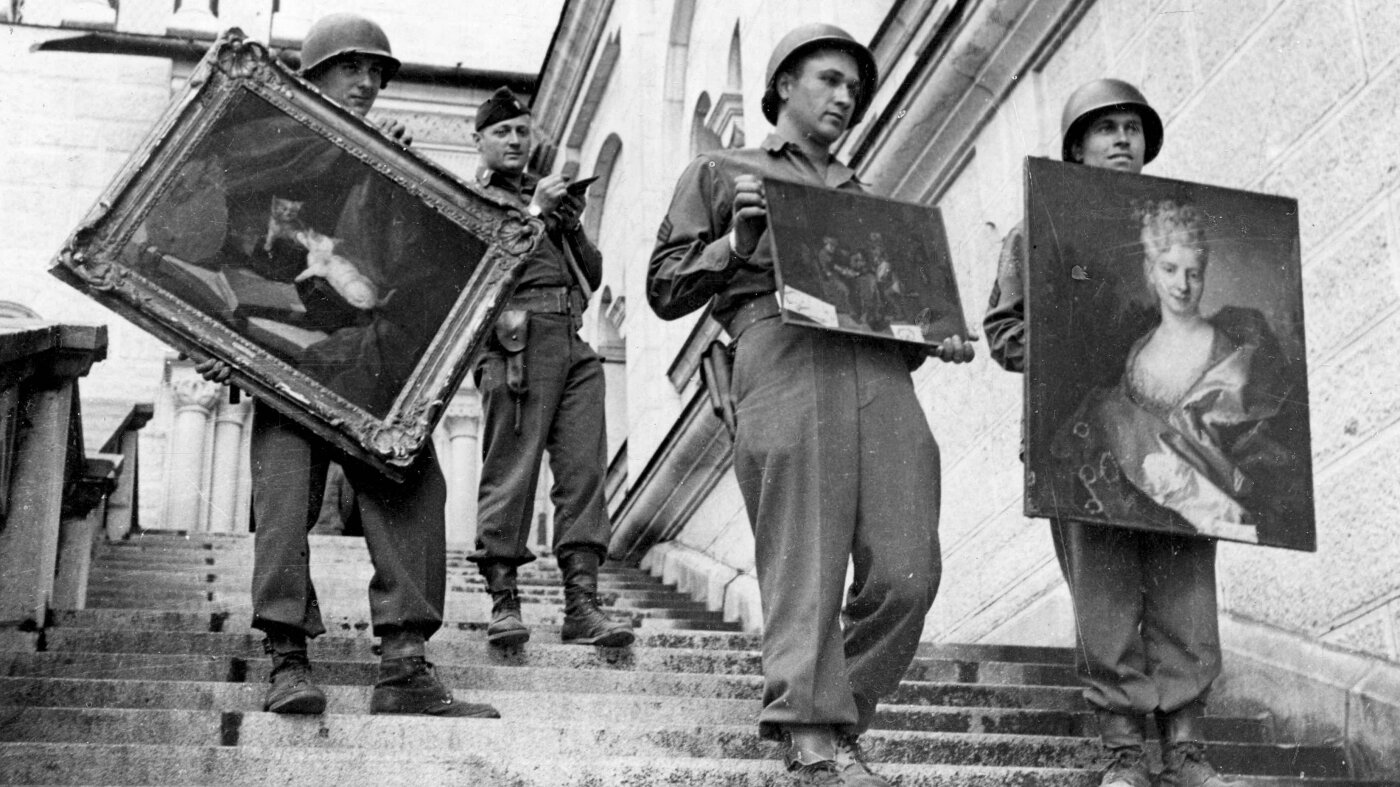
U.S. troops found a collection of treasures stolen by the Nazis hidden in a castle near the Austrian border in May 1945.
Horace Abrahams/Keystone Pool/APhide caption
toggle caption
Horace Abrahams/Keystone Pool/AP
More than 600,000 artworks and other cultural objects, mostly owned by Jews, were stolen by the Nazis leading up to and during World War II.
Efforts to shine a light on and restore the more than 100,000 as-yet-unclaimed artifacts from this hoard have been on the uptick. In April, President Trump signed the Holocaust Expropriated Art Recovery Act into law, which put an end to legal loopholes that advocates of the law said made it tough for people with valid claims to get their looted artworks back. And in May, the Musée D’Orsay in Paris opened a permanent gallery dedicated to paintings and sculptures by the likes of Degas, Rodin and Renoir that are thought to have been looted.
But reclaiming these artifacts is often a long and fraught process.
“There’s no central repository, no database that’s telling you where that art is,” said
Joel Greenberg, founder of Art Ashes, a nonprofit that helps families track down and recover art looted by the Nazis. On top of locating the missing art, the rightful owners need to prove it was stolen from them in the first place. “And then to recreate the historical record of what actually happened to the family and the family’s art is also very difficult, because those records, if they exist, are spread among different repositories around the world,” Greenberg said.
There are dozens of archives containing information about these missing artworks. Their holdings consist of records in a variety of languages and formats.
“If you could create a system that could scan all the databases that have the Nazi looted art records, that would be very, very useful,” Greenberg said.
The promise of AI
A team at Santa Clara University in Silicon Valley is aspiring to do just that, with a new AI chatbot that could help streamline the complicated process of getting these works back to their owners. It’s part of a broader shift toward digital tools in the field of art provenance and repatriation.
Developed by professors Michael Santoro, Haibing Lu and Michele Samorani, the AI Provenance Assistant is testing how artificial intelligence could eventually make it easier for people to search archives of stolen art.
“We are applying AI tools to make it easier to make the kinds of connections that seasoned researchers would have to spend a long time having to do manually,” said Santoro.
Supreme Court Says Germany Can’t Be Sued In Nazi-Era Art Case
Right now, the tool is only scraping records from one database — that of the Jeu de Paume museum in Paris. The Nazis warehoused tens of thousands of looted artworks at the museum during World War II and kept elaborate records — records that are now available for anyone to search online in a database alongside archives from several other institutions around the world, including the German Bundesarchiv, the French Archives of the Ministry of Europe and Foreign Affairs, and the U.S. National Archives.
But Santoro said his team’s AI tool is more intuitive than the Jeu de Paume’s database because it doesn’t require users to deal with drop-down menus and input keywords into boxes.
“It enables ordinary language queries to be made of art databases,” he said.
…and its limitations
Santoro admits the tool is currently limited in scope. But some experts in the field of tracking down and restoring artifacts seized by the Nazis are curious about how AI will shape their work in the future.
“This project shows promise,” said Carla Shapreau, who teaches cultural property law at the University of California, Berkeley. She said tools like the AI Provenance Assistant will be more useful when they encompass many databases, not just one.
Shapreau also said these chatbots should link to digitized copies of the original archival records such as confiscation and claim files, since the summaries available in online rel speculative if you can’t look at the evidence,” Shapreau said. “And the evidence is in the primary
But others are less optimistic about AI’s potential to streamline this complicated field of research and recovery.

Parallels
France Hopes Exhibit Of Nazi-Stolen Art Can Aid Stalled Search For Owners
“People find looted art without resorting to AI,” said Marc Masurovsky, co-founder of the Holocaust Art Restitution Project. He said many archives remain undigitized and subject to data privacy laws. These realities drastically limit the pool of data an AI tool can scrape.
“Even if they are published on the internet, how are you going to interpret all that alphabet soup?” Masurovsky said. “These are really complex cases.”
A digital shift
Researchers at Santa Clara University aren’t the only ones turning to AI to take on these complex cases.
One example is Legacy Explorer. The Jewish Digital Cultural Recovery Project Foundation’s AI-powered platform currently enables users to search documents and photographs of looted cultural property from a handful of databases. (The Jeu de Paume’s is among them.)
Meanwhile, the Santa Clara University team said they plan to expand their tool to include more databases and are launching a project to use AI to track down artworks that have not yet been identified as looted.
“This will involve using AI to find patterns in looted art and investigating whether those patterns are replicated in art databases where no looted art has heretofore been identified,” Santoro said. “We have only scratched the surface of how AI can assist in provenance research.”
