

Harvard University’s central fundraising and constituent database has been compromised, exposing sensitive personal profiles for 850,537 alumni and donors on breach notification index Have I Been Pwned (HIBP) Added Today (3rd November 2026), Security disclosures confirmed that threat actors infiltrated the university’s Alumni Affairs and Development systems through voice-phishing social engineering. The exfiltrated dataset contains donor names, residential addresses, gift histories, and personal biographical details spanning decades of Ivy League philanthropic operations. The compromised records appeared on dark-web repositories following an extortion campaign attributed to the ShinyHunters cybercriminal group.
The operational breach originated within Harvard’s administrative networks, where internal staff manage alumni engagement and multi-billion-dollar endowment contributions. An attacker contacted administrative personnel by telephone, impersonating authorized IT support specialists to harvest privileged network credentials. The adversary successfully bypassed internal authentication boundaries to access core constituent management tables. Unlike traditional ransomware attacks targeting disk encryption, the perpetrators focused entirely on bulk data exfiltration. The stolen records comprise alumni, major charitable donors, university staff, and family members of matriculated students.
Never Miss An UpdateFollow us on Google News to get our latest security, defense and cyber reporting in your feed. It’s free and takes one tap.
The inclusion of the Harvard dataset on Have I Been Pwned provides public verification of a major institutional leak. Threat actors weaponize high-net-worth constituent databases to execute targeted executive spear-phishing and philanthropic wire fraud. Similar exposure risks recently surfaced in our investigations into international travel credential breaches and mass personal record compromises. University officials verified that the compromised fundraising servers operated independently from core campus financial ledgers, preventing payment card losses.
Harvard Chief Information Officer Klara Jelinkova and development leadership issued formal security advisories to affiliates, detailing the incident’s boundaries and containment measures:
“The security of our community’s information remains our highest operational priority. While the affected systems contained personal contact and donation details, our investigators confirmed that Social Security numbers, banking passwords, and payment card numbers were not stored in this database.”
— Klara Jelinkova, Vice President and University Chief Information Officer, Harvard University
Harvard Alumni Affairs Database Telemetry and Exfiltrated Constituent Profiles
Harvard University’s Alumni Affairs and Development database breach compromised fourteen distinct personal attributes across 850,537 constituent accounts. The exposed data includes legal names, physical addresses, charitable donation histories, and corporate affiliations.
The compromised repository functioned as the master relationship management system for Harvard’s worldwide alumni network. Fundraisers relied on the platform to document personal relationships, career trajectories, and historical philanthropic pledges. When threat actors exfiltrated the database, they captured detailed dossiers on corporate executives, public officials, and prominent philanthropists. The granular detail of the leaked records dramatically increases the risk of secondary social engineering attacks.
Voice Phishing Help-Desk Intrusion Mechanics and ShinyHunters Extortion
The intrusion vector highlights a dangerous shift toward phone-based social engineering against institutional help desks. Threat actors contact organizational service desks using spoofed caller identifiers to mimic legitimate employees. By manipulating urgent password reset procedures, attackers convince help desk agents to issue multi-factor authentication overrides. Recent investigations into prompt-injection workspace compromises demonstrate how threat actors exploit trusted human interfaces.
Cybersecurity forensics teams linked the Harvard data release to extortion operations orchestrated by the ShinyHunters collective. When university administrators refused extortion demands, the threat actors published constituent tables to force compliance. This tactic mirrors broader double-extortion schemes targeting higher education and healthcare institutions nationwide. The publication of the dataset on Have I Been Pwned confirms that hundreds of thousands of personal emails are circulating among illicit brokers.
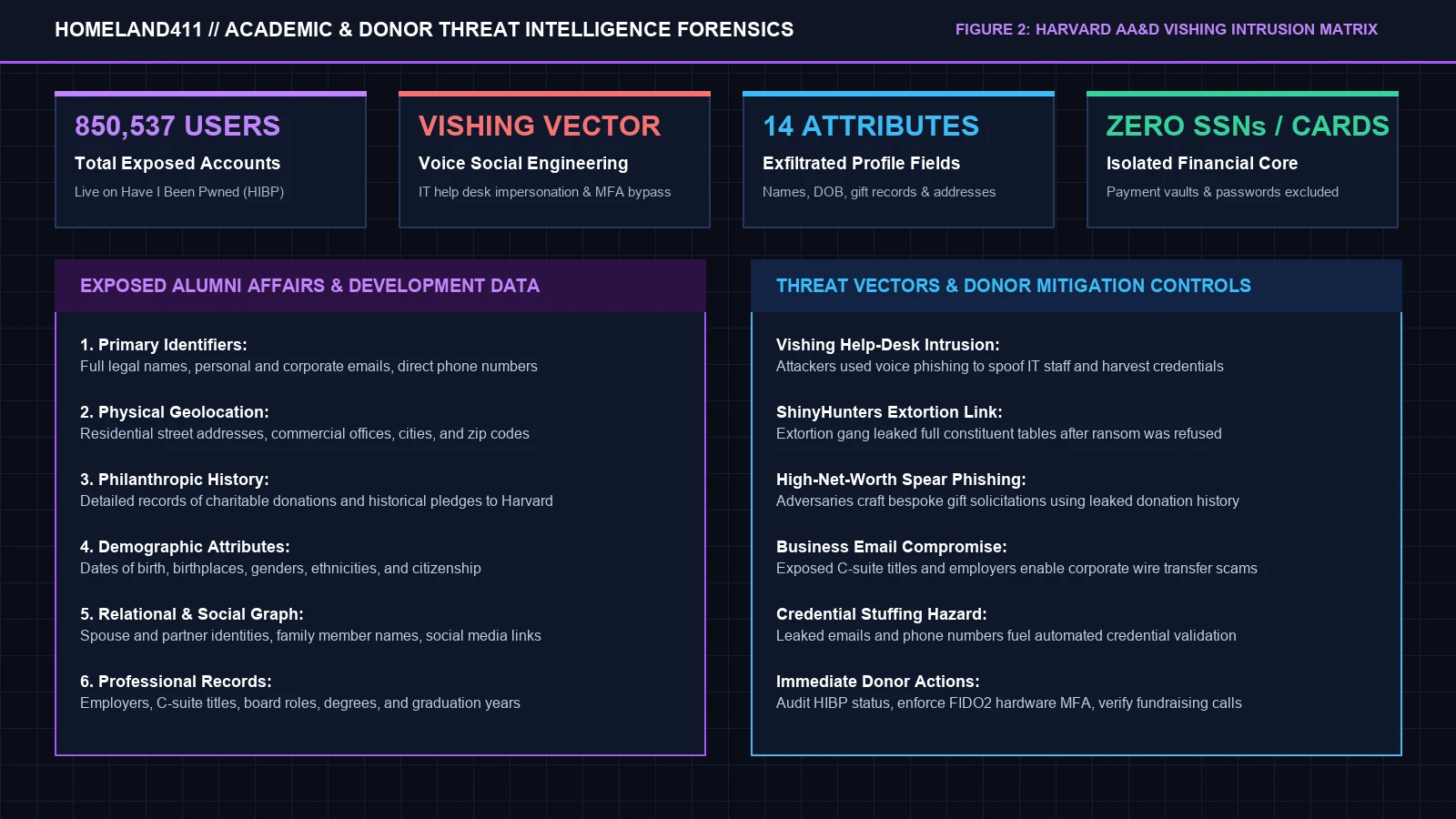
The exposure of charitable giving histories creates distinct forensic complications for affected constituents, enabling sophisticated follow-on exploitation campaigns:
- Bespoke Philanthropic Spear-Phishing: Adversaries weaponize precise donation figures and historical pledge timing to forge convincing university fundraising appeals, directing gifts into attacker-controlled bank accounts.
- Executive Business Email Compromise: Compromised job titles and corporate affiliations provide cybercriminals with authentic pretexts to target executive alumni with fraudulent commercial wire requests.
- Credential Stuffing and Account Takeover: Leaked personal email addresses and telephone numbers feed automated credential stuffing tools across personal banking, retail, and social media platforms.
- Physical Security and Doxxing Concerns: The publication of residential addresses paired with net-worth donation markers exposes high-profile donors to direct physical harassment and extortion.
Academic Endowment Vulnerabilities and Donor Protection Protocols
University fundraising databases represent lucrative targets for international cyber syndicates seeking high-value intelligence. Academic institutions manage massive constituent datasets that aggregate wealth indicators, personal biographies, and corporate networks. However, development offices frequently operate legacy software systems that lack modern zero-trust network segmentation. Protecting sensitive donor registries requires universities to enforce strict data classification and behavioral monitoring controls.
Security guidance from the Cybersecurity and Infrastructure Security Agency (CISA) urges academic institutions to eliminate voice-only password resets. Help desks must require out-of-band video verification or hardware FIDO2 tokens before granting credential recoveries. Simultaneously, alumni and donors should audit their breach exposure across Have I Been Pwned and implement proactive credit monitoring. Affiliates must scrutinize unverified communications claiming to represent Harvard fundraising offices.
“Higher education development platforms aggregate the wealth and social networks of the world’s most influential leaders. Securing these environments requires defensive parity with commercial banking systems rather than traditional campus open-network architectures.”
— Higher Education Information Security Council, Cyber Risk Assessment Report
Federal law enforcement agencies, including the Federal Bureau of Investigation (FBI), are actively tracking the ShinyHunters monetization infrastructure. Regulators under the Massachusetts Data Privacy Act are reviewing Harvard’s notification timeline and technical safeguards. The university confirmed that third-party forensic audits and mandatory access control overhauls will conclude by December 18, 2026. Affected constituents should remain vigilant against deceptive inquiries and establish multi-factor authentication across all personal accounts.
