

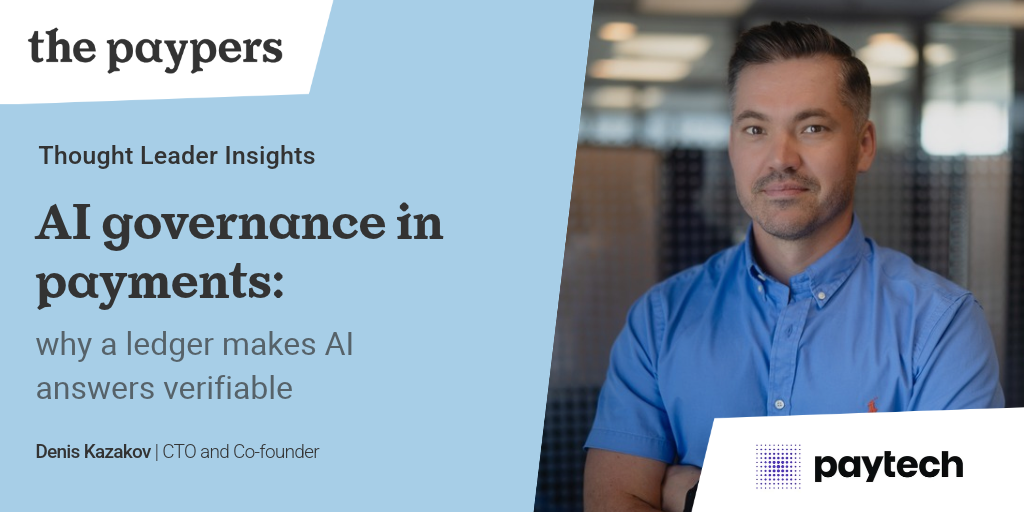
AI governance in payments: why a ledger makes AI answers verifiable
Thought Leader InsightsPayments
AI governance in payments needs a ledger behind it
Denis Kazakov, CTO and Co-founder at paytech, on why accuracy matters as much as speed when AI assistants explain payments, and what helps teams trace and verify what AI tells them.
One of the biggest risks of AI in payments is an answer that sounds right but is wrong, and a ledger helps you tell the two apart. Teams are now offered assistants that explain payments in seconds, but that speed only helps if the explanation is true.
What regulators and auditors are saying
The International Monetary Fund’s April 2026 note,How Agentic AI Will Reshape Payments, says payment systems need predictable, rule-based behaviour while AI works on probabilities, and it highlights the need to trace and explain what AI does. The Financial Stability Board’s June 2026 consultation flags explainability as a growing challenge and says proactive record-keeping supports AI risk management, with extended logging for agentic AI. Finance teams see the payoff:KPMG’s March 2026 survey of 1.013 finance leaders found that firms able to produce audit evidence for their AI quickly were far more likely to report improvements in error reductions: 33% against 6%.
The trouble with plausible
Picture a merchant’s finance manager who asks an AI assistant why Monday’s closing balance in the report is 4.300 euros higher than in their own books.
Fed with logs and spreadsheets, it gives a confident, sensible guess: a late refund or chargeback has not been posted yet. The manager spends the afternoon hunting for a refund that does not exist.
Reading from a proper ledger, the same assistant finds the real cause in a minute. The report closes the day at midnight UTC, while the merchant’s books close at midnight local time. Eleven entries are posted in the two hours between Monday in the report and Tuesday in the books.
The ledger does not make the AI smarter; it makes its mistakes visible.
Three rules for a trustworthy answer
First, base every answer on the financial record where each movement is traced, and balances are calculated from entries, not pieced together from several systems. Second, record the reason next to the number: which rule was applied to each transaction. Third, let the assistant investigate, but keep decisions with people, so that changing configuration, moving money, or contacting a counterparty needs clear approval.
What paytech has built
paytech provides a white-label payment gateway with built-in payment orchestration, enabling PSPs, acquirers, and fintechs to launch and operate their own branded payment infrastructure. tx.tech, powered by paytech, offers payment orchestration for merchants working with multiple payment providers. Both platforms support more than 1000 integrations.
Trust in AI starts with the data underneath it, and with knowing who controls it. At paytech, every white-label gateway runs in its own dedicated environment, with its own AWS instance and full ownership of its data, not just brand and domain. That makes PCI DSS Level 1 certification possible for each white-label gateway, on top of paytech’s own PCI DSS Level 1, ISO 27001, and ISO 22301.
The Finance Module calculates every balance from an account ledger and provides automatic reconciliationwith providers’ reports. For each transaction, it records the service-agreement rule applied, so that fees and rolling reserve can be explained. Any balance can be viewed in real time, at the end of a past day or as a projection for a future one.
The new AI Copilot supports the investigation step. It sits in the support chat widget, accessible from the client’s back office, so an answer is provided straight away, 24/7. Take a declined payment: it reads the transaction, finds the code the provider returned, and explains it in plain language. The support team can join the same conversation if needed.
For clients’ tech teams, an open-source plugin speeds up development. AI coding tools such as Claude Code and Codex use it to build a merchant’s integration with the white-label API, test it in the sandbox, and check existing code for duplicate charges and webhook problems. The plugin builds in the basics, such as verifying signatures and never treating a redirect as proof of payment. Hosted Fields now cover card payments, bank transfers, and card payouts, so data stays off the merchant’s servers.
What comes next
Making AI answers verifiable will remain the priority; paytech is building an AI Factory that aims to turn a request for a new integration into a pull request for engineers to review, so merchants do not need to do anything themselves. It is also developing a product and payment AI brain, predictive analytics, anomaly detection, and proactive business intelligence (BI) to help teams spot issues early.
As agents start to act on payments, not just explain them, regulators and buyers are likely to ask for the records behind every action. Companies that build on reliable foundations now will be one step ahead.
About Denis Kazakov
Denis Kazakov, CTO and Co-founder, leads paytech’s technology strategy, bringing more than a decade of experience across payments technology, R&D, banking integrations and payment operations.
About paytech
paytech is a B2B SaaS company founded in 2022 and based in Limassol, Cyprus. It provides a white-label payment gateway for PSPs, acquirers, and fintechs to launch their own branded payment services. Each white-label operates in a dedicated environment, so it goes beyond branding. It also powers tx.tech, a payment orchestration platform for merchants working with multiple payment providers, with 1000+ integrations behind both.
Keywords:paymentsAIgovernanceregulation
Companies:paytech
Countries:World
News on Payments
Fiserv makes Commerce Hub available globally for enterprise merchants
20 Oct 2026/5 min read/Payments
KPay secures Major Payment Institution licence in Singapore
19 Oct 2026/5 min read/Payments
DOSH adds Google Pay for prepaid customers underserved by banks
Unit launches real-time payments
Revolut launches Register POS with facial recognition payments
Expert views on Payments
Why tokenization is now strategic infrastructure
14 Oct 2026/8 min read/Payments
From mandate to mainstream: key takeaways on SEPA Instant as the default
09 Oct 2026/10 min read/Payments
Money20/20 USA 2026: Where payments, AI and stablecoins collide
09 Oct 2026/5 min read/Payments
Unfiltered: chargebacks are a relic
30 Sep 2026/8 min read/Payments
The Banking View by The Paypers: insights from bank executives on payments and financial crime
25 Sep 2026/10 min read/Payments
The Paypers is a global hub for market insights, real-time news, expert interviews, and in-depth analyses and resources across payments, fintech, and the digital economy. We deliver reports, webinars, and commentary on key topics, including regulation, real-time payments, cross-border payments and ecommerce, digital identity, payment innovation and infrastructure, Open Banking, Embedded Finance, crypto, fraud and financial crime prevention, and more – all developed in collaboration with industry experts and leaders.
No part of this site can be reproduced without explicit permission of The Paypers (v2.7).
Privacy Policy / Cookie Statement
