

‘;
document.currentScript.insertAdjacentHTML(“beforebegin”, banner);
let giftListenerCb = function (e) {
let date = new Date(e.detail.expiration_date);
let formatted = date.toLocaleDateString(“en-US”, {
month: “long”,
day: “numeric”,
year: “numeric”,
});
document.querySelector(“.article__gift-banner-exp”).textContent = formatted;
document.querySelector(“.article__gift-banner”).hidden = false;
window.removeEventListener(“hasValidGiftLink”, giftListenerCb);
};
window.addEventListener(“hasValidGiftLink”, giftListenerCb);
}
When the internet came to its modern form in the 1990s, there was so much awe and optimism that many have forgotten the voices who warned of impending dangers even then. Paulina Borsook was one such skeptic: As a Californian who began working for Bay Area software companies in the 1980s, she shared that sense of wonder. But she also noticed the ways the tech boom was rapidly transforming her home, from hippie-activism central to outpost for engineering whizzes who hailed from all over the world—and whose moral values were far different from the prior generation of techies she’d known.
Earlier iterations of tech innovators had benefited from government research and projects (ARPANET, Lockheed) and recognized that fact. Yet these transplants harbored a hostility toward governmental organization as a concept and barely understood how necessities like public infrastructure came to be. Instead, they fancied themselves as smarter and more enlightened than the average citizen, devoted not just to improving and developing new software, but to building and governing these new gizmos per their own visions. Once the business world latched on to the potential of the internet, this “technolibertarianism” only intensified.
After working for an exciting new tech-focused magazine
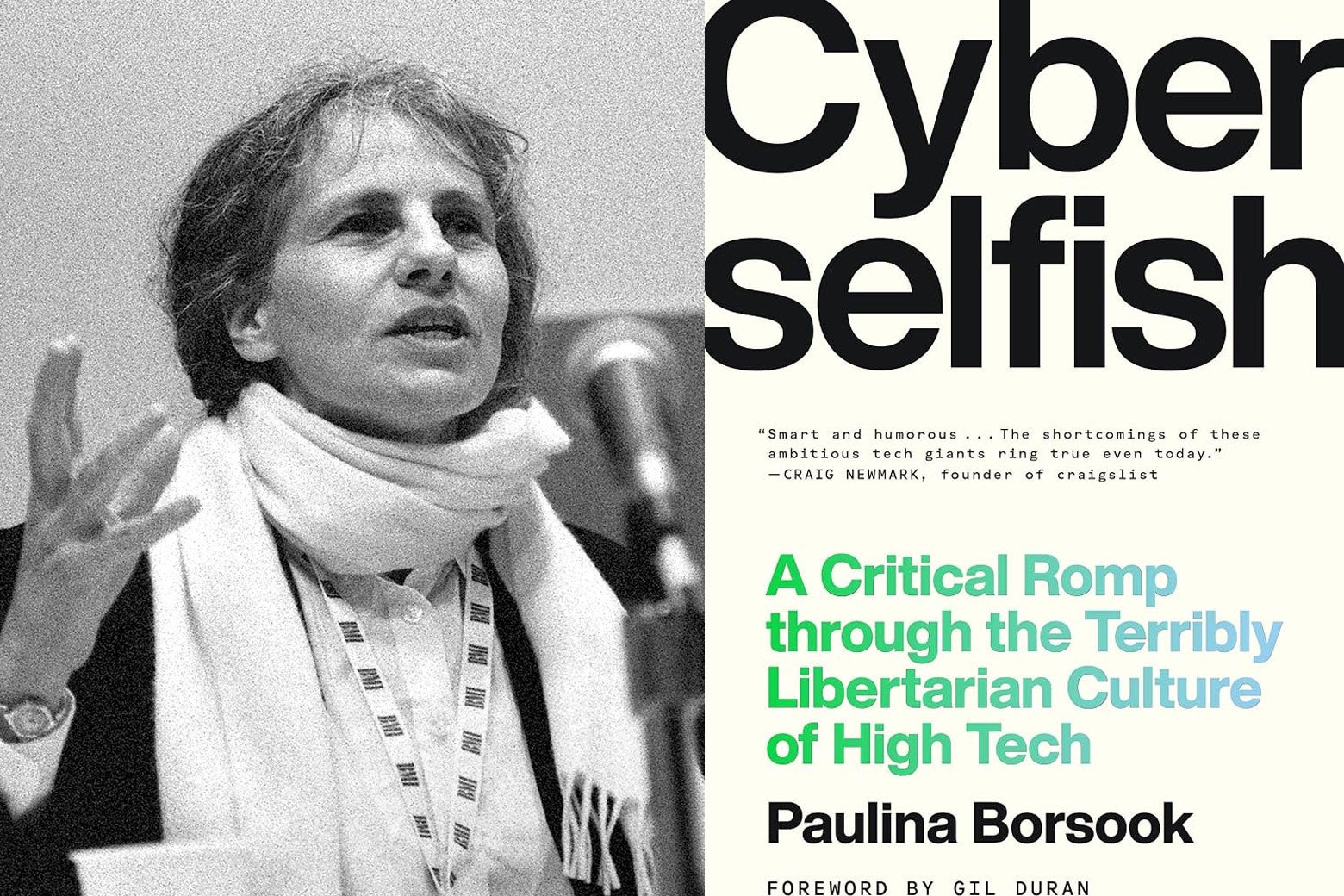
After working for an exciting new tech-focused magazine called Wired, Borsook penned an essay for Mother Jones titled “Cyberselfish,” expressing her alarm at the new vanguard of tech. It went ’90s viral, but shortly after she turned it into a book—Cyberselfish: A Critical Romp Through the Terribly Libertarian Culture of High Tech—in 2000, it was overshadowed by the shock waves of the dot-com bust. She struggled to find her footing in the decades after, but in recent years, as Silicon Valley liberalism has given way to an unyielding embrace of President Donald Trump and the MAGA movement, various techwritersbegan reinvoking the memory of Borsook and Cyberselfish, pointing out that her early observations of the tech world’s anti-government streak have played out far more prophetically, and horrifically, than anyone else could have imagined.
The new surge in intrigue around Cyberselfish got Tin House to republish the book, which is officially being reissued Tuesday. I spoke with Borsook about her newfound cult status, her early memories in the Valley, and what she makes of how right-wing the tech realm has become today. Our conversation has been edited and condensed for clarity.
Nitish Pahwa: What do you think is driving the surge of new interest in Cyberselfish?
Paulina Borsook: I always say, I don’t know.
Paulina Borsook: I always say, “I don’t know.” These kinds of reputational revivals, you hear them happening with novels or movies, but you don’t often hear it with nonfiction. I wondered if that’s because my book is not written journalistically. The facts are correct, but it was written in a literary and polemical way.
There was this guy, David Golumbia, who’s dead now, but he wrote Cyberlibertarianism a couple years ago. People told me he mentioned That Damned Book [Borsook’s nickname for Cyberselfish] in it, and that sparked some interest in academic circles. Then I found out that TDB was an underground thing people were talking about for years, and prices on used book platforms went way up from what they used to be. And I’d run into people who would tell me, “I read that in 2009.” How do I square that with how little attention was paid the first time?
TDB was well and widely reviewed at the time, but I think it didn’t register because the culture hadn’t caught up to it. It was this goofy, oddball thing. There really wasn’t a technology culture section in the bookstore. I was always going to bookstores and finding the book placed in the business section, next to some sort of Programming for Dummies volume.
InJack Dorsey’s interview this yearwith Steven Levy, he
InJack Dorsey’s interview this yearwith Steven Levy, he gets into this long digression about how he used to love Wired, before it got all supposedly pessimistic and nonutopian. You were one of thefirst regular contributorsat Wired, and in Cyberselfish you write at length about that experience—the assumed libertarian identity and the maleness of the masthead. I have to wonder what you make of Wired today and the reactions it provokes from folks like Dorsey.
Well, let’s talk about this notion that Wired drifted even in the ’90s. When I first started writing for them, what I loved was technology as culture, and they let me do that, and they were supportive of it. I didn’t have to sign a purity pledge. I could write whatever I wanted. But I think over time it became much more rigid about how we treated corporations, particularly. If you look at early Wired, it wasn’t all industry-boosting. It was about technology as culture. And then it became more ideological. I don’t know what else to call it.
If there’s this backlash of people not liking Wired now, it’s because, what strikes me about many people in tech these days is they will not tolerate any dissent, any criticism. How dare you question us? We are going for the greater good, and I’m going to stomp on you, grasshopper. It’s a kind of intellectual and emotional stillness I see these people having.
A lot of impulses that you identified among
A lot of impulses that you identified among tech folks wouldn’t be expressed so openly unless you were chatting in a more intimate setting, like a date or at a conference. What strikes me is that those hostile, tech-supremacist worldviews are so much more explicit now. They’re really, really saying it with their chest in a way they weren’t when you were criticizing these folks.
I also think that I was focusing on a subculture, and when does the subculture become the majority culture? I still have questions about how much the rank-and-file people in Silicon Valley are like this. I think a lot of them are, but not all of them. Some know enough to keep their mouth shut.
In the ’90s, you had a lot of people entering the scene who came from other places—by which I mean they’d actually read a novel that wasn’t Tolkien, they’d actually been to a museum and not just seen really bad CGI art, they had truly diverse backgrounds. I see much less of that now. You see people who started coding when they were in fifth grade, that’s all they’ve ever done, and they have no context or background to frame the other things they hear. These guys will say something that makes me think, If you had an actual grounding in biology, you wouldn’t say that. That’s what I’m often struck by—the appalling ignorance of these people. I’m not saying that from an outraged ideological place. I’m saying that from a 10th grade debate society place. The things they say are just wrong.
Once you got that spreadsheet way of knowledge
So once you got that spreadsheet way of knowledge infecting everything, and it started creeping in in the early 2000s, I sort of feel like there is no place you can go where this kind of thinking hasn’t crept in. Efficiency metrics, scientism—if you can’t count it, you can’t manage it.
Suppose you have something that introduces art in schools. There’s no way to measure the satisfaction and joy that kid got from the art in the schools.
Regarding the rank and file, what’s been interesting to me is that you can trace some of the “techlash” in the culture to theGoogle walkoutor theUber whistleblowers, the in-house protests at Microsoft over ICE contracts, all of which were very vital and robust during the first Trump administration. After the firms beganslashing tons of jobsand undermining any sort of worker solidarity, that activism became a little more muted, though ithasn’t totally gone away. I’m curious what you thought of that protest moment from afar.
There was a workplace culture that wasn’t so
There was a workplace culture that wasn’t so uncommon throughout the ’90s—that usually, as long as you did your job, nobody cared what you thought about anything else, and work wasn’t the place to get political. I remember being very surprised and kind of unsettled by the fact that at Google, there were all these in-company bulletin boards where people would talk about politics and whatever bad thing Google was doing or not doing or what was going on in the greater world. I had this reaction of: Your private life is your own. I don’t know if the workplace is the place to do this kind of organizing.
I know that’s not the response people normally expect. But it was funny: I just had lunch with some friends of mine, women my age who worked in tech in the ’80s and ’90s, and we were just talking about how it was so different then, particularly for the women. We all knew lots of women that worked in tech, not a ton, but they were there and it wasn’t a big deal. This sort of stupid sociobiological sexist crap just was not there. I mean, there were bad bosses, but there are always bad bosses. Still, the mindset was really different. To me it’s like, how did this stuff backslide so drastically? Because it was a much more woman-friendly environment in the ’80s and ’90s.
I would not have expected that!
It really was more like: Can you do the job? Can we work with you? Then it’s fine. It’s so much worse now, with the obsession over these silly ideas about presenting masculinity and all this stuff.
I was reading some recent article about these
I was reading some recent article about these two women from New York who come to San Francisco to be stylists for all the geeks there who can’t get dates. They tell them how to dress and what to do. My first thought was, Iwrote that story 30 years agoabout a different set of women trying to do the same thing. But this time, there’s a twist: The guys now are nervous about presenting themselves as being A.I. guys because they know how loathed it is. So they’re trying to have a presentation of self that doesn’t look like A.I. guy. I thought that was so interesting, that they’re hiding their party membership, as it were.
Instead of asking if there’s anything that gives you hope, I would like to know what other warnings or advice you have about the current tech moment.
I’m a big believer in local politics, in thinking globally and acting locally. There’s a data center coming, you do something about it. They want to put stupid A.I. in your kid’s third grade class, do something about it. That’s not a grand statement, but I think you should never underestimate the efficiency of doing that. You see that with the resistance to Flock cameras as well. In every place that’s local, you can do something about it, including vote. It sounds old-fashioned, but I’ve had a lot of success at being a local activist on different issues. I’ve been amazed at how much stuff—if you want to take the time and the care, and you’re not shrieky and shrill—you can get done.
As a capper: I’m sure you’ve been familiar
As a capper: I’m sure you’ve been familiar with Slate since its days as a Microsoft spinoff.We’re celebrating our 30th anniversary this year, and I’d love to hear what you thought of Slate back then.
Oh, I loved Slate back then. I read it every day. And I’m glad you’ve survived, because so many other great websites I once knew have gone.
