
Close Menu
AIToday7

    Subscribe to Updates

    Get the latest creative news from FooBar about art, design and business.

    What's Hot

    Developing Enterprise Frontier Safeguards with our customers

    September 2, 2026

    ChatGPT Health adds Epic integration for clinicians to import patient data

    September 2, 2026

    Infographic: Price Plays a Key Role in U.S. Consumer Tech Purchases

    September 2, 2026
    Facebook X (Twitter) Instagram
    Trending
    • Developing Enterprise Frontier Safeguards with our customers
    • ChatGPT Health adds Epic integration for clinicians to import patient data
    • Infographic: Price Plays a Key Role in U.S. Consumer Tech Purchases
    • AIR raises $50M to help companies vet the skills and add-ons AI agents use
    • 5 Tiny Gadgets That Are Surprisingly Powerful
    • Hackers claim millions of patient records stolen during data breach at healthcare giant McKesson
    • Deere launches AI assistant named JD to guide farmers
    • AI chatbot helps teach online-only psychology classes at Macquarie University
    Facebook X (Twitter) Instagram Pinterest Vimeo
    AIToday7
    • Home
    • AI News
    • Tech News
    • AI Guides
    • Chatbots
    • Cybersecurity
    • Gadgets
    • More
      • Generative AI
      • Startups
    AIToday7
    Home»Tech News»Feature Article: Biometrics at the Border—Making Exit Secure and Efficient
    Tech News

    Feature Article: Biometrics at the Border—Making Exit Secure and Efficient

    aitoday7By aitoday7September 1, 2026No Comments5 Mins Read
    Share Facebook Twitter Pinterest LinkedIn Tumblr Reddit Telegram Email
    Feature Article: Biometrics at the Border—Making Exit Secure and Efficient
    Share
    Facebook Twitter LinkedIn Pinterest Email

    The Science and Technology Directorate (S&T) recently brought industry partners to the Progreso International Bridge border crossing in Texas to demonstrate facial biometric capabilities for U.S. Customs and Border Protection (CBP). The effort supports S&T’s priority to help secure U.S. borders by identifying, testing, and transitioning technologies that strengthen security while facilitating efficient lawful travel. Hear from S&T, CBP, and our partners about this successful real-world test of secure, easy-to-use biometric technologies and how they capture essential data as pedestrians exit the country.

    Image
    <img src="https://aitoday7.com/wp-content/uploads/2026/09/26_0901_st_biometrics-20at_the_border_scanner_1.jpeg.webp" alt="Two upright grey metal kiosks stand a few feet apart on either side of the walkway. The kiosks have one camera that is around the average height of an adult and one camera that is positioned about two feet lower. In the background, a man has passed through the camera areas and is walking away.”>

    S&T has once again shown that strong technical expertise, trusted partnerships, technological precision, and sound science can operate at full throttle while delivering operational success across the Department of Homeland Security (DHS). Each of these elements is equally important when supporting agencies like CBP, especially when assessing mission-critical technologies before they are selected for deployment.
    Image
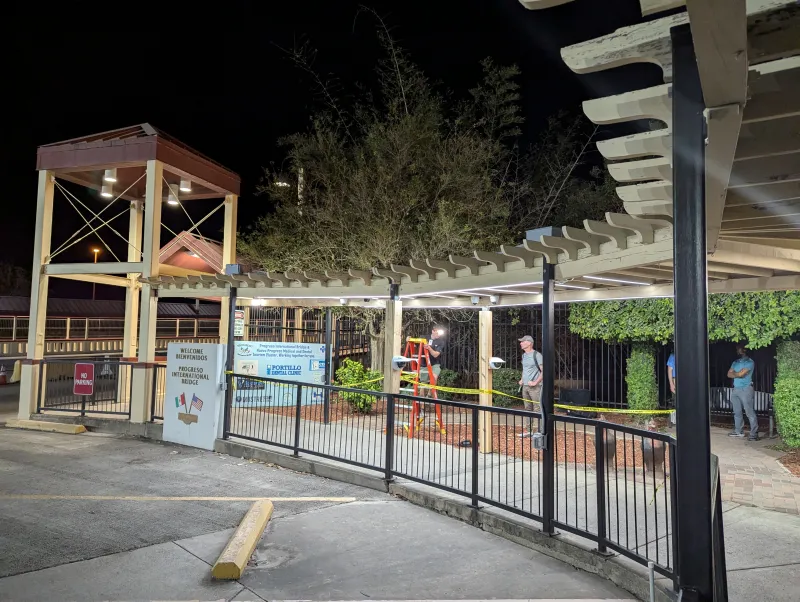
    The weathered pergola is well-lit with different lighting fixtures. A man is on a ladder talking to another man. They appear to be working on setting up the cameras and lighting for the live testing.

    “In October 2025, CBP approached S&T with a request for solutions that could securely, efficiently, and accurately confirm the departure of pedestrians exiting the U.S. at border crossings using biometrics,” said Arun Vemury, S&T Senior Advisor for Biometrics and Identity. “To meet long-standing legislative requirements and Administration priorities, S&T facilitated the technology demonstration to support CBP in testing cutting-edge technologies to efficiently perform its mission.”

    CBP turned to S&T and its knowledge of the facial biometrics landscape to quickly assess the current state of the market and identify emerging technologies that could meet CBP’s specific needs and high standards for secure border operations.

    To support the request, S&T coordinated with federal and industry partners through Cooperative Research and Development Agreements (CRADAs). The goal was to provide analysis to support CBP’s near-term planning and broader border security objectives. By leveraging the CRADAs, S&T enabled the industry partners to work quickly, cover their own costs, and provide the greatest value for informed governmental decision-making.

    In early 2026, S&T invited six companies to the Maryland Test Facility (MdTF) for basic capability demonstrations to determine which solutions should be operationally tested. These demonstrations led CBP and S&T to select three solutions for additional data collection: two from NEC National Security Systems (NSS) and one joint solution from Paravision and AiFi.

    Before deployment, S&T built a replica of the pedestrian exit environment at MdTF so vendors could install and assess their prototypes before taking them to the Progreso border crossing. This helped reduce risk by identifying issues in a controlled environment before testing in an active border environment.
    Image
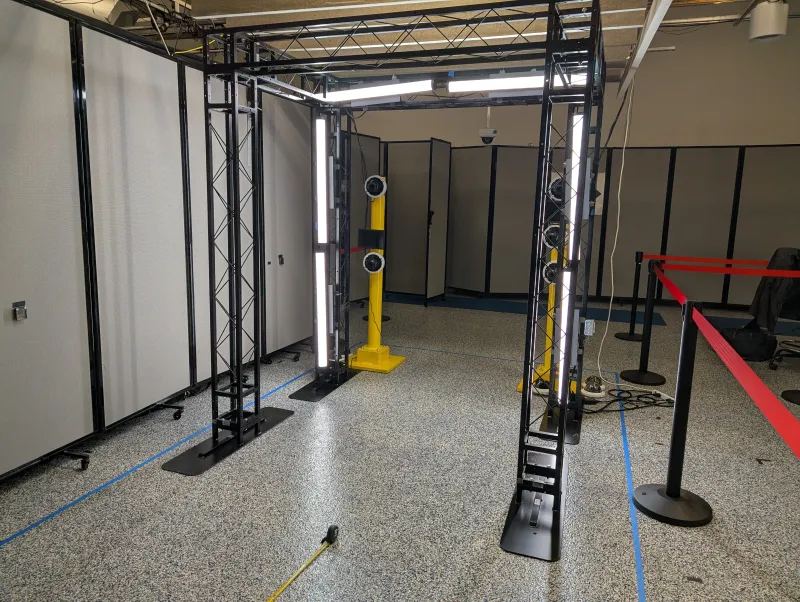
    Inside at the MdTF, a prototype lighting structure set up for testing in a room. Black metal scaffolding creates a boxy entranceway with four stands supporting a metal square above for individuals to walk through. It stands about eight feet tall and has lights on it. There are yellow metal stands with cameras mounted on them on that far side of the structure.

    When the industry partners arrived at the Progreso International Bridge in May, they began setting up for the operational assessment that would support CBP’s planning.

    For the testing to be successful, the technologies had to account for human factors such as travelers’ walking pace, as well as hats, sunglasses, umbrellas and other items people use or carry. Collecting usable facial images outdoors during the day and at night, at speed and scale, is challenging given the many variables.

    The partners leveraged artificial intelligence (AI) and other technologies to perform tasks such as constructing a 3D digital environment of the image capture zone, observing pedestrian movement, and analyzing facial images to determine whether they were suitable for biometric matching in CBP’s Traveler Verification Service.
    Image
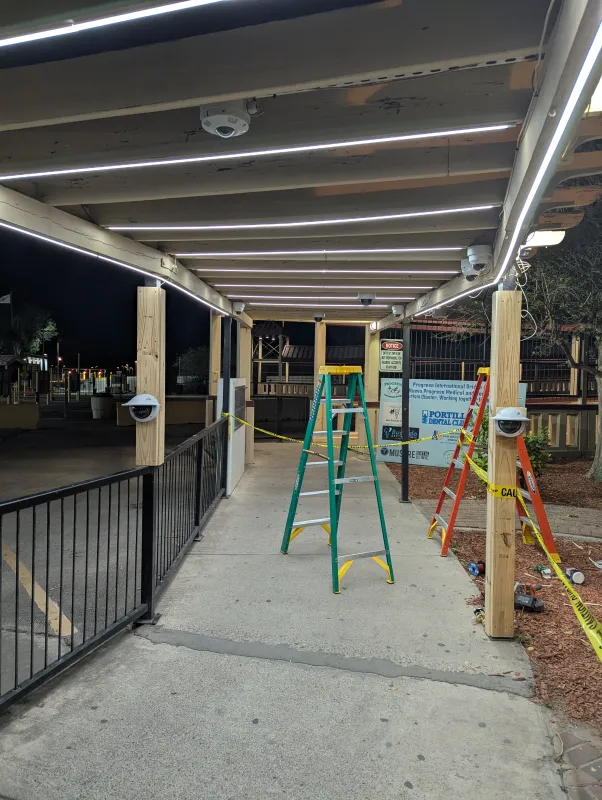
    A green and orange ladder, and yellow “Caution” tape wound around the poles and across the walkway. Looking down the weathered wooden pergola pedestrian walkway, there are cameras on the support poles and in the rafters. There are lighting strips affixed to the rafters as well as other lighting sources.

    The industry partners installed their products in various configurations. Some cameras were mounted on poles at different heights to account for individuals of different statures.
    Image
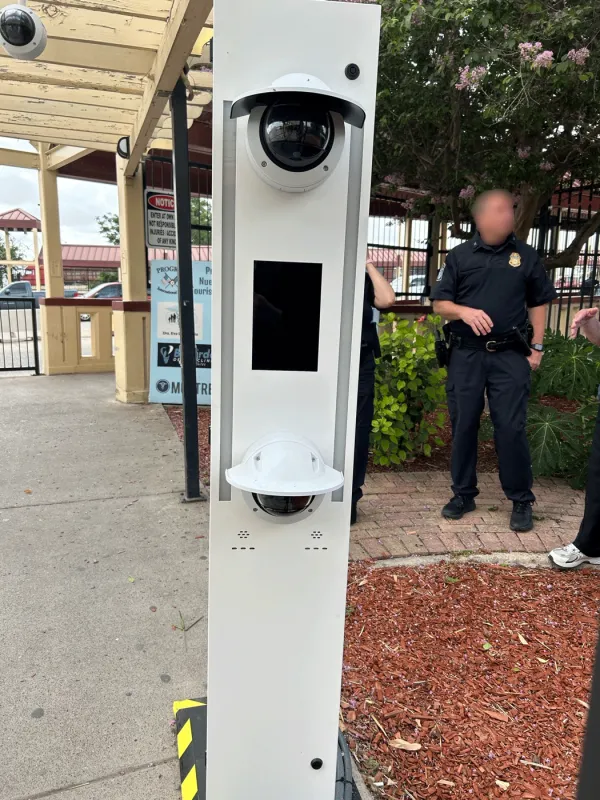
    A close up of one of the upright grey metal kiosks. The upper and lower camera lenses are black and have a grey lid over them. In between the upper and lower cameras is a black rectangle that looks like it might be a screen of some sort. In the background to the right, a Border Patrol officer in a black uniform is talking with other individuals.

    Because ports of entry operate day and night, tests were also conducted after dark using external lighting configurations. S&T evaluated how lighting affected facial image collection using various camera alignments.

    Image
    The walkway under the pergola at night with two signs indicating that there is a “Biometric opt-out lane” for U.S. Citizens Only. Looking down the walkway, we see the pergola is illuminated with lighting strips and has cameras in the rafters and on the poles.

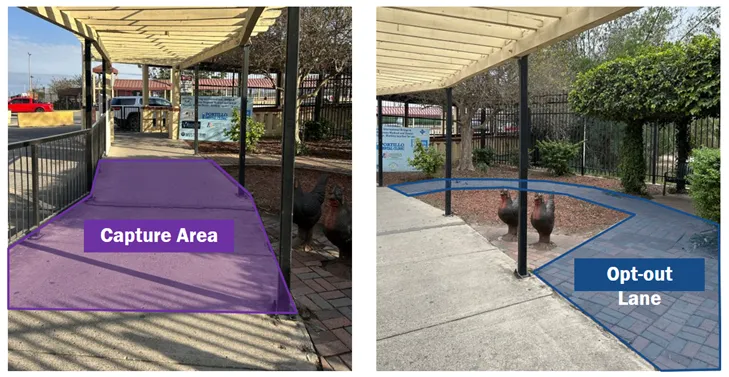
    As pedestrians approached the border exits, signs in English and Spanish informed them that U.S. citizens could opt out of biometric exit collection if they did not wish to have their picture taken, since the biometric Entry/Exit mandate applies to non-U.S. citizen travelers.
    Image
    There are two photographs side by side. The picture to the left has the main walkway of the pergola. There are purple graphics superimposed on the photo that shade part of the walkway. The words “Capture Area” are printed in the purple area, indicating that if you walk here, your image will be taken for the testing. The photograph to the right shows the way to walk around the image capture area. Blue graphics are superimposed on the photo and the words “Opt-Out Lane” are printed on in the blue shaded area.
    U.S. citizens were provided an opt-out lane if they chose not to participate in the image collection testing. Photo credit: S&T.

    “It is one thing for a technology to work in a lab like MdTF, but it is significantly more difficult when the tech is deployed operationally at the border. At Progreso, it had to work with limited infrastructure, in a challenging environment, and do it autonomously,” said Dr. Cameron Whitelam, director of S&T’s Biometric, Identity, and Advanced Computing Division. “And it did just that.”

    The technologies’ use of AI and other autonomous systems enhances border security and efficiency. This enables CBP to allocate officers to higher-value tasks while increasing the number of travelers processed and helping CBP accurately confirm the arrival and departure of foreign visitors to the United States.
    Image
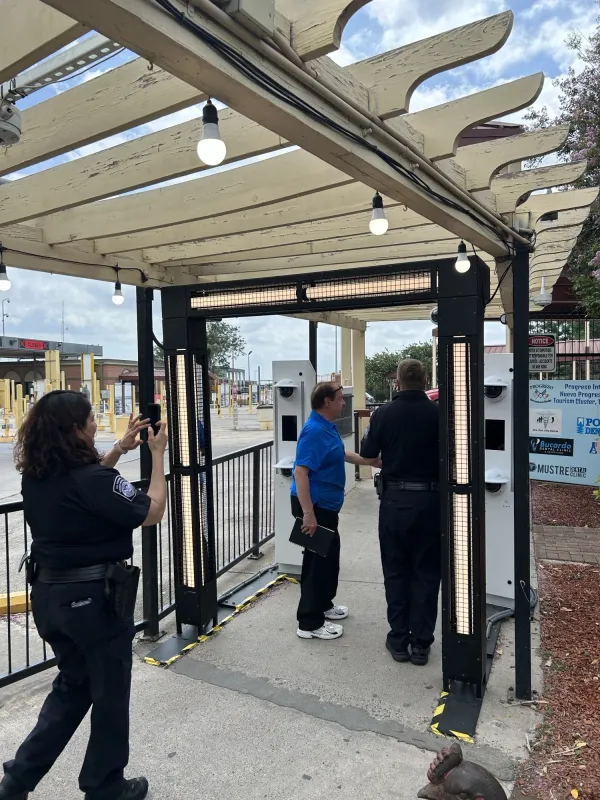
    The pergola has lights hanging from the rafters. Two men are standing underneath black metal scaffolding that has additional lighting sources. They are standing near one of the grey metal kiosks. A female Border Patrol officer is a few feet behind the men, and she is taking a cell phone picture of them. Although we can’t see her face well, it appears she might be smiling.

    “We were extremely impressed with the technology and the vendors that S&T brought down to Progreso on our behalf,” said Larry Panetta, Director of CBP’s Biometrics Program Office. “The image capture capabilities of pedestrians walking through the border exit area exceeded expectations in both day and night conditions. This technology could prove to be a force multiplier and allow CBP to maximize deployment of re

    “The fact that this went from concept to operational data collection in just a few months is amazing. It was a pleasure working with S&T and we’re looking forward to more collaborations with them in the near future.”

    For related media inquiries, please contact STMedia@hq.dhs.gov.

    • Science and Technology

      Keywords

    • Biometrics
    • Border Security
    • Science and Technology
    Post Views: 10

    Article Biometrics BorderMaking Exit feature
    Share. Facebook Twitter Pinterest LinkedIn Tumblr Email
    Previous ArticleSeven startups named for major Myrtle Beach golf tech expo
    Next Article Sam Altman Tried to Lobby Gavin Newsom Before Kids’ AI Chatbot Safety Bill Passed
    aitoday7
    • Website

    Related Posts

    Tech News

    Infographic: Price Plays a Key Role in U.S. Consumer Tech Purchases

    September 2, 2026
    Tech News

    Ila Kumar: Innovating with communities

    September 1, 2026
    Tech News

    Qi2 Campaign Challenges Consumers to Refuse the Same Old Crap

    August 31, 2026
    Add A Comment
    Leave A Reply Cancel Reply

    Top Posts

    Developing Enterprise Frontier Safeguards with our customers

    September 2, 20260 Views

    ChatGPT Health adds Epic integration for clinicians to import patient data

    September 2, 20260 Views

    Infographic: Price Plays a Key Role in U.S. Consumer Tech Purchases

    September 2, 20260 Views
    Stay In Touch
    • Facebook
    • YouTube
    • TikTok
    • WhatsApp
    • Twitter
    • Instagram
    Latest Reviews
    Chatbots

    OpenAI CEO goes viral for more strange ChatGPT parenting advice

    aitoday7August 4, 2026
    AI News

    The latest AI news we announced in July 2026

    aitoday7August 5, 2026
    Tech News

    What is Trump Media’s Truth API and why is it controversial?

    aitoday7August 5, 2026

    Subscribe to Updates

    Get the latest tech news from FooBar about tech, design and biz.

    Most Popular

    Developing Enterprise Frontier Safeguards with our customers

    September 2, 20260 Views

    ChatGPT Health adds Epic integration for clinicians to import patient data

    September 2, 20260 Views

    Infographic: Price Plays a Key Role in U.S. Consumer Tech Purchases

    September 2, 20260 Views
    Our Picks

    OpenAI CEO goes viral for more strange ChatGPT parenting advice

    August 4, 2026

    The latest AI news we announced in July 2026

    August 5, 2026

    What is Trump Media’s Truth API and why is it controversial?

    August 5, 2026

    Subscribe to Updates

    Get the latest creative news from FooBar about art, design and business.

    Facebook X (Twitter) Instagram Pinterest
    • About Us
    • Get In Touch
    • Disclaimer
    • Privacy Policy
    • Terms and Conditions
    © 2026 AIToday7. All Rights Reserved.

    Type above and press Enter to search. Press Esc to cancel.