
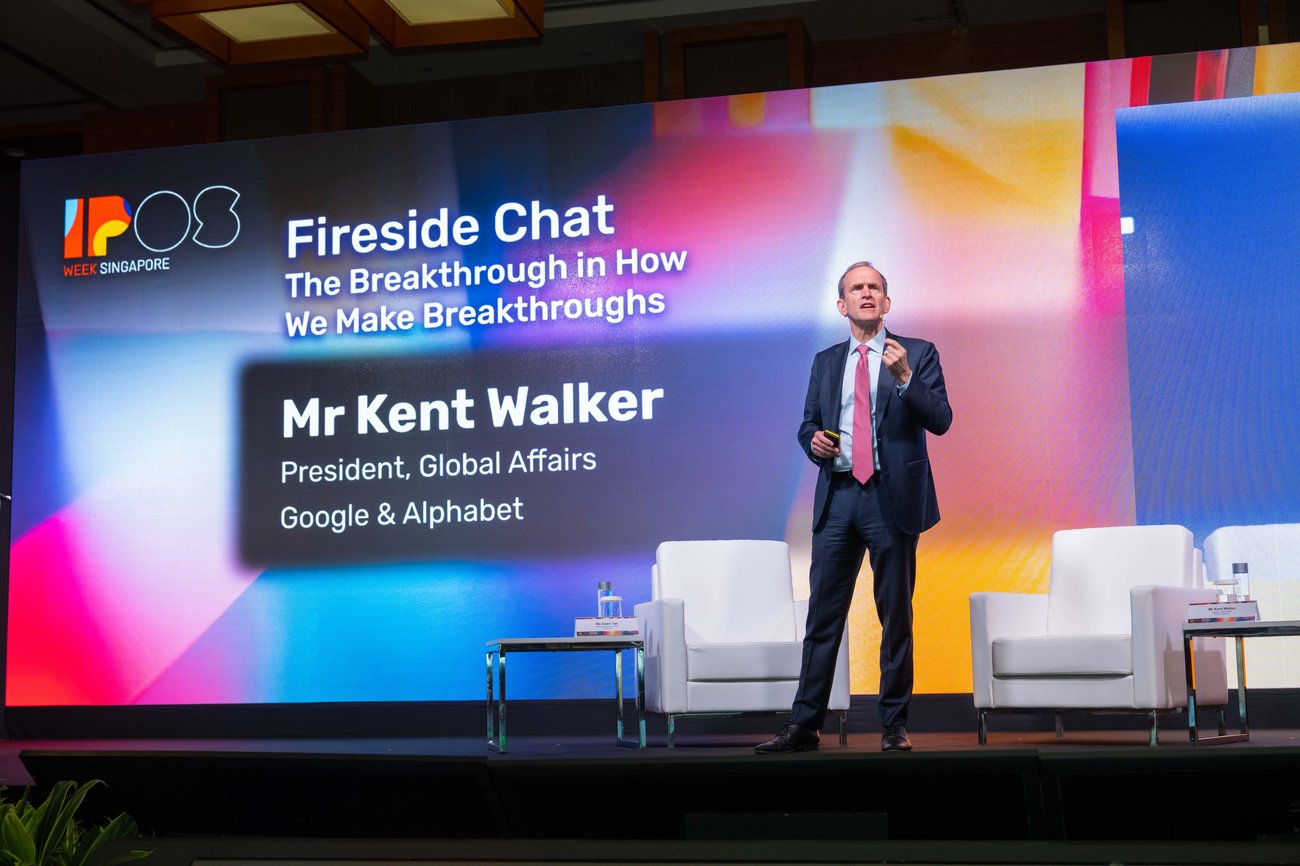
Read the transcript of Kent Walker’s keynote address, delivered during Singapore IP Week 2026.
Editor’s note: Today, Kent Walker, President of Global Affairs for Google and Alphabet, delivered a keynote address at the Global Forum on Intellectual Property. Below is a transcript of his remarks, titled “The breakthrough in how we make breakthroughs: AI and the future of innovation.”
It’s a privilege to be back in Singapore, and here at IP Week with so many experts at a critical time of change.
Let’s talk about two aspects of that change:
- First: The tremendous progress in AI and the value of getting these tools in the hands of more people.
- Second: How we realize the promise of AI while still safeguarding creators’ legitimate rights.
Let’s dive in.
Google’s mission has always been to organize the world’s information and make it universally accessible and useful. AI is a quantum leap in how we make progress against that mission.
Our new AI models are 300 times more efficient than those from just two years ago. Not 300% — 300 times.
And while that’s an incredible advance, what matters even more are the expanding ways they are benefiting people.
We are limited only by the scope and breadth of our imagination.
Today’s models don’t just make predictions, they can work independently, take different actions in different environments, and course correct when they run into dead ends.
That’s leading to scientific breakthroughs — and even breakthroughs in how we make breakthroughs — across medicine, energy, materials science, and more.
For example, today researchers at the University of Oxford are using AI tools like AlphaFold — an AI system developed by Google to predict the 3D structure of proteins — to design improved therapies for malaria, including a much more effective new vaccine.
Making AI work for everybody
And beyond science, turning from the extraordinary to the everyday, AI is a force multiplier for small businesses and entrepreneurs that promises to transform our economies.
ikura, a Japanese AI for travel platform, uses Google AI to take tourists off the beaten path.

ikura, a startup in Japan for travellers, is helping people access experiences outside of core tourist areas, which supports small businesses who might not otherwise reach travelers. The AI tool removes barriers that make travel difficult, like logistical and language barriers. In Indonesia, a startup called Aruna is using AI to help fishermen in remote villages get fairer prices for their catch.
Stories like these are becoming more common, and that diffusion is key in making AI work for everybody.
Technology races are won not necessarily by those who invent the technology first, but by those who deploy it best, putting it to work in everyday settings and integrating it across their economies.
People here in the Asia-Pacific region already have some of the highest levels of AI adoption in the world. Countries like India and Indonesia have the most absolute users, while places like Singapore have some of the highest levels of per capita adoption.
29% of AI users in Singapore — versus 12% of AI users in America — are what we call “super users”: The people who can delegate whole tasks, automate daily routines, and use paid models. Their relationship with AI is a working partnership, not just a search-engine substitute, which means they have intelligence on tap.
Optimism as a strategic advantage
One reason for this high level of adoption is that two-thirds of people in the Asia-Pacific region are optimistic about AI. And that optimism is a strategic advantage in putting AI to work.
Almost half of all people surveyed in APAC say they already save more than an hour a day by using generative AI at work.
For example, here in Singapore, educators from primary schools to junior colleges are using advanced AI in Google Workspace for Education to plan lessons and tailor course material, freeing up five hours per week for each teacher to focus on teaching and mentoring students.
New data details how AI could deliver up to $6 trillion to global GDP
In the coming months, we’re going to start seeing organizations and companies not just making efficiency gains, but reshaping roles and functions, inventing new products and services, and building long-term competitive advantage.
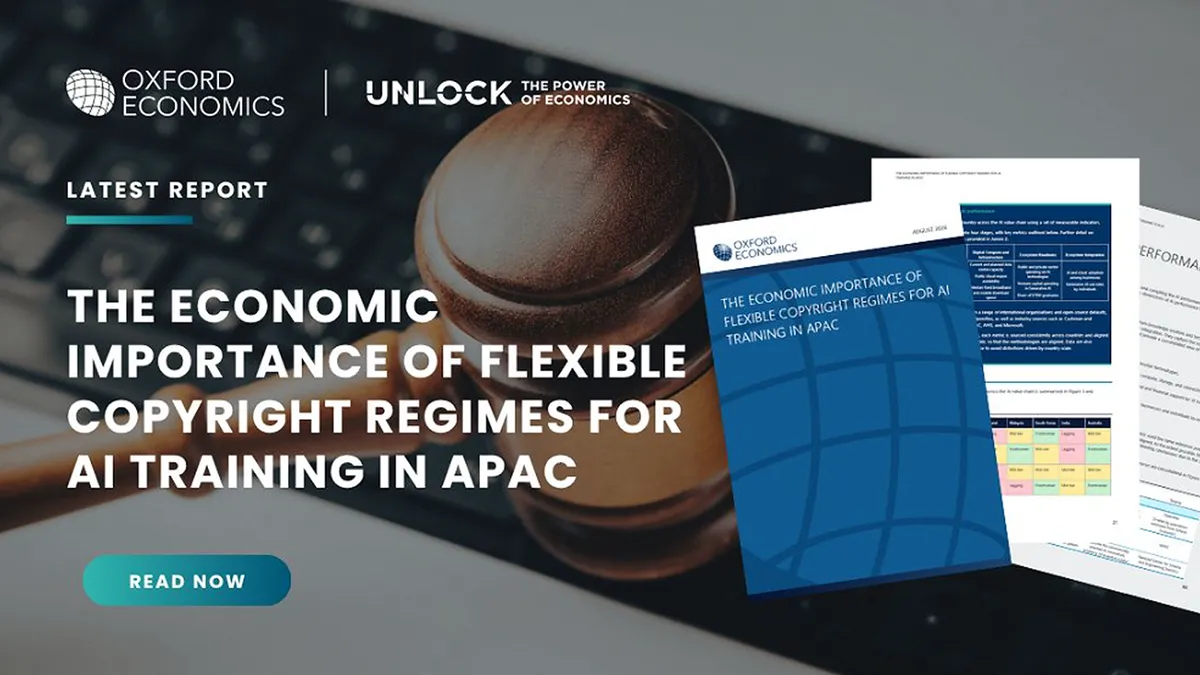
According to a recent Oxford Economics report, AI could deliver up to $6 trillion to global GDP over the next 10 years.
The stakes have never been higher — so we have to get this right. Capturing those gains depends on countries creating the right enabling environment.
We recently commissioned a report by Oxford Economics that unpacks how copyright rules influence how much value countries capture from AI.
How we safeguard creator rights while delivering on the promise of AI
At that same time, and at this conference, we have to ask “Can we safeguard creator rights while still delivering on the promise of AI?”
I think we can.
Let’s look at patents and copyrights, both highly relevant to AI.
First, patents. The patent system today is working through important issues.
Google has been working in AI for many years, and we have the largest AI patent portfolio, with some of the most foundational patents on AI technologies.
Of course, whenever there’s a new technology, people rush to try to patent old ways of working in this new setting. Just as we saw with first computers, and then again with the internet, we’ve seen a dramatic surge in global AI patent applications.
And this time, Generative AI tools have compounded the challenge, by making it easier than ever before to write an application.
As a result, according to the World Intellectual Property Organization, more new patents were published in 2024 and 2025 than in the prior ten years combined.
We’re seeing claims across all aspects of AI technology, including model architectures themselves as well as novel applications of those models in different fields.
Of course not all of those claims may be valid, and we need to ensure we have tools in place to evaluate claim quality, including using AI to analyze prior art and deconstruct claims generated by AI.
If LLMs are turning three bullet points into patent applications, patent offices may need LLMs to turn patent applications back into three bullet points.
But at a high level, the patent system is supporting the development and deployment of AI tools.
There’s no need to tear down an architecture that is working, but there is a need to work together to adapt to a moment of rapid change.
When we turn to copyright, the conversation becomes more complex. One key insight is that traditional copyright has always focused on outputs, not inputs.
For our part, we are prioritizing safeguards for AI outputs as we aim to protect intellectual property while preserving freedom for creative expression.
Our approach includes a range of efforts, from deploying advanced, modality-specific filters that help to prevent AI models from exactly replicating content that might be in the training data, to actively removing infringing material
And we believe we don’t have to reinvent the wheel: We need evolution not revolution. Existing copyright principles can help to deal with these new tools and their outputs.
AI is a tool that assists creation. If a user creates an infringing output, it’s infringing regardless of the technology used to create it.
It doesn’t matter whether a work is created with a pencil or a typewriter, a personal computer or an AI tool.
The legal standard remains.
Just as it does with traditional creative tools, the law should focus on how an AI tool is used, while recognizing the transformative nature of the technology itself.
When it comes to liability, the law has always sought to draw a clear line between the tool and how someone chooses to use it.
AI training is learning to recognize patterns
In evaluating the training necessary to create AI models, we can likewise draw on our laws governing the creation of words and images inspired by prior works.
Human creativity has always drawn on what came before.
If students go to a public library, read the books on the shelves, learn how to create plot twists, and then go home to write their own original novels, they have not infringed copyright. They have used those works to learn the craft, the art of how words and passages typically relate to one another. Generative AI training works in an analytically identical way, recognizing patterns in what’s come before.
A legal regime that required developers to get a commercial license for every piece of publicly available data used to train a model would end AI innovation.
The better approach — similar to those pioneered by Singapore, Japan, and the EU — is to have clear rules around AI training by having clear text and data mining exceptions for training on publicly accessible content. And the courts in India have just followed this approach as well.
The importance of reasonable opt-outs
Balanced regimes also recognize the unique scale and nature of content on the internet, and give publishers and creators the ability to opt out from having their content used to train or ground a model’s output.
A balanced copyright framework, with clear text and data mining exceptions, does not preclude commercial negotiations between AI developers and rights holders for access to content — in fact by establishing clear rules of the road, it facilitates those negotiations.
While Google believes that both training a model and grounding it to improve accuracy are transformative uses, we are also engaging with the ecosystem to explore new types of partnership and value-exchange models.
And we have implemented various rights to opt out, including through controls like Google-Extended, which gives rights holders the ability to say, “I choose not to participate in this ecosystem;” Long-established international protocols like robots.txt, which allow creators to decide whether they want their content to be used for training; and our Updated Search Console protocols, which let website owners manage how their links and content appear in generative AI Search features.
Having a broad right to train and ground, coupled with a machine-readable right to opt-out, offers the reasonable middle way, allowing the benefits of cutting-edge AI while protecting the rights of copyright holders.
The role the private and public sectors can play in responding to deceptive digital replicas
Before I close, I want to also touch briefly on an issue that is often raised in conversations around intellectual property and AI: deceptive digital replicas — the unauthorized generation of misleading AI deepfakes of an individual’s voice, face, or likeness.
Using an AI tool to create these replicas could harm the reputation of the person or deceive the audience.
We believe that both industry and regulators have a role to play in safeguarding against deceptive digital replicas.
Industry has a responsibility to build technical guardrails that prevent misuse of our tools and foster trust.
For example Google pioneered the industry-leading SynthID tool, which embeds imperceptible watermarks directly into AI-generated images, audio, text, or video, reducing the risk of deception about who created a particular material. We also developed advanced Likeness detection tools on YouTube, scanning our system to identify videos that potentially contain the face of creators.
Google’s watermarking tool, SynthID, is designed specifically for AI-generated content. It empowers users to identify AI-generated (or altered) content, helping to foster transparency and trust in generative AI.

And on the government side, we need laws that address this problem.
Copyright law isn’t the right tool to address this issue.
Copyright protects original creative works, not personal identity or facts. So it’s ill-suited for addressing issues like deepfakes. Other sets of laws — those against misappropriating images or fake endorsements — are a better fit.
That’s why in the U.S., Google supports bills like the NO FAKES Act of 2025 and the TAKE IT DOWN Act to establish clear legal protections against unauthorized and deceptive digital replicas. And we look forward to working with other governments on similar efforts to tailor existing legal frameworks to these new realities.
IP frameworks will determine the trajectory of this incredible new technology
The good news is that our time-tested legal systems are already evolving to meet the AI moment.
Every time a transformative technology has emerged over the past two centuries — from player pianos and cameras, to radio and television, to the internet to AI — some people have claimed that the new technology required a revolution in IP law.
And each time, the law instead flexed to address the new challenges, recognizing new technological opportunities and new mediums for human creativity and expression.
The same is true today.
If we want to ensure people can fully tap into the benefits of this remarkable new wave of technology, then we need to keep the conversation going.
The magic of AI is available now.
And by working together, we can make sure that it benefits everyone.
