

Abstract
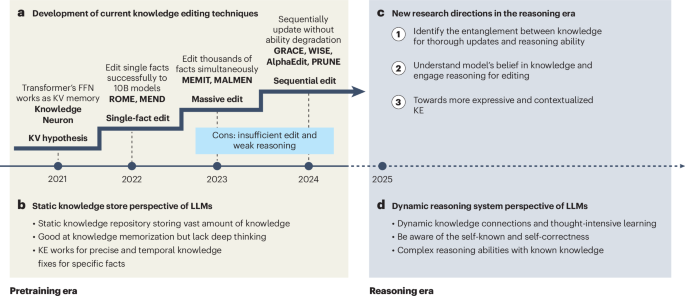
Knowledge editing has emerged as a promising approach that leverages understanding of a model’s inner knowledge mechanisms to enable precise knowledge updates and behaviour control without costly retraining. It is particularly appealing for enabling continuous knowledge adaptation, a capability essential for building truly intelligent, self-evolving AI systems. However, current methods treat large language models as modular knowledge stores where facts can be edited independently, ignoring the fact that knowledge forms an interconnected system in which elements depend on each other. As large language models increasingly exhibit sophisticated reasoning abilities, such as spanning multistep deduction and causal inference, the need for reasoning-consistent knowledge updates becomes critical. In this Perspective we explore some limitations of existing knowledge editing techniques and argue that effective knowledge editing must account for the intricate nature of knowledge representation. We outline three promising research directions: (1) addressing knowledge interdependence through deductive closure circuit editing; (2) integrating model beliefs and confidence into the editing process; and (3) enabling contextualized updates for complex, interdependent knowledge forms. Together, these directions suggest a pathway towards more principled knowledge editing methods capable of supporting the next generation of adaptive, reasoning-driven AI systems.
This is a preview of subscription content, access
Access options
- Purchase on SpringerLink
- Instant access to the full article PDF.
Prices may be subject to local taxes which are calculated during checkout
Subjects
- Language and linguistics
- Computer science
References
-
Guo, D. et al. DeepSeek-R1 incentivizes reasoning in LLMs through reinforcement learning. Nature645, 633–638 (2025).
-
Achiam, J. et al. GPT-4 technical report. Preprint at https://arxiv.org/abs/2303.08774 (2023).
-
Yao, Y. et al. Editing large language models: problems, methods, and opportunities. In Proc. 2023 Conference on Empirical Methods in Natural Language Processing (eds Bouamor, H. et al.) 10222–10240 (Association for Computational Linguistics, 2023).
-
Meng, K., Bau, D., Andonian, A. & Belinkov, Y. Locating and editing factual associations in GPT. In Advances in Neural Information Processing Systems Vol. 35 (eds Koyejo, S. et al.) 17359–17372 (Curran Associates, 2022).
-
Mitchell, E., Lin, C., Bosselut, A., Finn, C. & Manning, C. D. Fast model editing at scale. In The Tenth International Conference on Learning Representations (2022).
-
Qin, J. et al. Why does new knowledge create messy ripple effects in LLMs? In Proc. 2024 Conference on Empirical Methods in Natural Language Processing (eds Al-Onaizan, Y. et al.) 12602–12609 (Association for Computational Linguistics, 2024).
-
Liu, J. et al. EVEDIT: event-based knowledge editing for deterministic knowledge propagation. In Proc. 2024 Conference on Empirical Methods in Natural Language Processing (eds Al-Onaizan, Y. et al.) 4907–4926 (Association for Computational Linguistics, 2024).
-
Wang, P. et al. Wise: rethinking the knowledge memory for lifelong model editing of large language models. In Advances in Neural Information Processing Systems Vol. 37 (eds Globerson, A. et al.) 53764–53797 (Curran Associates, 2024).
-
Fang, J. et al. AlphaEdit: null-space constrained knowledge editing for language models. In Thirteenth International Conference on Learning Representations (2025).
-
Hartvigsen, T., Sankaranarayanan, S., Palangi, H., Kim, Y. & Ghassemi, M. Aging with GRACE: lifelong model editing with discrete key-value adaptors. In Advances in Neural Information Processing Systems 36 (eds Oh, A. et al.) 47934–47959 (Curran Associates, 2023).
-
Wang, M. et al. Detoxifying large language modelsiation for Computational Linguistics Vol. 1 (eds Ku, L.-W. et al.) 3093–3118 (Association for Computational Linguistics, 2024)
-
Tian, B. et al. To forget or not? Towards practical knowledge unlearning for large language models. In Findings of the Association for Computational Linguistics: EMNLP 2024 (eds Al-Onaizan, Y. et al.) 1524–1537 (Association for Computational Linguistics, 2024).
-
Mao, S. et al. Editing personality for large language models. In CCF International Conference on Natural Language Processing and Chinese Computing (eds Wong, D. F. et al.) 241–254 (Springer, 2024).
-
Zhong, Z., Wu, Z., Manning, C.D., Potts, C. & Chen, D. Mquake: assessing knowledge editing in language modelsethods in Natural Language Processing (eds Bouamor, H. et al.) 15686–15702 (Association for Computational Linguistics, 2023)
-
Yao, Y. et al. Reflection on knowledge editing: charting the next steps. Notion Bloghttps://yyzcowtodd.cn/rethinkedit (2025).
-
He, G., Song, X. & Sun, A. Knowledge updating? No more model editing! Just selective contextual reasoning. Preprint at https://arxiv.org/abs/2503.05212 (2025).
-
Geva, M., Schuster, R., Berant, J. & Levy, O. Transformer feed-forward layers are key-value memories. In Proc. 2021 Conference on Empirical Methods in Natural Language Processing (eds Moens, M.-F. et al.) 5484–5495 (Association for Computational Linguistics, 2021).
-
Dai, D. et al. Knowledge neurons in pretrained transformers. In Proc. 60th Annual Meeting of the Association for Computational Linguistics Vol. 1 (eds Muresan, S. et al.) 8493–8502 (Association for Computational Linguistics, 2022).
-
Meng, K., Sharma, A.S., Andonian, A., Belinkov, Y. & Bau, D. Mass-editing memory in a transformer. In Eleventh International Conference on Learning Representationshttps://openreview.net/forum?id=MkbcAHIYgyS (2023).
-
Tan, C., Zhang, G. & Fu, J. Massive editing for large language modelsng Representationshttps://openreview.net/forum?id=L6L1CJQ2PE (2024)
-
Piao, H., Wang, H., Wu, D. & Wei, Y. A3E: towards compositional model editing. In Advances in Neural Information Processing Systems Vol. 38 (eds Belgrave, D. et al.) 42906–42941 (Curran Associates, 2025).
-
Gu, J.-C. et al. Model editing harms general abilities of large language models: regularization to the rescue. In Proc. 2024 Conference on Empirical Methods in Natural Language Processing (eds Al-Onaizan, Y. et al.) 16801–16819 (Association for Computational Linguistics, 2024).
-
Gupta, A., Rao, A. & Anumanchipalli, G. Model editing at scale leads to gradual and catastrophic forgetting. In Findings of the Association for Computational Linguistics, ACL 2024 (eds Ku, L.-W. et al.) 15202–15232 (Association for Computational Linguistics, 2024).
-
Yang, W. et al. The butterfly effect of model editing: few edits can trigger large language models collapse. In Findings of the Association for Computational Linguistics:ACL 2024 (eds Ku, L.-W. et al.) 5419–5437 (Association for Computational Linguistics, 2024).
-
Gu, X. et al. UltraEdit: training-, subject-, and memory-free lifelong editing in language models. Trans. Mach. Learn. Res.https://openreview.net/forum?id=GoJLp3BlRV (2026).
-
Gupta, A. et al. Lifelong knowledge editing requires better regularization. In Findings of the Association for Computational Linguistics: EMNLP 2025 (eds Christodoulopoulos, C. et al.) 22653–22675 (Association for Computational Linguistics, 2025).
-
Ma, J. Y., Wang, H., Xu, H. X., Ling, Z. H. & Gu, J. C. Perturbation-restrained sequential model editing. In Thirteenth International Conference on Learning Representationshttps://openreview.net/forum?id=bfI8cp8qmk (2025).
-
Huang, Z. et al. Transformer-patcher: one mistake worth one neuron. In Eleventh International Conference on Learning Representationshttps://openreview.net/forum?id=4oYUGeGBPm (2023).
-
Yu, L., Chen, Q., Zhou, J. & He, L. MELO: enhancing model editing with neuron-indexed dynamic LoRa. Proc. AAAI Conf. Artif. Intell.https://doi.org/10.1609/aaai.v38i17.29916 (2024).
-
Huang, B., Chen, C., Xu, X., Payani, A. & Shu, K. Can knowledge editing really correct hallucinations? In Thirteenth International Conference on Learning Representationshttps://openreview.net/forum?id=hmDt068MoZ (2025).
-
Rosati, D. et al. Long-form evaluation of model editing. In Proc. 2024 Conference of the North American Chapter of the Association for Computational Linguistics: Human Language Technologies Vol. 1 (eds Duh, K.et al.) 3749–3780 (Association for Computational Linguistics, 2024).
-
Wang, P. et al. EasyEdit: an easy-to-use knowledge editing framework for large language models. In Proc. 62nd Annual Meeting of the Association for Computational Linguistics Vol. 3 (eds Ku, L.-W. et al.) 82–93 (Association for Computational Linguistics, 2024).
-
Niu, J., Liu, A., Zhu, Z. & Penn, G. What does the knowledge neuron thesis have to do with knowledge? In Twelfth International Conference on Learning Representationshttps://openreview.net/forum?id=2HJRwwbV3G (2024).
-
Chen, Y., Cao, P., Chen, Y., Liu, K. & Zhao, J. Journey to the center of the knowledge neurons: discoveries of language-independent knowledge neurons and degenerate knowledge neurons. Proc. AAAI Conf. Artif. Intell.https://doi.org/10.1609/AAAI.V38I16.29735 (2024).
-
Hase, P., Bansal, M., Kim, B. & Ghandeharioun, A. Does localization inform editing? Surprising differences in causality-based localization vs. knowledge editing in language models. In Advances in Neural Information Processing Systems Vol. 36 (eds Oh, A. et al.) 17643–17668 (Curran Associates, 2023).
-
Lindsey, J. et al. On the biology of a large language model. Transformer Circuits Threadhttps://transformer-circuits.pub/2025/attribution-graphs/biology.html (2025).
-
Yao, Y. et al. Knowledge circuits in pretrained transformers. In Advances in Neural Information Processing Systems Vol. 37 (eds Globerson, A. et al.) 118571–118602 (Curran Associates, Inc., 2024).
-
Ge, H., Rudzicz, F. & Zhu, Z. Understanding Language Model Circuits through Knowledge Editing. Preprint at https://arxiv.org/abs/2406.17241 (2024).
-
Elhage, N. et al. Toy models of superposition. Preprint at https://arxiv.org/abs/2209.10652 (2022).
-
Henighan, T. et al. Superposition, memorization, and double descent. Transformer Circuits (2023).
-
Wei, Z. et al. MLaKE: multilingual knowledge editing benchmark for large language models. In Proc. 31st International Conference on Computational Linguistics (eds Rambow, O. et al.) 4457–4473 (Association for Computational Linguistics, 2025).
-
Wu, Z., Yu, X., Yogatama, D., Lu, J. & Kim, Y. The semantic hub hypothesis: language models share semantic representations across languages and modalities. Preprint at https://arxiv.org/abs/2411.04986 (2024).
-
Bandarkar, L., Yang, C., Fayyaz, M., Hu, J. & Peng, N. Multilingual routing in mixture-of-experts. In Fourteenth International Conference on Learning Representations (ICLR, 2026).
-
Yao, Y. et al. CaKE: circuit-aware editing enables generalizable knowledge learners. In Proc. 2025 Conference on Empirical Methods in Natural Language Processing (eds Christodoulopoulos, C. et al.) 11366–11382 (Association for Computational Linguistics, 2025).
-
Hase, P., Hofweber, T., Zhou, X., Stengel-Eskin, E. & Bansal, M. Fundamental problems with model editing: how should rational belief revision work in LLMs? Trans. Mach. Learn. Res. (2024).
-
Quine, W. v. & Ullian, J. S. The Web of Belief Vol. 2 (Random House, 1978).
-
Kadavath, S. et al. Language models (mostly) know what they know. Preprint at https://arxiv.org/abs/2207.05221 (2022).
-
Jiang, Z., Araki, J., Ding, H. & Neubig, G. How can we know when language models know? On the calibration of language models for question answering. Trans. Assoc. Comput. Linguist.9, 962–977 (2021).
-
Yin, Z. et al. Do large language models know what they don’t know? In Findings of the Association for Computational Linguistics: ACL 2023 (eds Rogers, A. et al.) 8653–8665 (Association for Computational Linguistics, 2023).
-
Trivedi, P., Heimann, M., Anirudh, R., Koutra, D. & Thiagarajan, J. Accurate and scalable estimation of epistemic uncertainty for graph neural networks. In Twelfth International Conference on Learning Representationshttps://openreview.net/forum?id=ZL6yd6N1S2 (2024).
-
Kuhn, L., Gal, Y. & Farquhar, S. Semantic uncertainty: linguistic invariances for uncertainty estimation in natural language generation. In Eleventh International Conference on Learning Representationshttps://openreview.net/forum?id=VD-AYtP0dve (2023).
-
Zhou, K., Jurafsky, D. & Hashimoto, T. Navigating the grey area: how expressions of uncertainty and overconfidence affect language models. In Proc. 2023 Conference on Empirical Methods in Natural Language Processing (eds Bouamor, H. et al.) 5506–5524 (Association for Computational Linguistics, 2023).
-
Wang, X. et al. Self-consistency improves chain of thought reasoning in language models. In Eleventh International Conference on Learning Representationshttps://openreview.net/forum?id=1PL1NIMMrw (2023).
-
Manakul, P., Liusie, A. & Gales, M. SelfCheckGPT: zero-reage models. In Proc. 2023 Conference on Empirical Methods in Natural Language Processing (eds Bouamor, H. et al.) 9004–9017 (Association for Computational Linguistics, 2023)
-
Pournemat, M. et al. Reasoning under uncertainty: exploring probabilistic reasoning capabilities of LLMs. Preprint at https://arxiv.org/abs/2509.10739 (2025).
-
Fu, T., Conde, J., Martínez, G., Grandury, M. & Reviriego, P. Multiple choice questions: reasoning makes large language models (LLMs) more self-confident even when they are wrong. Preprint at https://arxiv.org/abs/2501.09775 (2025).
-
Lacombe, R., Wu, K. & Dilworth, E. Think with moderation: reasoning models and confidence calibration in the climate domain. In ICML 2025 Workshop on Reliable and Responsible Foundation Modelshttps://openreview.net/forum?id=e7G5aeMOUP (2025).
-
Niwa, A., Kaneko, M. & Inui, K. Rectifying belief spacesociation for Computational Linguistics: ACL 2025 (eds Che, W. et al.) 25060–25075 (Association for Computational Linguistics, 2025)
-
Lin, J. et al. Learning facts at scale with active reading. Preprint at https://arxiv.org/abs/2508.09494 (2025).
-
Wang, R. et al. Modifying LLM beliefs with synthetic document finetuning. Anthropic Alignment Science Bloghttps://alignment.anthropic.com/2025/modifying-beliefs-
-
Wang, X. et al. Editing conceptual knowledge for large language models. In Findings of the Association for Computational Linguistics: EMNLP 2024 (eds Al-Onaizan, Y. et al.) 706–724 (Association for Computational Linguistics, 2024).
-
Zhou, B. et al. RuleEdit: towards rule-level knowledge generalization to mitigate over-editing in large language models. In Findings of the Association for Computational Linguistics: ACL 2025 (eds Che, W. et al.) 3159–3175 (Association for Computational Linguistics, 2025).
-
Baghel, B. K., Jordan, S. M., Shi, Z. R. & Li, X. L. Resolving underedit & overedit with iterative & neighbor-assisted model editing. Preprint at https://arxiv.org/abs/2503.11895 (2025).
-
Huang, R. & Wang, S. Steering LLMs’ behavior with concept activation vectors. ICLR Blogposts 2025https://iclr-blogposts.github.io/2025/blog/steering-llms-behavior (2025).
-
Squire, L. R. Memory systems of the brain: a brief history and current perspective. Neurobiol. Learn. Mem.82, 171–177 (2004).
-
Petroni, F. et al. Language models as knowledge bases? In Proc. 2019 Conference on Empirical Methods in Natural Language Processing and the 9th International Joint Conference on Natural Language Processing (eds Inui, K. et al.) 2463–2473 (Association for Computational Linguistics, 2019).
-
Schwitzgebel, E. A phenomenal, dispositional account of belief. Noûs36, 249–275 (2002).
-
Calcagni, G. Control vectors as dispositional traits. Less Wronghttps://www.lesswrong.com/posts/Bf3ryxiM6Gff2zamw/control-vectors-as-dispositional-traits (2024).
-
Chen, R., Arditi, A., Sleight, H., Evans, O. & Lindsey, J. Persona vectors: monitoring and controlling character traits in language models. Preprint at https://arxiv.org/abs/2507.21509 (2025).
-
Ameisen, E. et al. Circuit tracing: revealing computational graphs in language models. Transformer Circuitshttps://transformer-circuits.pub/2025/attribution-graphs/methods.html (2025).
-
Wang, B., Yue, X., Su, Y. & Sun, H. Grokked transformers are implicit reasoners: a mechanistic journey to the edge of generalization. Preprint at https://arxiv.org/abs/2405.15071 (2024).
-
Park, C. F., Zhang, Z. & Tanaka, H. New news: System-2 fine-tuning for robust integration of new knowledge. Preprint at https://arxiv.org/abs/2505.01812 (2025).
-
Allen-Zhu, Z. & Li, Y. Physics of language models: part 3.2, knowledge manipulation. In Thirteenth International Conference on Learning Representations (2025).
-
Wei, Z. et al. Stable knowledge editing in large language models. Preprint at https://arxiv.org/abs/2402.13048 (2024).
-
Behrouz, A., Zhong, P. & Mirrokni, V. Titans: learning to memorize at test time. Preprint at https://arxiv.org/abs/2501.00663 (2025).
-
Behrouz, A., Razaviyayn, M., Zhong, P. & Mirrokni, V. Nested learning: the illusion of deep learning architectures. Preprint at https://arxiv.org/abs/2512.24695 (2025).
-
Rimsky, N. et al. Steering llama 2g of the Association for Computational Linguistics Vol. 1 (eds Ku, L. W. et al.) 15504–15522 (Association for Computational Linguistics, 2024)
-
Wu, Z. et al. ReFT: representation finetuning for language models. In Advances in Neural Information Processing Systems Vol. 37 (eds Globerson, A. et al.) 63908–63962 (Curran Associates, 2024).
-
Shi, Z. et al. Safety alignmentng of the Association for Computational Linguistics Vol. 1 (eds Che, W. et al.) 25515–25529 (Association for Computational Linguistics, 2025)
-
Jang, J. et al. Knowledge unlearning for mitigating privacy risks in language models. In Proc. 61st Annual Meeting of the Association for Computational Linguistics Vol. 1 (eds Rogers, A. et al.) 14389–14408 (Association for Computational Linguistics, 2023).
-
Wang, Y., Wu, R., He, Z., Chen, X. & McAuley, J. Large scale knowledge washing. In Thirteenth International Conference on Learning Representationshttps://openreview.net/forum?id=dXCpPgjTtd (2025).
-
Jia, J. et al. WAGLE: strategic weight attribution for effective and modular unlearning in large language models. In Advances in Neural Information Processing Systems Vol. 37 (eds Globerson, A. et al.) 55620–55646 (Curran Associates, 2024).
-
Gur-Arieh, Y., Suslik, C. H., Hong, Y., Barez, F. & Geva, M. Precise in-parameter concept erasure in large language models. Preprint at https://arxiv.org/abs/2505.22586 (2025).
-
Huben, R., Cunningham, H., Riggs Smith, L., Ewart, A. & Sharkey, L. Sparse autoencoders find highly interpretable features in language models. In Twelfth International Conference on Learning Representations (2024).
-
Lieberum, T. et al. Gemma Scope: open sparse autoencoders everywhere all at once on Gemma 2. In Proc. 7th BlackboxNLP Workshop: Analyzing and Interpreting Neural Networks for NLP 278–300 (2024).
-
He, Z. et al. Llama scope: extracting millions of features from Llama-3.1-8b with sparse autoencoders. Preprint at https://arxiv.org/abs/2410.20526 (2024).
-
Shu, D. et al. A survey on sparse autoencoders: interpreting the internal mechanisms of large language models. In Findings of the Association for Computational Linguistics: EMNLP 2025 (eds Christodoulopoulos, C. et al.) 1690–1712 (Association for Computational Linguistics, 2025).
-
Templeton, A. et al. Scaling monosemanticity: extracting interpretable features from Claude 3 Sonnet. Transformer Circuitshttps://transformer-circuits.pub/2024/scaling-monosemanticity/index.html (2024).
-
Zhao, Y. et al. Steering knowledge selection behaviours in llmsxiv.org/abs/2410.15999 (2024)
-
Chalnev, S., Siu, M. and Conmy, A. Improving steering vectors by targeting sparse autoencoder features. Preprint at https://arxiv.org/abs/2411.02193 (2024).
-
Mayne, H., Yang, Y. and Mahdi, A., Can sparse autoencoders be used to decompose and interpret steering vectors? Preprint at https://arxiv.org/abs/2411.08790 (2024).
-
Arad, D., Mueller, A. & Belinkov, Y. SAEs are good for steering – if you select the right features. Preprint at https://arxiv.org/abs/2505.20063 (2025).
Acknowledgements
N.Z. and H.C. are funded by the New Generation Artificial Intelligence-National Science and Technology Major Project (grant no. 2025ZD0122801), the National Natural Science Foundation of China (grant no. 62576307), the Fundamental Research Funds for the Central Universities (226-2023-00138), the Yongjiang Talent Introduction Programme (2021A-156-G) and the Information Technology Center and State Key Lab of CAD& CG, Zhejiang University. We thank N. Peng and H. Ji for helpful discussions.
Authors and Affiliations
Contributions
Y.Y., J.Q., and Z.Y. contributed to the conceptualization of the paper. N.Z., Y.Y., J.Q., H.X. and Y.Z. prepared the initial draft. Major revisions to the initial draft were contributed by Y.Y., H.X. and Y.Z., with additional feedback provided by S.D., M.W., J.-C.G. and H.C. Y.Y. and Y.T. contributed to the experimental studies and analyses. Y.Y. and J.Q. developed Fig. 1. Y.Y. and Y.Z. developed Figs. 2 and 4. J.Q. developed Figs. 5 and 6. H.X. developed Fig. 7. All authors participated in discussions, contributed to edits and approved the final version of the paper.
Ethics declarations
Competing interests
The authors declare no competing interests.
Peer review
Peer review information
Nature Machine Intelligence thanks Liang Pang and the other, anonymous, reviewer(s) for their contribution to the peer review of this work.
Additional information
Publisher’s note Springer Nature remains neutral with regard to jurisdictional claims in published maps and institutional affiliations.
Rights and permissions
Springer Nature or its licensor (e.g. a society or other partner) holds exclusive rights to this article under a publishing agreement with the author(s) or other rightsholder(s); author self-archiving of the accepted manuscript version of this article is solely governed by the terms of such publishing agreement and applicable law.
About this article
Cite this article
Zhang, N., Yao, Y., Qin, J. et al. Towards principled knowledge editing methods for large language model reasoning.
Nat Mach Intell (2026). https://doi.org/10.1038/s42256-026-01276-y
-
Version of record:14 August 2026
-
DOI
:https://doi.org/10.1038/s42256-026-01276-y
